


How AI Automates Regional Content Localization

How AI Automates Regional Content Localization
 21-02-2026 (Last modified: 26-02-2026)
AI-driven regional content localization transforms content to align with the preferences of specific regions, like the U.S., by going beyond basic translation. It adjusts text, formatting, and even cultural nuances to improve engagement. For example, it converts dates to the MM/DD/YYYY format, uses U.S. spelling (“color” instead of “colour”), and adapts idioms to resonate with local audiences. This process is faster and more cost-effective than traditional methods, saving companies time and money while maintaining quality.
Key Takeaways:
- AI localization tailors content for regional audiences, not just translates it.
- It adjusts technical elements like dates, currency, and measurements (e.g., $1,000.00, 72°F, 10 miles).
- Companies using AI save up to 80% on localization costs and cut time-to-market by 60%. This efficiency allows growth marketers to scale campaigns rapidly across new territories.
- AI handles large-scale tasks while humans refine creative details for authenticity.
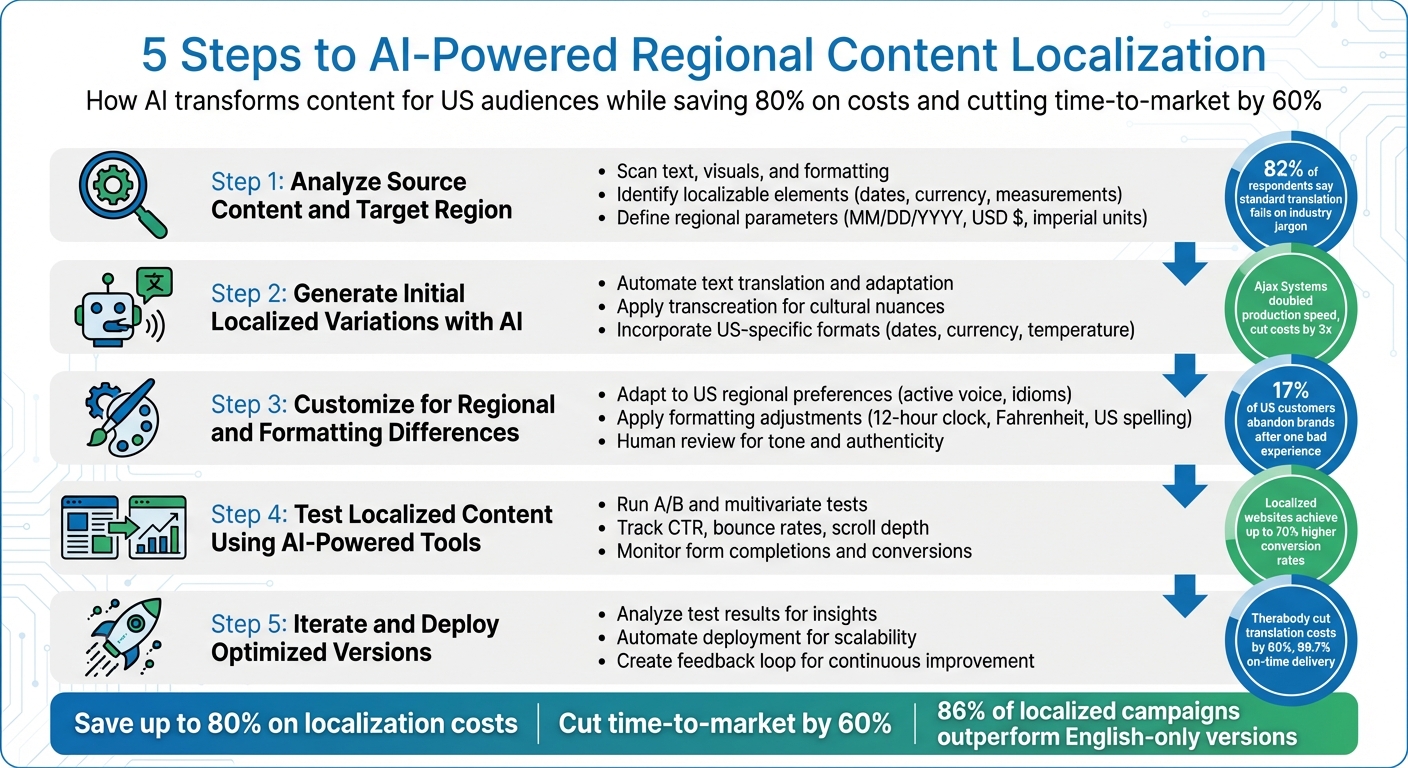
5-Step AI Content Localization Process for US Markets
AI Localization: Automating Translation for Global Markets #shorts
sbb-itb-6e49fcd
Step 1: Analyze Source Content and Target Region
When adapting content for a U.S. audience, AI takes a comprehensive approach, mapping everything from text to technical details. It carefully evaluates context, tone, and intent to adjust idioms, technical terms, and brand messaging appropriately. This process is essential – 82% of respondents noted that standard machine translation often fails to handle industry-specific jargon effectively. The first step is breaking down the content into elements that require adjustment.
Identifying Localizable Elements
AI begins by scanning the content for text, visuals, and formatting that need alignment with U.S. norms. This includes adapting dates to the MM/DD/YYYY format, using the dollar symbol ($) for currency, and converting measurements to miles, pounds, or inches. Even visual elements, such as seasonal imagery, are assessed to ensure they resonate with American audiences. Product descriptions, slogans, and calls-to-action are also flagged for regional adjustments.
“We’ve seen brands translate content word for word and wonder why engagement dropped in new regions. In practice, localisation that adapts tone, examples, and intent consistently outperforms literal translation.” Becky Halls, Strategist at PageTest.ai
For example, in January 2026, Polhus utilized AI workflows to localize their content into seven languages. The system analyzed text, UI screenshots, and developer notes to understand the technical context, leading to substantial savings in both time and cost.
The analysis extends to functional aspects like payment methods, local SEO keywords, and compliance requirements. For U.S. content, this might mean ensuring adherence to ADA accessibility standards or formatting phone numbers to the American style (e.g., (555) 123-4567). AI even checks character length restrictions for UI elements to prevent design issues caused by text expansion during translation.
This meticulous analysis ensures that every adaptation aligns with U.S. cultural and technical standards.
Defining Regional Content Localization Parameters
Once the AI identifies what needs localization, the next step is defining how the content will be tailored for the U.S. market. This involves setting specific regional parameters to guide the AI’s output.
| Regional Parameter | US-Specific Format | Purpose |
|---|---|---|
| Date Format | MM/DD/YYYY (02/21/2026) | Matches American date conventions |
| Currency | USD ($) | Displays pricing in a familiar format |
| Measurement | Imperial (miles, pounds, inches) | Aligns with U.S. measurement standards |
| Phone Numbers | (555) 123-4567 | Follows American formatting syntax |
A master glossary is a valuable tool during this process. It can include U.S.-specific terminology, approved translations, and style guidelines to ensure brand consistency. For instance, specifying the use of “apartment” instead of “flat” or “elevator” instead of “lift” helps the content feel more natural to American readers.
Advanced AI tools can take this a step further by integrating existing U.S. marketing copy and style guides, training the system to match your brand’s voice. Life360, under the leadership of Localization Manager Joaquín Muñoz, used this approach to translate their mobile app into five languages in just one month. By defining clear regional parameters upfront, they reduced localization costs by 80% and halved the time required.
“With AI we cut time in less than half and costs by 80%, so big savings in time and money with the same output at the end.”
– Joaquín Muñoz, Localization Manager, Life360
With these parameters in place, AI can produce localized content that feels tailored and relevant to the U.S. audience.
Step 2: Generate Initial Localized Variations with AI
After defining regional parameters in Step 1, the next step involves using AI to create a localized first draft. Instead of relying on basic word-for-word translations, modern AI localization leverages large language models (LLMs) to consider tone, context, and cultural nuances. This approach ensures that translations go beyond literal meanings, producing content that resonates with specific audiences. This first draft lays the groundwork for further refinements in transcreation and formatting.
Automating Text Translation and Adaptation
AI plays a key role in transcreation – rewriting marketing messages to preserve their emotional essence while incorporating local expressions and pricing variations. For instance, it replaces phrases or idioms that may confuse with ones that feel natural and relatable to the target audience.
A real-world example of this efficiency comes from Ajax Systems, which, in January 2026, used AI-driven workflows to double production speed while cutting costs by three times. This demonstrated how transcreation can balance creativity with technical constraints.
Advanced tools, like “Vector Cloud” technology, allow brands to upload style guides and past campaigns. These inputs train AI to match a brand’s voice while adapting to regional preferences. For U.S. audiences, this means the content doesn’t just use the right words – it feels like it was crafted by someone deeply familiar with American culture.
Once these localized variations are generated, the focus shifts to ensuring technical formats align with U.S. standards.
“In our experience, AI speeds up regional content creation dramatically, but it still needs clear brand guidelines. Without guardrails, messaging drift across markets becomes a real risk.” Ian Naylor, Founder of PageTest.ai
Incorporating US-Specific Formats
Localization goes beyond language – it extends to technical details that meet U.S. conventions. AI modifies elements like:
- Dates to MM/DD/YYYY format (e.g., 02/21/2026)
- Prices with the dollar symbol (e.g., $1,000.00)
- Measurements converted to imperial units
- Temperatures changed from Celsius to Fahrenheit
- Time displayed in a 12-hour clock with AM/PM notation
These adjustments are achieved through precise prompt engineering. For example, specific instructions guide AI to convert dates, temperatures, and times into formats familiar to U.S. audiences. The AI processes the entire document, ensuring these changes maintain the original tone and intent.
To catch errors, formatting validators review the content, flagging inconsistencies like incorrect currency symbols, date formats, or unconverted units. This step ensures that even technically accurate language doesn’t feel out of place, reducing the risk of alienating U.S. readers with unfamiliar formatting.
Step 3: Customize for Regional and Formatting Differences
After AI creates the initial localized draft, the next step is refining it to align with the cultural norms and technical standards of U.S. audiences. While AI handles the translation, humans step in to polish the details, ensuring the content resonates on a deeper level. Here’s how style, phrasing, and formatting are tailored for U.S. readers.
Adapting to US Regional Preferences
In the U.S., people tend to favor clear, straightforward communication. This means using an active voice and concise language. Adding references to popular U.S. holidays like the Fourth of July, Thanksgiving, or Black Friday can make marketing campaigns feel more relevant. Similarly, incorporating American idioms – like “home run”, “ballpark figure”, or “touch base” – helps the content feel natural. However, these phrases require careful human review to ensure they fit the context.
Why does this matter? Consider this: 17% of U.S. customers will abandon a brand after just one bad experience. When AI-generated content feels overly formal or robotic, it can alienate readers. Human input helps smooth out awkward phrasing and catch any instances where AI-generated text might come across as invasive or “creepy”, especially when referencing user data. The sweet spot is a tone that’s friendly yet professional – engaging without crossing any boundaries.
Style adjustments are one part of the equation, but formatting changes are equally important for creating a seamless experience.
Formatting Adjustments: A Comparative Table
Here’s a quick look at how technical formatting is adapted for U.S. audiences:
| Element | Original Format | US Format |
|---|---|---|
| Date | 21/02/2026 (DD/MM/YYYY) | 02/21/2026 (MM/DD/YYYY) |
| Currency | 1.234,56 € or £1,234.56 | $1,234.56 |
| Decimals | 3,14 (comma separator) | 3.14 (period separator) |
| Thousands | 1.000.000 or 1 000 000 | 1,000,000 (comma separator) |
| Time | 14:30 (24-hour clock) | 2:30 PM (12-hour with AM/PM) |
| Measurements | 5 kilometers, 10 kilograms | 3.1 miles, 22 pounds |
| Temperature | 22°C | 72°F |
| Spelling | Organise, colour, centre | Organize, color, center |
These changes go a long way in making content feel tailored to U.S. users. Localization expert Simona Rahmanova highlights this point well: “A currency sign or the order of a date speak about the care you’ve put into the cultural adaptation of your product”. Familiar formats build trust, making users more likely to increase site conversion – whether that’s completing a purchase or signing up for a service.
Step 4: Test Localized Content Using AI-Powered Tools
After tailoring your content to align with regional preferences, the next step is testing. This ensures that your adjustments genuinely improve engagement. For U.S. audiences, testing localized content with real-world data is essential. AI-powered tools make this process faster, helping you compare different versions of your content to identify what resonates most effectively.
Using PageTest.AI for A/B and Multivariate Testing
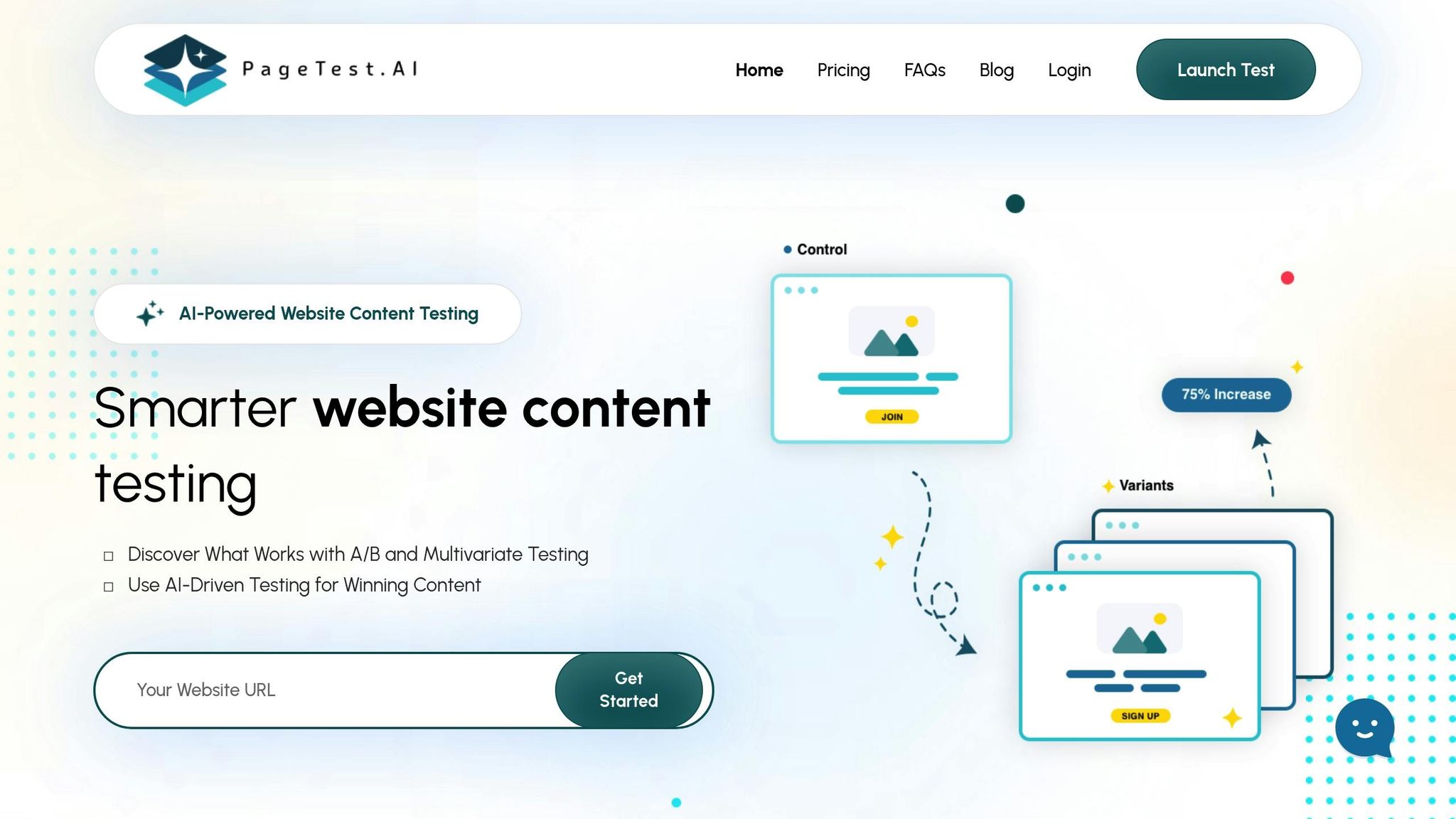
PageTest.AI simplifies the testing process, offering a no-code platform to experiment with various website elements – headlines, CTAs, buttons, or product descriptions. For example, you can test phrases like “Get Started Free” versus “Start Your Free Trial” or display pricing as “$49/month” versus “$49 per month” to find out which version drives better engagement.
The platform supports multivariate testing vs A/B testing methods:
- A/B Testing: Compares two versions of a single element to determine which performs better.
- Multivariate Testing: Tests multiple elements simultaneously, allowing you to experiment with combinations of U.S.-specific phrases or formats.
Performance is tracked using key metrics, such as:
- Time on Page: Measures how long users stay engaged.
- Click Element: Tracks interactions with buttons or links.
- Visit URL: Monitors whether users reach critical pages like checkout or registration.
“AI can also help with A/B testing of localized content, allowing for data-driven decisions on which versions resonate best with each market.” – Vubiquity
PageTest.AI offers flexible pricing plans to suit different needs. For $10/month, the Startup plan covers 10,000 impressions on a single website. The Enterprise plan, priced at $50/month, supports 100,000 impressions across ten websites. Agencies can opt for the $200/month plan, which includes 1,000,000 impressions across 100 websites.
Tracking Key U.S. Metrics
Once your tests are complete, the next step is analyzing the results to refine your localization strategy. Focus on these metrics:
- Click-Through Rate (CTR), form submissions, and purchase rates to assess if your regional adjustments are driving conversions.
- Bounce Rates and Scroll Depth to identify where visitors lose interest. If bounce rates are high, your localized content may need further tweaks.
Be sure to investigate form abandonment rates. For example, if a localized lead form sees high drop-off, look at the “Form Start Rate” to pinpoint issues. Fields like U.S.-specific phone number formats or state selection dropdowns could be discouraging users.
Lastly, confirm that technical elements, such as hreflang tags, are functioning correctly to guide U.S. users to the appropriate regional pages.
The results speak for themselves: localized websites can achieve up to a 70% higher conversion rate in their target markets. Additionally, 86% of localized marketing campaigns outperform English-only campaigns in terms of engagement and conversions. Testing ensures you’re making the most of this potential rather than leaving opportunities untapped.
Step 5: Iterate and Deploy Optimized Versions
This step builds on the testing phase by using AI to refine and roll out improved content across platforms. The goal is to transform the insights from testing into scalable, consistent localized content that resonates with your audience.
Analyzing Test Results for Insights
Start by digging into the performance data of your content variations using a conversion optimization platform. Metrics like click-through rates, scroll depth, form completions, and exit patterns can tell you a lot. For instance, if a localized headline gets clicks but leads to quick bounces, it could mean the message is attracting the wrong audience or setting up false expectations.
AI tools like Language Quality Estimation (LQE) systems can help by scoring translations on a scale of 1–100. This makes it easier to spot content that falls short of your quality standards. Your team can then focus on critical content – like slogans or legal disclaimers – where subtle messaging differences can have a big impact.
To stay proactive, set up automated triggers to refresh content based on performance thresholds. For example, if engagement drops on a localized product page, you can automate updates or adjustments. This creates a feedback loop that keeps your content relevant without requiring constant manual intervention.
These insights feed directly into the next step: automated deployment.
Automating Deployment for Scalability
When managing content for multiple regions, manual deployment just isn’t practical. Instead, integrate your localization workflow with tools you already use, like CMS platforms, GitHub, or design software. This allows you to automate the release of localized content once it clears quality checks.
Dynamic workflow routing can speed things up even more. For example, content with high Translation Memory (TM) matches – 95% or above – can skip human review and go live immediately. Lower-scoring segments, meanwhile, can be sent to linguists for fine-tuning. This approach balances speed with accuracy.
The effectiveness of this strategy is backed by real-world examples. Therabody, for instance, cut translation costs by 60% while maintaining a 99.7% on-time delivery rate by switching to AI-driven workflows in October 2025. Similarly, Secret Escapes reduced the time spent translating hotel deals by 25%, allowing their team to focus on more creative tasks.
“The AI handles what it should, and my team handles what we do best. No confusion about roles, no redundant work. Just better marketing, faster.” – Kevin, Fieldgrade
Finally, centralize your approved localized assets – headlines, CTAs, product descriptions – so AI can reference them in future projects. This ensures consistency across campaigns and helps fine-tune the AI to better align with your brand’s voice over time.
Conclusion: How AI Improves Content Localization
From initial analysis to deployment, AI is reshaping the way content localization is handled. What once required extensive manual effort is now streamlined for efficiency and scale. AI simplifies the process by standardizing formats like dates, currency, and measurements to align with US norms. It also adjusts language, replacing non-native idioms with expressions that feel more familiar to American audiences – like using “home run” to convey success.
The results speak for themselves. Companies leveraging AI for localization have reported cutting time-to-market by up to 80% and reducing costs by as much as 60%. For instance, in November 2025, Polhus achieved a 75% approval rate with zero edits, saving $80,000 in the process. Similarly, in December 2024, Typeface showcased its AI ad generator for a Portland pet daycare, slashing traditional content production time by 90%.
These efficiency gains open the door to more effective testing strategies. Tools like PageTest.AI take localization further by enabling no-code A/B and multivariate testing. This allows you to test headlines, CTAs, and product descriptions with US audiences, tracking metrics like clicks, engagement, and scroll depth to see what resonates most.
The real strength of AI lies in its ability to adapt and improve continuously. By using AI-powered testing, you can quickly pinpoint which localized content connects best with your audience, ensuring your messaging stays on-brand and culturally aligned.
Regional Content Localization – FAQs
When should humans review AI-localized content?
When it comes to AI Regional Content Localization, human review is essential in situations where cultural nuances, context, or market-specific standards play a key role. Sure, AI can speed up translations and cut down errors, but it often struggles with subtleties like idiomatic expressions or sensitive cultural references.
Human oversight acts as a safeguard, ensuring the content aligns with local expectations – especially in critical scenarios where misunderstandings or reputational damage could occur. This extra layer of review is crucial for delivering content that’s both accurate and appropriate for the target audience.
How do I keep localized content on-brand across regions?
To keep content aligned with your brand across different regions, AI tools can help fine-tune for linguistic, cultural, and platform-specific differences while ensuring consistency. These tools analyze tone, terminology, and local preferences to match your brand’s voice seamlessly. They also provide ongoing adjustments, cutting down on manual work while maintaining the genuine feel of your message. This approach ensures your global story connects with local audiences without losing the essence of your brand.
What should I test first with PageTest.AI after localization?
After using PageTest.AI to tailor your content for a specific region, the next step is to test different variations to find what resonates most with your audience. The platform lets you experiment with multiple versions of elements like headlines, calls-to-action (CTAs), or product descriptions. By monitoring engagement metrics – such as click-through rates and user behavior – you can pinpoint the messaging that drives the best results. This process ensures your content connects more effectively with your audience, boosting both engagement and conversions.
Related Blog Posts
say hello to easy Content Testing
try PageTest.AI tool for free
Start making the most of your websites traffic and optimize your content and CTAs.
Related Posts

31-08-2026
 Becky Halls
Spiralyze alternatives: CRO agency or software in 2026?
Spiralyze makes an offer that’s hard to argue with. “30% lift in 90 days. No fee until we deliver.” More precisely: 10 tests, 3 wins, more than 30% lift in your first 90 days, and you pay nothing until they’ve done it. I’ll say plainly what most competitor pages wouldn’t. On risk alone, that’s a better offer than […]

31-08-2026
Becky Halls
AB Tasty alternatives: an honest comparison for 2026
AB Tasty is a strong platform with a well-liked support team, sitting at 4.4 on G2 across 418 reviews. Reviewers on TrustRadius describe it as better value than pricier AB Tasty alternatives, which in this category is a real compliment. It also has the most unusual buying process here. No published pricing, and no free […]

31-08-2026
Becky Halls
The best Optimizely alternative: a comparison for 2026
Optimizely is the most capable experimentation platform on the market. I don’t think that’s seriously disputed. Server-side testing, feature flags, personalization, statistical depth, and it all runs at genuine enterprise scale. In 2026 they’ve wrapped the whole thing in “agentic experimentation” branding and shipped an AI variation development agent, and the underlying Web Experimentation product […]