


How AI Shapes Semantic Search Trends

How AI Shapes Semantic Search Trends
 17-02-2026 (Last modified: 17-02-2026)
Semantic search has transformed how search engines understand user queries, moving beyond simple keyword matching to interpreting context and intent. We now know how AI shapes semantic search trends – with AI technologies like NLP, neural networks, and large language models now enable search engines to deliver more accurate and personalized results. Key shifts include:
- AI-Driven Search Growth: By March 2025, AI Overviews appeared in 13.1% of searches, doubling from January 2025. Visual searches via Google Lens surpassed 12 billion monthly.
- Changing User Behavior: Queries are longer and more conversational, with 60% of searches starting with “who”, “what”, or “why” triggering AI summaries. By 2025, 69% of global searches resulted in zero-click outcomes.
- Personalized Results: AI tailors search outcomes based on user behavior, preferences, and context, offering synthesized answers directly on result pages.
- Impact on Metrics: Click-through rates (CTR) for organic links have dropped, but AI-driven visitors are 4.4x more valuable, with higher conversion rates and longer session durations.
Marketers now need to focus on creating structured, well-organized content optimized for AI readability. Regular updates, clear formatting, and credible sources are critical for being cited in AI-generated summaries. As search evolves, visibility is no longer about ranking alone but about being included in AI-driven results.
“AI Search to Overtake Traditional Search by 2028”, According to Semrush
sbb-itb-6e49fcd
AI Technologies Behind Semantic Search
AI’s role in search continues to evolve, and three key technologies – Natural Language Processing (NLP), topic modeling algorithms, and personalization engines – are at the heart of semantic search. Each contributes to how search engines interpret queries and deliver results that feel more intuitive and relevant.
Natural Language Processing (NLP) for Query Understanding
NLP helps search engines understand language the way humans do. Instead of just matching keywords, it dives into intent, sentiment, and context. For instance, when you type “apple”, NLP figures out if you’re asking about the fruit, the tech company, or something else entirely.
“We’ve seen pages with lower keyword density outperform heavily optimised competitors simply because they answered the user’s full question more clearly.” Ian Naylor, founder at PageTest.ai
Some of the critical functions of NLP include stemming and lemmatization (simplifying words like “running” to “run”), entity extraction (identifying names, places, or dates), and part-of-speech tagging (determining whether a word is a noun, verb, etc.). Advanced models like BERT and GPT take this further by analyzing how words interact within a sentence.
Microsoft demonstrated the power of NLP in February 2021 when it applied semantic ranking to its Docs library. The result? A 2.0% increase in click-through rates overall and a 4.5% boost for longer queries – the team’s biggest engagement jump to date. NLP also handles common issues like misspellings, which affect 10% to 15% of all search queries, while keeping the original intent intact.
“In semantic search, NLP decodes human language nuances, allowing search engines to process and understand user queries as a human would.” – Semrush
These capabilities lay the groundwork for technologies like Latent Semantic Indexing (LSI) and topic modeling, which dig deeper into content relationships.
Latent Semantic Indexing (LSI) and Topic Modeling
Topic modeling goes beyond individual words, focusing on semantic density – how thoroughly a subject is covered. This approach connects related terms, helping search engines group them into meaningful topics.
By analyzing word relationships, topic modeling resolves ambiguity and identifies content that’s rich and comprehensive. Articles that include primary, secondary, and even tertiary entities signal expertise. Structured content also performs better: pages with clear sections show a +22.91% correlation with being cited by AI search systems, while summarization and clarity boost citations by +32.83%. Not surprisingly, 76% of pages cited in Google AI Overviews already rank in the top 10 of traditional search results.
“Clarity and structure are not SEO shortcuts. They simply make information easier for both people and AI systems to interpret. When content is organized, direct, and backed by clear expertise, models can understand it more reliably.” – Cecilia Meis, Senior Editor, Semrush
While these algorithms focus on understanding content, AI personalization takes things a step further by tailoring results to individual users.
“In our experience, adding more articles around a topic didn’t move rankings nearly as much as strengthening one comprehensive page that covered the intent properly.” Becky Halls, Strategist at PageTest.ai
AI-Based Personalization and Behavior Prediction
AI has turned search into a personalized recommendation engine, delivering results based on your behavior and preferences. By converting queries into “Entity Intent pairs”, AI highlights brands or products that align with your past interactions. For example, searching “visa process” followed by “jobs in Berlin” might surface job listings related to immigration.
Personalization also involves sentiment detection and temporal cues. AI can adjust its tone, offering calming language if your search history suggests stress, or recommending coffee shops near your next meeting based on calendar data and driving routes. Advanced systems like SASRec and BERT4Rec track how your needs shift over time, ensuring results stay relevant.
This personalized approach has reshaped search behavior. By mid-2025, 69% of searches resulted in zero clicks, with users finding answers directly on the results page. Additionally, 31% of Gen Z users now start their searches on AI platforms or chatbots instead of traditional engines. Click-through rates have dropped 15.5% for queries with AI Overviews, showing a growing preference for synthesized answers over traditional link lists. These trends highlight how personalization is shaping the future of search, setting the stage for advancements in generative AI and multi-modal search.
How AI Changes User Search Behavior
AI is reshaping how we search, moving us from short keyword phrases to more natural, conversational queries. By 2025, the average search query in the U.S. had grown to 3.4 words, reflecting this shift toward a more human-like way of interacting with search engines.
What’s different now isn’t just the length of these queries. People are asking full questions and including details, expecting AI to pick up on their intent rather than just matching keywords. For instance, 60% of searches that begin with words like “who”, “what”, “when”, or “why” now trigger AI-generated summaries.
This trend is particularly noticeable among Gen Z, with 31% starting their searches on AI platforms compared to 20% of the general population. Some even use terms like “Chat” or “Gemini” as verbs, much like “Google” became synonymous with searching. These changes highlight how AI tools are becoming second nature for many users, fundamentally altering how we approach search.
Changes in Query Types and Zero-Click Results
As queries get more detailed, search engines are stepping in with direct answers. By May 2025, 69% of global searches resulted in zero-click outcomes – up from 56% in 2023. The numbers are even higher for mobile devices, with a zero-click rate of 77.2%. AI Overviews now pull information from multiple sources and display it directly on the results page, meaning users often don’t need to visit external websites.
This shift has had a noticeable impact on user behavior. When an AI summary appears, the click-through rate for the top organic result drops from 28% to around 19%. Additionally, 26% of users end their browsing session after viewing an AI summary, compared to 16% on standard results pages. Even the links cited in these summaries see minimal engagement, with only 1% of users clicking on them.
AI Overviews are also expanding into new types of searches. While 91.3% of these summaries addressed purely informational queries in early 2025, that number dropped to 57.1% by October as AI began handling commercial, transactional, and navigational searches. For example, navigational triggers grew from 0.74% to 10.33% during this period. The likelihood of generating an AI summary also increases with longer queries – AI Overviews appear for just 8% of 1–2 word searches but jump to 53% for queries with 10 or more words. These changes show how AI is adapting to meet a broader range of user needs.
How AI Improves User Satisfaction
Even though fewer users are clicking through to websites, many report being more satisfied with their search experiences. Sixty percent of users say AI provides clearer and more helpful answers than traditional search engines. By summarizing information, comparing viewpoints, and evaluating source credibility, AI eliminates the need to open multiple tabs and piece together answers manually.
Studies suggest that AI-assisted search reduces mental effort and task complexity by up to 30%. Today, 80% of users rely on AI for 40% of their searches. However, while trust in AI is growing, users aren’t abandoning traditional search entirely. Eighty percent of users believe AI delivers unbiased information, but 85% still verify answers using legacy search engines.
The way people use search tools is evolving. Now, 37% of users start their search journey with AI platforms rather than traditional engines like Google or Bing. AI has become the go-to tool for discovery and synthesis, while older search engines are increasingly used for fact-checking and verification. This marks a clear shift from simple keyword searches to a more intent-driven, conversational approach.
Current Trends: Generative AI and Multi-Modal Search
Search has evolved far beyond scrolling through a list of blue links. Generative AI is transforming search engines into tools that deliver synthesized insights from multiple sources in a single response. And this change is happening fast – AI Overviews appeared in just 6.49% of searches in January 2025, but by March 2025, that number had doubled to 13.1%.
The way we interact with search is also shifting. Google Lens now handles over 12 billion visual searches every month, and features like Circle to Search allow users to draw directly on their screens to find information. These multi-modal capabilities show how search is adapting to how we naturally communicate – through images, voice, and even video – rather than relying solely on text and keywords.
Generative AI in Search Results
AI tools like ChatGPT and Google Gemini are changing how search results are presented. Instead of simply listing pages ranked by authority, these models synthesize data from reliable sources into unified answers. Together, ChatGPT and Google Gemini now account for 78% of all traffic to AI-powered search models as of mid-2024. This approach doesn’t just answer questions – it interprets user intent on a deeper level.
The focus has shifted from matching keywords to understanding what users truly want. Search engines now handle complex, multi-part queries – what some call “exactly-what-I-want” searches. For instance, AI-driven search pages group results into thematic categories like “sunset views” versus “seafood havens”, giving users a way to explore multiple perspectives instead of delivering a single answer. As Philipp Schindler, Google’s Chief Business Officer, explained:
“Generative AI is allowing people to search in ways never before possible”.
Advanced models like Gemini 2.5 take this even further. They can process long-context inputs, such as hours of video or millions of text tokens, enabling them to execute complex tasks in one query.
But there’s a trade-off. Click-through rates have dropped by 15.5% for queries that trigger AI Overviews. When no AI summary is present, click rates are nearly double – 15% compared to 8%. While users enjoy the convenience of synthesized answers, this shift is pushing marketers to rethink their strategies and evaluate the right conversion optimization platform to maintain performance. Metrics like ranking position are becoming less relevant when the goal is to be cited in an AI-generated summary rather than driving clicks.
Beyond text responses, search is expanding into new formats to meet changing user expectations.
Multi-Modal Search Capabilities
Building on AI-driven text synthesis, multi-modal search integrates images, video, and audio for a richer, more interactive experience. By combining visual and voice inputs, it deepens the understanding of user intent and delivers more contextually accurate results.
Multi-modal search allows users to interact with search engines in ways that feel natural. For example, you can snap a photo of a plant to identify it instantly or point your phone at a foreign menu to get translations and dish recommendations.
These advancements are powered by large language models like Gemini 1.5 and 2.5, which excel at “long-context” understanding. They can process hours of video or audio in a single query, making it possible to search through recorded lectures, podcasts, or even security footage without manually scrubbing through content. These models also handle complex planning tasks, like creating a full day’s itinerary based on specific preferences and locations.
Voice search is growing alongside visual inputs, especially on mobile devices where typing can be inconvenient. Younger users, in particular, are embracing this shift. They’re blending text, images, and voice inputs seamlessly, treating AI not just as a search tool but as a conversational partner. This evolution is redefining how people think about search – it’s no longer about typing queries but about interacting with AI in ways that feel intuitive and collaborative.
Measuring AI’s Effect on Search Performance Metrics
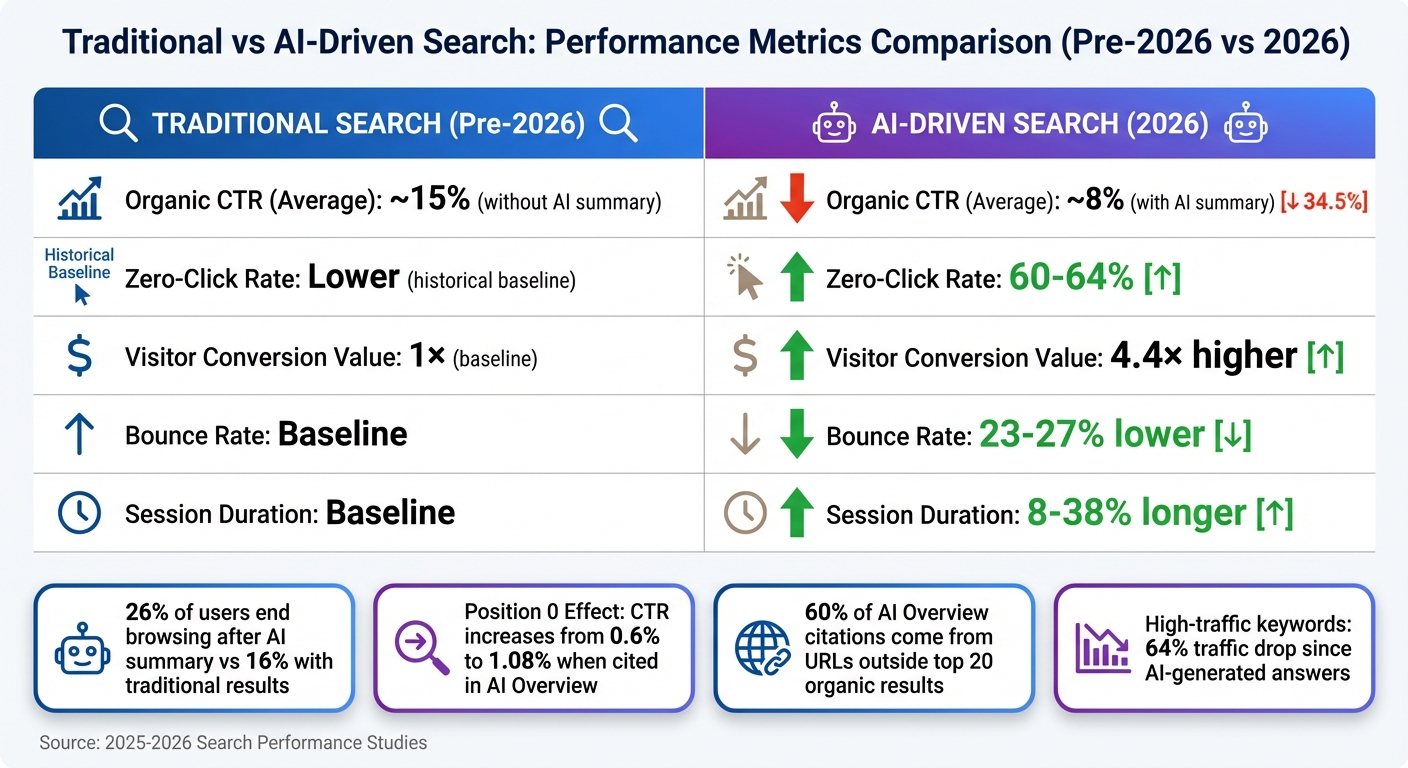
Traditional vs AI-Driven Search Performance Metrics 2026
The rise of AI in search has brought dramatic changes to performance metrics, especially in how search engines align results with user intent. For instance, when an AI Overview appears at the top of Google’s results, click-through rates (CTR) for organic links drop by 34.5%. For high-traffic keywords, traffic has plummeted by as much as 64% since AI-generated answers became the norm. Compare this to Position 3 in search results: in 2024, it had a 4.88% CTR, but by 2025, that figure had fallen to just 2.47%. Position 4 has seen an even sharper decline, dropping from 2.79% to 1.05%.
Interestingly, while traffic volumes have decreased, the quality of visitors has improved significantly. Visitors arriving via AI searches are 4.4 times more valuable in terms of conversion rates compared to traditional organic search visitors. These users bounce 23–27% less often, stay on sites 8–38% longer, and explore more pages. In the B2B SaaS sector, AI chatbot conversion rates (6.69%) are nearly on par with Google organic rates (6.71%).
Nitin Manchanda, an industry expert, highlights the unique behavior of these visitors:
“Users who land on sites from an AI engine often behave very differently. They’ve already been briefed by the AI; they know who you are and why you matter. I call this the ‘educated click'”.
Comparing Search Metrics: Pre-2026 vs. 2026
The shift from traditional search engines to AI-driven search has fundamentally changed how success is measured. Zero-click searches now dominate, accounting for 60–64% of all queries. When an AI summary is present, only 8% of users click through to a traditional link, compared to 15% when no summary is provided. Furthermore, 26% of users end their browsing session after viewing an AI summary, while only 16% do so with traditional results.
A new metric, known as the “Position 0” effect, has emerged. Being cited in an AI Overview can boost a site’s CTR from 0.6% to 1.08%. Surprisingly, 60% of AI Overview citations come from URLs that don’t rank in the top 20 organic results, and ChatGPT often references pages ranked 21st or lower nearly 90% of the time.
| Metric | Traditional Search (Pre-2026) | AI-Driven Search (2026) |
|---|---|---|
| Organic CTR (Average) | ~15% (without AI summary) | ~8% (with AI summary) |
| Zero-Click Rate | Lower (historical baseline) | 60–64% |
| Visitor Conversion Value | 1x (baseline) | 4.4× higher |
| Bounce Rate | Baseline | 23–27% lower |
| Session Duration | Baseline | 8–38% longer |
These evolving metrics highlight the need for marketers to rethink their strategies in an AI-dominated search landscape.
What This Means for Marketers and SEO Professionals
As these metrics evolve, marketers must adapt their strategies to stay relevant. Traditional rankings no longer guarantee visibility. Instead, marketers should focus on their “Share of Model” – a measure of how often their brand is mentioned or cited across AI platforms like ChatGPT, Perplexity, and Gemini. Mitul Gandhi, Chief Architect & Co-Founder at seoClarity, underscores this shift:
“Traditional SEO alone isn’t enough. In a world where brand mentions, citations, and AI-generated summaries influence user decisions, visibility must be redefined”.
To remain competitive, content must be structured for AI readability. AI models favor clear, concise sections – often referred to as “atomic content” – that are easy to cite. AI citations are strongly linked to factors like clarity and summarization (+32.83%), E-E-A-T signals (+30.64%), Q&A formatting (+25.45%), logical sections (+22.91%), and structured data (+21.60%). Brands that publish original research with citable statistics see 3.4 times higher citation rates than those without. Additionally, pages not updated quarterly are over three times more likely to lose AI citations.
Conversion optimization is essential for the high-quality traffic AI referrals bring. Since these visitors are often well-informed and closer to making a decision, landing pages must be designed to convert effectively. Tools like PageTest.AI can help refine headlines, calls-to-action (CTAs), and product descriptions specifically for these high-intent users, ensuring every click delivers maximum value in this AI-driven era.
Conclusion
AI has completely changed the way search operates, moving beyond basic keyword matching to grasping context, user intent, and the connections between concepts. The data paints a clear picture: 37% of consumers now begin their search journey with AI tools instead of traditional search engines, a number expected to grow to 90 million U.S. users by 2027.
This shift calls for a fresh approach to achieving visibility and learning how AI shapes semantic search. Traditional rankings are becoming less relevant, especially when 60% of AI Overview citations come from URLs outside the top 20 organic results. The new game is about being cited in AI-generated responses. As Cecilia Meis from Semrush explains:
“Clarity and structure are not SEO shortcuts. They simply make information easier for both people and AI systems to interpret”.
Interestingly, AI-referred visitors are proving to be 4.4 times more valuable than traditional organic traffic, with conversion rates 31% higher than non-AI traffic. These numbers highlight the need for a strategic overhaul in content creation. To capture this traffic, brands should focus on:
- Structured content with clear Q&A formats
- Regular updates (quarterly) to maintain relevance in AI citations
- Topic authority through well-organized content clusters
- Enhanced E-E-A-T signals by showcasing comprehensive author credentials
Specialized tools can make this transition smoother. For example, platforms like PageTest.AI can optimize your headlines, CTAs, and product descriptions to better appeal to these informed, conversion-ready users. Adopting such AI-focused strategies can help brands not just adapt but excel in this changing landscape.
In this new era, brands that treat AI visibility with the same importance as they once did Google rankings will find themselves leading the pack. The search landscape has evolved, and with it comes immense opportunity for those ready to embrace the change.
How AI Shapes Semantic Search – FAQs
How can I get my content cited in AI overviews?
Creating content that gets referenced in AI-generated overviews isn’t just about writing well – it’s about crafting material that stands out as reliable and authoritative. Focus on producing clear, well-organized content that demonstrates expertise in your subject area.
Here’s how to do it:
- Use structured data: This helps AI systems better understand and categorize your content.
- Stay neutral: Avoid overly promotional language; aim for an informative tone instead.
- Keep it fresh: Regularly update your content to ensure it remains relevant and accurate.
- Build credibility: Mentions or links from trustworthy third-party sources can significantly increase your content’s visibility and make it more likely to be cited by AI.
By combining these strategies, you enhance your content’s appeal to both readers and AI systems alike.
How should SEO change for zero-click search?
SEO efforts today need to focus on boosting visibility, strengthening brand presence, and achieving entity recognition in key SERP features like AI Overviews and Knowledge Panels. Why? Because nearly 60% of searches now end without a click, making traditional rankings less impactful than they once were.
Instead of solely chasing higher rankings, the goal should be to optimize content that stands out in these features. By doing so, you can deliver value directly within search results, ensuring your audience finds what they need without having to click away. This approach not only meets user expectations but also positions your brand as a trusted source of information.
What metrics matter most for AI-driven traffic?
When analyzing AI-driven traffic, several metrics stand out. One important figure is the percentage of total website traffic coming from AI sources, which currently ranges between 0.1% and over 1%. Other key indicators include AI referral growth rates, conversion rates, and citation accuracy.
The future of AI referrals looks promising. In fact, projections suggest that AI referrals could outpace traditional search visitors by 2028. A striking example of this trend is Gemini, which has seen an impressive 388% year-over-year growth in AI-driven referrals.
How AI Shapes Semantic Search – Related Blog Posts
say hello to easy Content Testing
try PageTest.AI tool for free
Start making the most of your websites traffic and optimize your content and CTAs.
Related Posts

31-08-2026
 Becky Halls
Spiralyze alternatives: CRO agency or software in 2026?
Spiralyze makes an offer that’s hard to argue with. “30% lift in 90 days. No fee until we deliver.” More precisely: 10 tests, 3 wins, more than 30% lift in your first 90 days, and you pay nothing until they’ve done it. I’ll say plainly what most competitor pages wouldn’t. On risk alone, that’s a better offer than […]

31-08-2026
Becky Halls
AB Tasty alternatives: an honest comparison for 2026
AB Tasty is a strong platform with a well-liked support team, sitting at 4.4 on G2 across 418 reviews. Reviewers on TrustRadius describe it as better value than pricier AB Tasty alternatives, which in this category is a real compliment. It also has the most unusual buying process here. No published pricing, and no free […]

31-08-2026
Becky Halls
The best Optimizely alternative: a comparison for 2026
Optimizely is the most capable experimentation platform on the market. I don’t think that’s seriously disputed. Server-side testing, feature flags, personalization, statistical depth, and it all runs at genuine enterprise scale. In 2026 they’ve wrapped the whole thing in “agentic experimentation” branding and shipped an AI variation development agent, and the underlying Web Experimentation product […]