


User Engagement Signals That Impact Rankings
User Engagement Signals That Impact Rankings
 13-12-2025 (Last modified: 18-12-2025)
User engagement signals are behaviors that show how visitors interact with your content. These signals – like click-through rate (CTR), dwell time, bounce rate, and pages per session – help search engines evaluate whether your page satisfies user needs. Positive signals, such as longer visits and repeat clicks, can improve rankings, while negative ones, like high bounce rates, may hurt them.
Here’s what matters most:
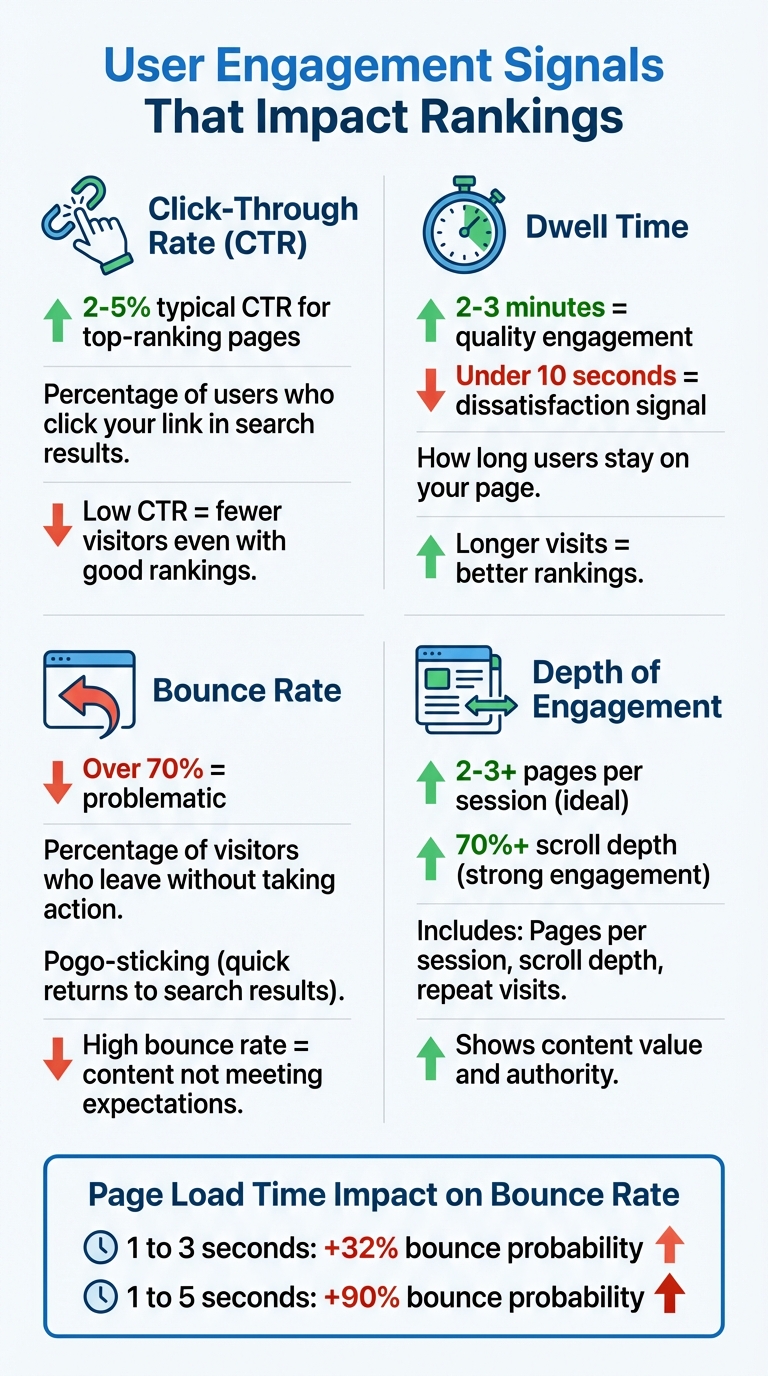
- CTR: Measures how often users click your link in search results. Low CTR means fewer visitors, even if you rank well.
- Dwell Time: Tracks how long users stay on your page. Short visits suggest your content isn’t meeting expectations.
- Bounce Rate: High bounce rates or pogo-sticking (quick returns to search results) indicate dissatisfaction.
- Depth of Engagement: Includes pages per session, scroll depth, and repeat visits. These show how much value users find on your site.
Improving these metrics involves aligning content with search intent, creating fast and mobile-friendly pages, and crafting compelling titles and meta descriptions. Tools like PageTest.AI can help test and optimize key elements like headlines and CTAs to boost engagement and rankings.
Key User Engagement Metrics That Impact SEO Rankings
CTR, Click Through Rate Manipulation, and Engagement Signals
User Engagement Signals That Affect Rankings
User engagement plays a critical role in determining how well your content performs in search engine rankings. Search engines rely on specific signals to evaluate whether your content satisfies visitors. Here’s a closer look at four key engagement signals that influence rankings:
Dwell Time: How Long Users Stay
Dwell time refers to the amount of time a visitor spends on your page after clicking through from search results. If users stay longer, it suggests your page is effectively addressing their query. On the flip side, if they leave in under 10 seconds, it’s often a sign of dissatisfaction. Typically, quality content keeps users engaged for about 2–3 minutes, and pages that consistently achieve higher dwell times are more likely to rank better.
Bounce Rate and Pogo-Sticking
Bounce rate measures the percentage of visitors who leave your page without taking further action. A high bounce rate – anything over 70% – can indicate that your content isn’t meeting user expectations. Pogo-sticking is another red flag. This happens when users click on your page, immediately return to the search results, and choose another link. Both behaviors signal to search engines that your page isn’t fulfilling the search intent, which can hurt your rankings.
Click-Through Rate (CTR) from Search Results
CTR reflects how many people click on your link compared to how many see it in the search results. A high CTR shows that your snippet resonates with users and aligns with their search intent. Interestingly, a temporary spike in CTR can even give your rankings a short-term boost by signaling relevance. For most top-ranking pages, CTRs typically range from 2% to 5%, though this varies by industry and query type. Crafting compelling meta titles and descriptions is key to improving CTR.
Depth of Engagement and Repeat Visits
Engagement goes beyond just one page. Metrics like pages per session (ideally 2–3 or more) and scroll depth (70% or higher) demonstrate how deeply users interact with your site. Repeat visits are another strong signal, showing that your content holds ongoing value and authority. Encouraging users to explore more through internal links and related content can create a positive feedback loop, boosting both engagement and rankings.
Why Engagement Signals Matter for Rankings
How Search Engines Evaluate Engagement
When it comes to ranking pages, Google focuses on both quality and relevance, while also analyzing user engagement signals like click-through rate (CTR), dwell time, and quick returns to assess user satisfaction. Although Google has stated that it doesn’t directly use metrics from tools like Google Analytics in its ranking algorithm, it does track user behavior across its platforms – like Chrome and Android – to evaluate satisfaction on a larger scale. This data plays a key role in ranking experiments, where Google tests pages and adjusts positions based on how users interact with them. Many SEO experts see engagement as a “subtle ranking booster”, especially in cases where traditional SEO factors are evenly matched. In such scenarios, how users behave can make the difference between one page outranking another. Understanding this process helps clear up common misunderstandings about how engagement metrics influence rankings.
Common Myths About Engagement Metrics
Engagement metrics alone don’t directly improve rankings – they work alongside quality content that aligns with user intent. These signals act as a support system, complementing core ranking factors like content quality, topical relevance, backlinks, and E-E-A-T (Experience, Expertise, Authoritativeness, Trustworthiness). While strong engagement can help fine-tune rankings among already relevant results, it won’t save a page with poor content or weak relevance. For example, a high bounce rate on an informational page isn’t necessarily a bad thing if users quickly found the answers they were looking for. To properly interpret engagement metrics, it’s crucial to consider the specific context and user intent behind the interactions.
sbb-itb-6e49fcd
How to Improve User Engagement Signals
Match Content to Search Intent
Every search query serves a purpose – whether it’s informational, navigational, transactional, or commercial. Your content needs to align with that purpose from the moment a visitor lands on your page. For instance, if someone searches for “best running shoes”, they’re likely expecting detailed comparisons or buying guides, not just a basic product list. When your content aligns with their intent, users are more likely to stay engaged and less likely to hit the back button.
Start by analyzing top-ranking pages for your target keywords. This helps you understand the format and depth users expect. Make sure your above-the-fold section immediately addresses the query with a clear headline and summary. This reduces “pogo-sticking” (when users quickly return to the search results) and shows search engines that your page meets user needs. Sprinkle related questions throughout your content to keep visitors engaged and exploring without leaving your site. And don’t forget – your site’s performance plays a big role in supporting this strategy.
Improve User Experience to Reduce Bounce Rates
Fast-loading pages are key to keeping users engaged. Research from Google shows that as page load time increases from 1 second to 3 seconds, the likelihood of a user bouncing jumps by 32%. If it stretches to 5 seconds, that probability skyrockets to 90%. To speed things up, compress images to under 100KB, enable browser caching, and minimize JavaScript and CSS files. Aim for meaningful content to load within 2–3 seconds on mobile devices.
A mobile-first design is no longer optional – it’s essential. This means responsive layouts, readable font sizes without zooming, tap-friendly buttons, intuitive menus, and clear internal links to guide users to more content. Improve readability by using short paragraphs, clear subheadings, bullet points, and visuals that support your message. Avoid intrusive elements like aggressive pop-ups or auto-playing media, which can frustrate users. In fact, sites that removed these distractions saw bounce rates drop by 15–20%.
Write Better Titles and Snippets for Higher CTR
Your title tag and meta description are the first things users see in search results, so they need to grab attention and communicate value. Use your primary keyword naturally and focus on crafting benefit-driven titles. For example, a title like “How to Improve Dwell Time and Rankings in 7 Steps” is far more engaging than something generic. One e-commerce site swapped “Running Shoes Sale” for “Best Running Shoes Under $100 – Top 10 Picks for 2025” and saw a 42% increase in CTR. Similarly, an SEO blog changed “SEO Tips” to “How to Rank #1 on Google: 5 Data-Backed Strategies” and boosted CTR by 28%.
Keep your titles under 60 characters and meta descriptions between 150–160 characters. Include a concise call-to-action in your meta description, like “Discover 5 proven UX tweaks to cut your bounce rate in half.” Specifics – such as numbers, timeframes, or formats like “checklist” or “step-by-step guide” – make your snippets more appealing. However, avoid clickbait. Your content must deliver on the promises of your title, or you risk triggering pogo-sticking and short dwell times.
Use Testing to Improve Engagement Metrics
Testing is a powerful way to identify what works best for your audience. Experiment with different versions of titles, headlines, CTAs, images, and body copy to see which combinations drive better engagement. Run tests for 1–2 weeks to gather statistically significant results, focusing on metrics like organic CTR, bounce rate, dwell time, scroll depth, and conversion rate.
Tools like PageTest.AI simplify this process. Using a Chrome extension, you can set up tests in minutes and generate AI-powered content variations for headlines, CTAs, button text, and product descriptions. The platform automatically tracks performance metrics like clicks, time on page, scroll depth, and user behavior, helping you pinpoint which variations keep visitors engaged and encourage them to explore more pages.
Focus your testing on high-priority areas, such as:
- Pages with high impressions but low CTR – test titles and meta descriptions.
- Pages with strong CTR but high bounce rates – test content depth and user experience.
- Pages with good engagement but low conversions – test offers and CTAs.
Tracking and Measuring Engagement Improvements
Engagement Metrics to Track
To improve user engagement, it’s essential to monitor the right metrics. One key metric is dwell time, which reflects how long visitors stay on your site. In Google Analytics 4, aim for sessions lasting 2–3 minutes. If sessions are consistently under 10 seconds, it could mean your content isn’t meeting expectations. Longer dwell times signal to search engines that your content is valuable, which can positively impact rankings.
Another critical metric is organic click-through rate (CTR), available in Google Search Console. A good CTR for top-ranking positions is between 5–10%. If your CTR is below 2–5% despite high rankings, it’s a sign your titles or meta descriptions aren’t enticing enough, which can eventually harm your position. Additionally, keep an eye on scroll depth – a value above 70% indicates that users are highly engaged with your content. Don’t forget to track bounce rate and engagement rate (sessions lasting at least 10 seconds with a conversion or multiple pageviews). However, always consider the context of these metrics, as they can vary by industry and content type.
Creating an Optimization Plan
Start by establishing baseline metrics for your site. Use tools like Google Analytics 4 and Google Search Console to identify pages that aren’t performing well. Look for signs like high impressions but low CTR, bounce rates exceeding 70%, or engagement times under 1 minute. Prioritize pages based on their potential – focus on those ranking in positions 5–10 that could break into the top spots, as well as high-traffic landing pages with weak engagement.
To improve these pages, test key elements like titles, meta descriptions, content layout, and user experience (UX). Tools like PageTest.AI can simplify this process. With its Chrome extension, you can generate AI-powered variations for headlines, calls-to-action (CTAs), or body text, and then track metrics like time on page, scroll depth, and clicks. Run these tests for 1–2 weeks, implement the best-performing changes, and reassess after 2–4 weeks to measure progress. Set up a quarterly review process to continually analyze metrics and refine your strategy based on the results. This consistent cycle of testing and optimization will help you maintain and improve user engagement over time.
Conclusion
User engagement signals – like dwell time, bounce rate, CTR, and page depth – serve as powerful indicators of visitor satisfaction. When users spend more time on your site, navigate through multiple pages, and return for more, search engines take notice. These patterns suggest your content is both relevant and valuable, which often translates into better rankings, greater visibility, and increased conversions.
To harness these signals effectively, strategies must focus on meeting user intent while optimizing site performance. Approaches such as aligning content with search intent, improving site speed, enhancing mobile usability, and refining titles, meta descriptions, and CTAs can significantly boost engagement. Regular testing and adjustments are necessary to keep pace as user behaviors and search algorithms shift.
This is where PageTest.AI comes in. By generating AI-driven variations and tracking metrics like time on page, scroll depth, and clicks, it simplifies the testing process. Running experiments for just a week or two, identifying the most effective changes, and implementing them creates a repeatable cycle of improvement. Over time, this method not only enhances individual pages but strengthens your overall SEO performance.
Start with a focused approach: pick a few high-priority pages, establish baseline metrics, and test key elements like headlines. After two weeks, analyze the results and refine your strategy. By embracing this cycle of measurement, testing, and optimization, you can turn engagement insights into tangible improvements in rankings and revenue. In the end, the websites that consistently meet user expectations are the ones that thrive in search – and in business.
FAQs
What are some effective ways to improve my website’s click-through rate (CTR) to boost rankings?
To boost your site’s click-through rate (CTR) and climb higher in search rankings, start by creating attention-grabbing headlines, effective call-to-action (CTA) buttons, and persuasive button text. Use short, action-driven phrases that connect with your audience while including relevant keywords.
For a smoother optimization process, consider using AI tools like PageTest.AI. These tools analyze user behavior, clicks, and performance metrics, giving you insights to make informed, data-backed changes that enhance user engagement.
How can I lower my website’s bounce rate?
Reducing your website’s bounce rate hinges on creating a user experience that truly captures attention. Start by offering content that’s relevant and aligns with what visitors are looking for. Pay close attention to key elements like your headlines, calls-to-action (CTAs), and overall page layout. These should work together to make your site inviting and easy to explore.
Leverage AI-powered tools to test and refine your website’s copy and design. These tools can help you try out different variations and discover what resonates best with your audience. Beyond that, focus on boosting metrics like time on page and scroll depth by presenting content that’s engaging and simple to digest. Even small tweaks can make a big difference in keeping visitors on your site longer and lowering your bounce rate.
What is dwell time, and why does it matter for SEO?
Dwell time is the duration a visitor stays on a page before heading back to the search results. It’s a key factor for SEO because when users stick around longer, it tells search engines that your content is engaging and relevant – potentially boosting your rankings.
To increase dwell time, focus on crafting content that grabs and holds attention. Start with attention-grabbing headlines, incorporate videos, images, or other multimedia, and make sure your page loads fast. Tools like PageTest.AI can also be useful for testing and refining elements like headlines and CTAs, helping you keep visitors engaged longer.
Related Blog Posts
say hello to easy Content Testing
try PageTest.AI tool for free
Start making the most of your websites traffic and optimize your content and CTAs.
Related Posts

31-08-2026
 Becky Halls
Spiralyze alternatives: CRO agency or software in 2026?
Spiralyze makes an offer that’s hard to argue with. “30% lift in 90 days. No fee until we deliver.” More precisely: 10 tests, 3 wins, more than 30% lift in your first 90 days, and you pay nothing until they’ve done it. I’ll say plainly what most competitor pages wouldn’t. On risk alone, that’s a better offer than […]

31-08-2026
Becky Halls
AB Tasty alternatives: an honest comparison for 2026
AB Tasty is a strong platform with a well-liked support team, sitting at 4.4 on G2 across 418 reviews. Reviewers on TrustRadius describe it as better value than pricier AB Tasty alternatives, which in this category is a real compliment. It also has the most unusual buying process here. No published pricing, and no free […]

31-08-2026
Becky Halls
The best Optimizely alternative: a comparison for 2026
Optimizely is the most capable experimentation platform on the market. I don’t think that’s seriously disputed. Server-side testing, feature flags, personalization, statistical depth, and it all runs at genuine enterprise scale. In 2026 they’ve wrapped the whole thing in “agentic experimentation” branding and shipped an AI variation development agent, and the underlying Web Experimentation product […]