


User Flow Conversion Planner
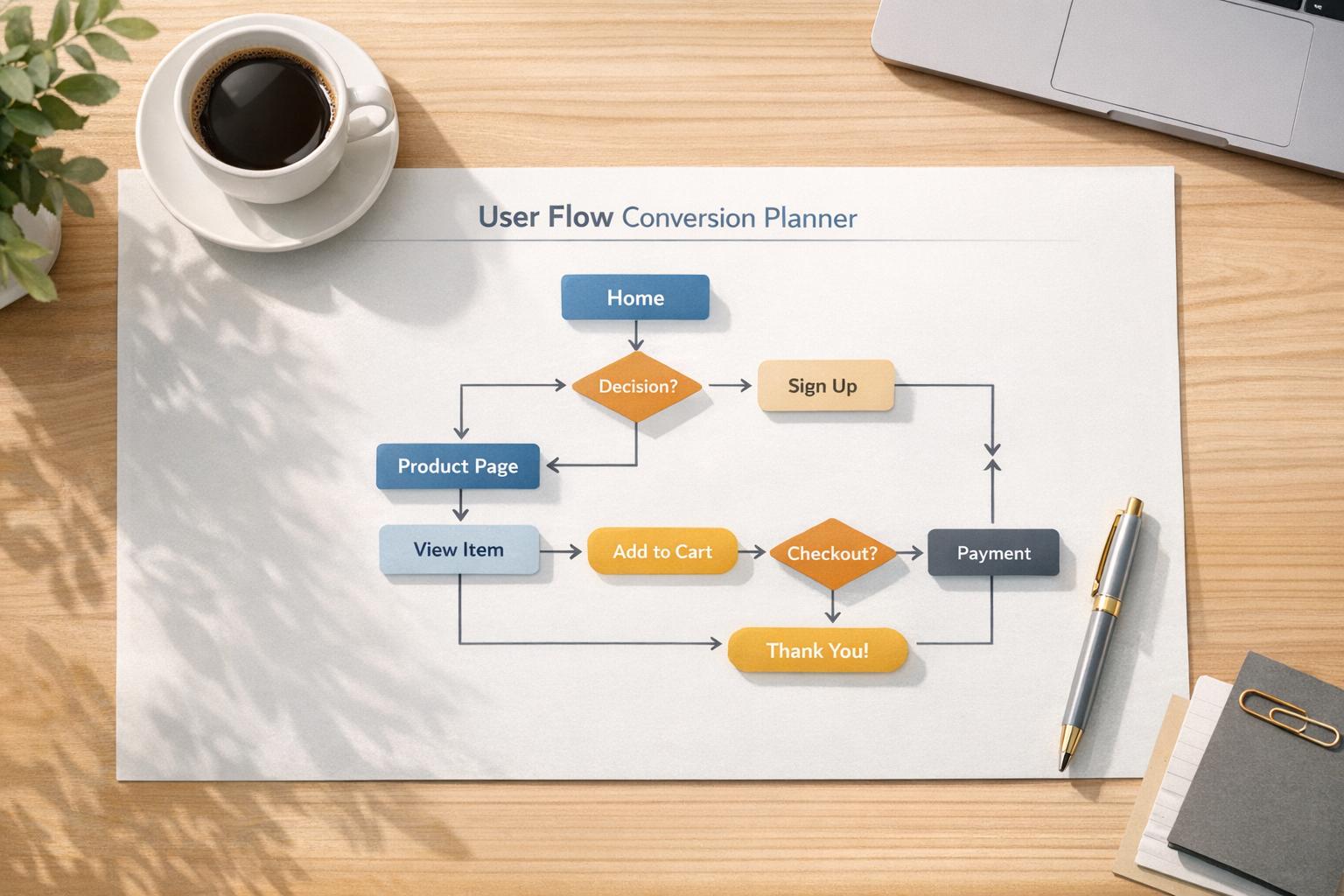
User Flow Conversion Planner
 22-12-2025 (Last modified: 09-01-2026)
Improve Conversions by Fixing the Journey with a User Flow Conversion Planner
Most conversion problems aren’t caused by a bad landing page. They’re caused by a broken journey.
A user flow conversion planner helps you see where users hesitate, get confused, or drop off as they move from one step to the next. Instead of guessing where things go wrong, you get a clear view of how the flow actually performs.
Quick snapshot:
-
A user flow conversion planner maps how users move through your site or funnel
-
Highlights friction points between steps, not just page-level issues
-
Helps prioritise fixes that unlock the biggest conversion gains
-
Useful for SaaS funnels, lead gen flows, ecommerce checkouts, and onboarding
We’ve seen teams endlessly tweak individual pages while the real issue sat between them. Once the flow was mapped properly, the fix became obvious.
Why user flow matters more than individual pages
Optimising pages in isolation only gets you so far. Users don’t experience your site as a collection of pages. They experience it as a sequence of decisions.
Every step in a flow asks something of the user:
-
read this
-
trust this
-
click this
-
fill this out
-
wait for this
If any step feels unclear or unnecessary, users drop out.
A user flow conversion planner helps answer questions like:
-
Where are users abandoning the journey?
-
Which steps cause the biggest drop-offs?
-
Are we asking for too much, too early?
-
Does the flow match user intent at each stage?
In our experience, fixing one weak transition between steps often outperforms optimising five individual pages.
What a user flow conversion planner actually does
A user flow conversion planner breaks a journey into clear stages and evaluates how users move between them.
Typical steps might include:
-
pricing page
-
signup or checkout
-
confirmation or onboarding
Instead of looking at raw analytics in isolation, the planner helps you see:
-
conversion rate between steps
-
where friction increases
-
where intent drops
-
where expectations don’t match reality
We’ve seen flows where every page performed “okay” on its own, yet the overall conversion rate was poor. The planner revealed that one confusing handoff between pages caused most users to leave.
Common user flow issues the planner reveals
A user flow conversion planner often uncovers problems like:
1. Asking for commitment too early
Requesting signups, demos, or payments before trust is built.
2. Intent mismatch between steps
Educational content leading straight into a hard sell.
3. Too many decisions
Multiple CTAs competing at the same stage.
4. Unclear next steps
Users finish one action but don’t know what happens next.
5. Friction-heavy forms
Long forms or unnecessary fields that interrupt momentum.
We’ve seen conversion lifts simply by removing one step or delaying a request until users were ready.
How to use a user flow conversion planner effectively
Here’s a practical approach that works well:
-
Define the primary goal
What does success look like for this flow? -
Map the full journey
Include every step, even the “small” ones. -
Identify drop-off points
Look for sharp declines between steps. -
Evaluate intent at each stage
Does the content match what the user expects next? -
Fix the biggest blocker first
Don’t spread effort evenly. Focus where loss is highest.
In our experience, the best gains come from simplifying flows, not adding more persuasion.
Why user flow optimisation beats page-level tweaks
Page-level optimisation improves local performance. Flow optimisation improves outcomes.
A strong user flow conversion planner helps you:
-
reduce unnecessary steps
-
align messaging across stages
-
improve trust progression
-
shorten time to conversion
We’ve seen flows convert better after removing content, buttons, or choices. Fewer decisions often lead to more action.
User flow planning and modern SEO
User flows don’t directly affect rankings, but they strongly influence engagement signals:
-
pages per session
-
time on site
-
completion rates
-
return visits
Search engines and AI-driven systems favour sites that guide users clearly and efficiently. Broken flows create frustration, which shows up in engagement metrics.
In our experience, improving user flow leads to more stable performance during algorithm changes because users behave more predictably and positively.
Where a user flow conversion planner is most useful
A user flow conversion planner is especially effective for:
-
SaaS signup funnels
-
free trial onboarding
-
ecommerce checkout flows
-
lead generation journeys
-
multi-step forms
-
content-to-conversion paths
Anywhere users need to move through multiple steps, flow matters more than polish.
FAQs
What is a user flow conversion planner?
It’s a tool that helps you analyse and optimise how users move through a multi-step journey, highlighting where conversions are lost between steps.
Is this better than page-level optimisation?
They work best together, but flow optimisation often delivers bigger gains because it addresses journey-wide friction rather than isolated issues.
Do I need complex analytics to use this?
No. As long as you can see how users move between steps and where they drop off, a user flow conversion planner can surface actionable insights.
say hello to easy Content Testing
try PageTest.AI tool for free
Start making the most of your websites traffic and optimize your content and CTAs.
Related Posts

09-10-2026
 Becky Halls
VWO and AB Tasty Are Now Wingify: What the Merger Actually Means for Your Testing Stack
If you run A/B tests on VWO or AB Tasty, you’ve probably noticed the logins moved, the branding changed, and a new name, Wingify, started showing up in your inbox. Here’s what actually happened, what’s still unclear, and where a smaller, published-price tool like PageTest.AI fits if you’re reconsidering your stack because of it. The […]

31-08-2026
Becky Halls
Spiralyze alternatives: CRO agency or software in 2026?
Spiralyze makes an offer that’s hard to argue with. “30% lift in 90 days. No fee until we deliver.” More precisely: 10 tests, 3 wins, more than 30% lift in your first 90 days, and you pay nothing until they’ve done it. I’ll say plainly what most competitor pages wouldn’t. On risk alone, that’s a better offer than […]

31-08-2026
Becky Halls
AB Tasty alternatives: an honest comparison for 2026
AB Tasty is a strong platform with a well-liked support team, sitting at 4.4 on G2 across 418 reviews. Reviewers on TrustRadius describe it as better value than pricier AB Tasty alternatives, which in this category is a real compliment. It also has the most unusual buying process here. No published pricing, and no free […]