


AI-Driven Mobile Segmentation with Real-Time Data

AI-Driven Mobile Segmentation with Real-Time Data
 12-12-2025 (Last modified: 31-01-2026)
AI-driven mobile segmentation uses machine learning to group app users based on real-time behaviors, context (like location or time), and historical trends. Unlike static segmentation, this method dynamically updates user groups as behaviors change, enabling businesses to deliver personalized experiences instantly. For example, apps can identify "loyal buyers" or "cart abandoners" and trigger targeted actions like discounts or notifications.
Why it matters:
- 71% of consumers expect brands to tailor interactions.
- 76% feel frustrated when personalization is missing.
- Real-time segmentation improves user engagement, retention, and revenue.
How it works:
- Data Sources: Behavioral (taps, swipes), transactional (purchases), contextual (location, time), and device-level data.
- AI Techniques: Clustering (grouping users), predictive modeling (forecasting actions like churn), and real-time updates (adjusting segments instantly).
- Applications: Sending timely offers, optimizing in-app content, and improving user experiences.
Start small by targeting key user actions (e.g., cart abandonment) with automated triggers, then expand to advanced AI models for deeper insights. This approach helps businesses stay competitive in fast-paced markets like retail, gaming, and travel.
How to Build Customer Segments with AI (Real-World Use Case)
Mobile Data Sources for AI Segmentation
AI segmentation relies on four main data sources: behavioral, transactional, contextual, and device-level data. Each type reveals unique insights into user behavior and preferences.
- Behavioral data captures user interactions within your app, such as taps, scrolls, screen views, and navigation paths.
- Transactional data focuses on revenue-related activities like purchases (in USD), subscription statuses, and cart behaviors.
- Contextual data considers external factors like location, time of day, and weather conditions.
- Device-level data includes technical details like operating system, device model, screen size, and connection quality.
When combined, these data streams provide a well-rounded view of user intent, enabling AI models to create dynamic, continuously updating segments. These data sources feed directly into the AI systems responsible for real-time segmentation updates.
Behavioral and Transactional Data
Behavioral data serves as the backbone of AI segmentation, capturing every meaningful action users take in your app. This includes events like app opens, onboarding flows, screen views, adding items to a cart, completing checkouts, searching for products, viewing content, sharing, and adding items to wishlists. To ensure this data can be analyzed efficiently, it’s crucial to use consistent naming conventions (e.g., snake_case or camelCase), standardized timestamps (like ISO 8601 UTC), and structured event properties. For example:
cart_value: $129.99items_count: 3category: "sneakers"
Transactional data complements behavioral insights by focusing on revenue metrics. This includes order values (in USD), purchased items and categories, purchase frequency, recency, average order value, payment methods, discount usage, refunds, and subscription start or renewal dates. These details allow AI models to identify segments such as VIP customers, users at risk of churning, or shoppers sensitive to discounts. Additionally, cart-level data helps pinpoint high-intent abandoners, enabling timely re-engagement strategies.
Metrics like session count, session duration, and navigation paths add further depth to behavioral analysis. For instance, AI models that track time-series data – such as changes in session length over a 14-day period – can more effectively predict churn or the likelihood of an upgrade compared to models that rely only on raw event counts.
Contextual and Device-Level Signals
Contextual signals refine segmentation by adding real-time environmental data. Location data, for example, can range from coarse details like city, state, or ZIP code to precise geohashed coordinates. These can be enriched with attributes such as urban versus suburban classification, proximity to stores, or service availability – key factors in a geographically diverse market like the U.S. Recording both UTC and local time of day enables AI models to identify patterns, such as weekday commuting usage versus weekend leisure shopping, or lunchtime versus late-night activity. Third-party APIs can also enhance segmentation by incorporating external data like weather conditions, local events, or holidays. This allows for highly specific segments, such as "weekday lunchtime shoppers in New York City" or "bad-weather delivery users in Chicago."
Device-level data provides additional layers of segmentation by focusing on technical attributes like operating system, device model, screen size, connection type, and app version. For example, you can create segments like "legacy Android users on slow connections", who may benefit from simplified app flows, or "latest iOS users on high-end devices", who could enjoy richer media and advanced features. OS- and version-based data also supports controlled feature rollouts and A/B testing, while connection quality insights help optimize features like prefetching, video autoplay, and caching.
AI Techniques for Mobile Segmentation
AI-powered segmentation revolves around three main techniques that transform raw mobile data into meaningful user groups. These methods include clustering algorithms, predictive models, and real-time updates. Together, they help businesses identify user behaviors, predict future actions, and maintain up-to-date user segments. For example, clustering uncovers natural behavior patterns, predictive models anticipate actions like churn or purchases, and real-time updates ensure segments stay relevant as new data flows in. Below, we’ll break down how each of these techniques works.
Clustering and Behavioral Patterns
Clustering groups users based on shared behaviors, such as how often they use an app, what they view, or how much they spend. Techniques like k-means, hierarchical clustering, and DBSCAN are commonly used because they handle large datasets efficiently. Imagine a mobile shopping app: clustering might reveal "premium loyal subscribers" who frequently make high-value purchases, "deal-seekers" who shop mainly during sales, and "engaged browsers" who explore products but rarely buy. These insights are invaluable – high-value groups often show strong retention and revenue, while at-risk groups might exhibit declining engagement or increased errors. Such clusters can trigger personalized campaigns tailored to each group’s behavior. Once these clusters are identified, predictive models take it a step further by forecasting user actions.
Predictive and Propensity Models
Predictive models estimate the likelihood of specific outcomes for individual users, creating segments like "churn risk above 80%" or "purchase probability above 60% in the next week". These models rely on supervised learning methods like logistic regression, gradient-boosted trees, and random forests. They analyze inputs such as recent activity, purchase history, content interactions, and engagement with campaigns. For example, a churn model might focus on users inactive for over 30 days, while a purchase model might evaluate behaviors like wishlist additions or abandoned carts to identify likely buyers. These predictions are updated frequently and categorized into actionable groups – high, medium, or low likelihood – enabling targeted actions like push notifications, in-app messages, or even paid ads.
Real-Time Model Updates
Real-time updates use streaming analytics to process events like app launches, product views, purchases, or push notification interactions as they happen. Instead of waiting for daily updates, online learning allows models to adjust continuously, which is especially useful during rapid changes in user behavior. This dynamic approach ensures segments are always current. For instance, a user can be removed from a "cart abandoner" segment immediately after completing a purchase or added to a "reactivated user" segment after a burst of renewed activity. Achieving this requires a robust setup, including event pipelines, real-time computation layers, and low-latency data storage to handle updates instantly.
sbb-itb-6e49fcd
Using AI-Driven Segments to Improve Conversions
AI-powered segments can help you deliver more targeted and timely experiences. The idea is straightforward: show the right content to the right person at the perfect moment. This involves tailoring what users see in your app, experimenting with different approaches for each group, and monitoring which strategies actually drive engagement. Major players like Uber, Walmart, and Disney have used these methods to see measurable increases in both engagement and revenue. Let’s dive into how real-time segmentation can enhance mobile conversions.
Personalization with Real-Time Segments
Real-time segmentation allows you to adjust messaging, offers, and layouts instantly based on a user’s behavior. Take Uber, for example – they use location and time-based data to decide whether to promote ride-hailing or food delivery. Urban users might get midday lunch deals, while commuters see ride offers during rush hour. This kind of dynamic personalization reacts to user actions in real time.
In fact, 71% of consumers now expect brands to provide personalized experiences. If a premium subscriber opens your app, you can highlight exclusive deals or early access to features tailored for them. Even optimizing the interface for specific devices can make the experience feel more seamless.
Behavioral segments, created through clustering algorithms, make it easier to fine-tune your offers. For instance, you might identify "tech-savvy frequent shoppers" or "deal-seekers" and cater to their preferences. High-engagement mobile users could see discounts on tech gadgets, while premium subscribers might get upsell offers based on their spending habits. The key is aligning your content with the user’s intent and current context.
Once you’ve deployed personalized content, it’s crucial to measure its impact through targeted testing.
Testing and Optimizing Segment-Specific Experiences
Personalization is just the starting point – you also need to test and refine your strategies for each segment. For example, a high-value customer who abandoned their cart might respond well to urgency-focused messaging like “Buy Now – 20% Off,” while a first-time visitor may prefer content that emphasizes product benefits. Testing helps uncover what resonates most with each group.
This is where tools like PageTest.AI come into play. Their no-code platform enables A/B and multivariate testing for headlines, CTAs, button text, and layouts, all tailored to AI-defined mobile segments. With PageTest.AI, you can generate content variations effortlessly and track real-time metrics – like clicks, engagement, and time spent on a page – to see what works best. For example, if you’ve identified an "at-risk" segment, you could test re-engagement messages such as “See What’s New” or “Come Back for 30% Off,” and let the data guide your decision.
Event-triggered A/B testing is especially effective in mobile apps. By launching tests immediately after specific user actions, you can quickly determine whether urgency- or value-driven messaging performs better. The goal is to pinpoint the winning approach for each segment and apply it across your app.
Metrics and Feedback Loops
To gauge the success of your segmentation and personalization efforts, track key metrics like conversion rates, retention rates (Day 1, Day 7, Day 30), ARPU (Average Revenue Per User), CLV (Customer Lifetime Value), session duration, and cart abandonment rates. For example, if a personalized offer for a high-value segment increases ARPU by $15.50 compared to a control group, you’ve clearly hit the mark. In fact, dynamic personalization has been shown to boost ARPU by 20–30%.
These metrics also provide valuable feedback for improving your AI models. For instance, if retention drops for a specific segment, it might signal the need to retrain your churn prediction model or tweak your targeting criteria. Automated alerts can trigger updates to ensure your segmentation stays aligned with evolving user behavior. Companies that implement continuous feedback loops like these have reported long-term conversion increases of 15–25%.
Building an AI-Driven Mobile Segmentation System
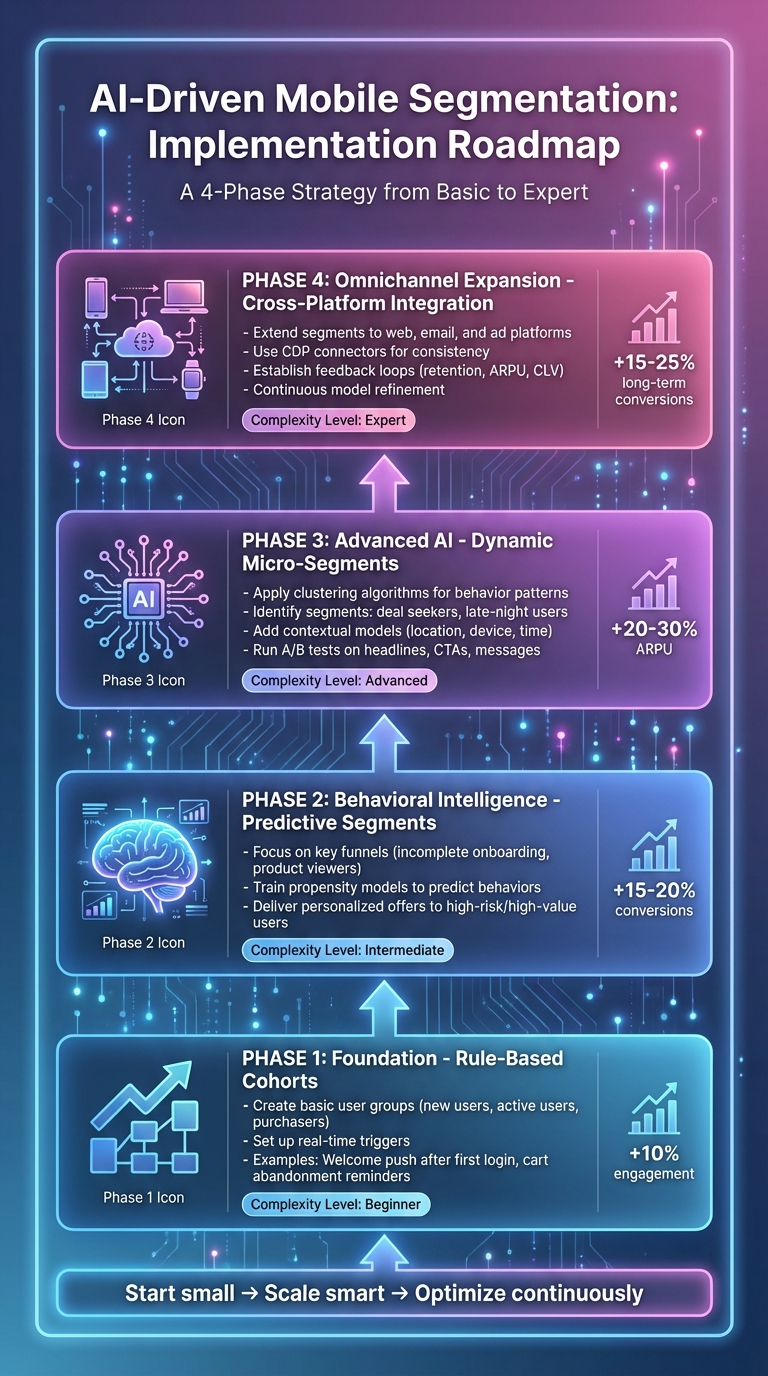
4-Phase Implementation Strategy for AI-Driven Mobile Segmentation
Using real-time segmentation insights effectively requires a system that can translate these models into actionable, mobile-specific strategies. By incorporating AI techniques and real-time updates, you can create a framework to build, scale, and maintain a mobile segmentation system that delivers results.
To implement AI-driven segmentation, you’ll need three key components: reliable event tracking with identity resolution, a real-time data pipeline, and low-latency machine learning models for dynamic marketing and personalization. Starting with high-impact areas and gradually expanding as your data quality improves is a smart way to approach this.
Data Readiness and Infrastructure
Before diving into model training, it’s essential to ensure your data is clean and complete. Start by outlining a tracking plan for your mobile app. Identify key events to capture, such as app installs, user registration, onboarding milestones, add-to-cart actions, purchases, and subscription updates. Include relevant details like device type, operating system version, campaign source, revenue (in USD), and product categories. Use a mobile analytics SDK or a customer data platform (CDP) to gather first-party event data from both iOS and Android apps. Consistency in event naming and schemas across platforms is crucial.
Equally important is identity resolution. Combine stable identifiers (like user_id) with device IDs, and link anonymous activity to user profiles once they log in. Modern CDPs, such as Twilio Segment, emphasize the importance of clean, consented data as a foundation for AI models. To maintain compliance, integrate automated data quality checks and consent management systems.
Step-by-Step Implementation Strategy
Phase 1: Start with the basics. Create rule-based cohorts (e.g., new users, active users, or purchasers) and activate them using real-time triggers. For instance, send a welcome push notification after a user logs in for the first time or a reminder shortly after cart abandonment.
Phase 2: Move to behavioral and predictive segments. Focus on key funnels, such as users who didn’t complete onboarding or those who viewed products but didn’t purchase. Train propensity models to predict these behaviors. Use these predictions to deliver personalized offers to high-risk or high-value users in real time.
Phase 3: Introduce advanced AI. Apply clustering algorithms to identify dynamic micro-segments, such as deal seekers or late-night users, based on behavioral patterns. Add contextual models that adapt experiences based on factors like location, device type, or time of day. Tools like PageTest.AI can help here by tying AI-driven segments to A/B and multivariate tests. These tools allow you to experiment with different headlines, CTAs, or in-app messages for each segment, measuring their impact on conversions and revenue in USD.
Phase 4: Expand across channels. Extend your mobile segments to web, email, and ad platforms using CDP connectors to maintain consistent logic. Establish feedback loops to monitor segment performance metrics like retention rates, ARPU (average revenue per user), and customer lifetime value. Feed this data back into your models for ongoing refinement.
Maintaining and Monitoring Segmentation Models
Once your system is live, ongoing monitoring is critical. Set up dashboards and alerts to track key metrics like prediction accuracy, segment sizes, and anomalies in data freshness or churn rates. Schedule regular retraining sessions – monthly or quarterly for most apps, but more frequently for fast-changing industries like mobile gaming or ride-hailing. Monitor for model and data drift by comparing current metrics to historical baselines. If you notice significant deviations, retrain your models or adjust their features accordingly.
When rolling out new models or segment definitions, use A/B testing to validate their impact on conversions, retention, or revenue before full-scale deployment. Keep thorough documentation: maintain version control for models and segmentation rules, log changes, and assign clear responsibilities across data science, engineering, and marketing teams. Real-time streaming analytics platforms can process massive amounts of customer data instantly, enabling quick segment updates and timely actions based on events like purchases or cart abandonments. This continuous optimization ensures your segmentation stays relevant as user behaviors evolve.
Conclusion
AI-powered mobile segmentation with real-time data takes user engagement to a whole new level. Instead of relying on static lists, it creates dynamic audiences that adjust instantly based on actions – whether someone taps, swipes, makes a purchase, or leaves their cart behind. This shift from delayed reports to immediate insights allows you to engage users at the perfect moment, whether it’s a lunchtime shopper near your store or a late-night browser at risk of churning. The result? Higher conversion rates, better retention, and improved ROAS as every interaction aligns with the user’s current intent.
This approach builds on clean first-party data, real-time data pipelines, and machine learning models that continuously adapt to behavioral, transactional, and contextual signals. By systematically testing elements like headlines, CTAs, and user flows, brands can establish a feedback loop that drives ongoing improvement. Tools like PageTest.AI simplify this process by generating and testing tailored content variations, helping you pinpoint what resonates most with each audience segment and what drives measurable results.
Real-time segmentation has become a necessity. With personalization now an expectation for most consumers, brands that prioritize high-quality data, cross-team collaboration, and smart automation will be better equipped to navigate changing user behaviors and evolving privacy regulations. By balancing personalization with transparency, businesses can create meaningful interactions at every touchpoint – whether on mobile apps, mobile web, or beyond.
To get started, focus on a couple of high-priority use cases, like reducing cart abandonment or boosting first-purchase rates. Set up one real-time segment with an automated trigger, measure the results, and refine your strategy from there. Over time, AI-driven segmentation can do more than just target users – it can orchestrate entire customer journeys, turning mobile marketing into a proactive, data-driven powerhouse.
FAQs
How can AI-driven mobile segmentation enhance user engagement?
AI-powered mobile segmentation takes user engagement to the next level by analyzing real-time behavioral data like time spent on a page, scrolling habits, clicks, and navigation patterns. By interpreting this information, AI crafts personalized and highly targeted experiences that align with individual user preferences.
This precision ensures users encounter content that genuinely matches their interests and needs. The outcome? Increased interaction, stronger engagement, and higher conversion rates – all thanks to a user experience that feels tailor-made.
What data is crucial for effective AI-based mobile user segmentation?
To make AI-powered mobile user segmentation work effectively, you need to focus on behavioral data like how much time users spend on a page, how far they scroll, and what they click on. On top of that, keeping an eye on broader actions – like moving to other pages or interacting with specific types of content – can offer deeper insights into user behavior.
By combining this real-time data, AI models can uncover patterns and build precise user groups. The result? Better personalization and stronger engagement with your audience.
How can businesses use AI to segment mobile app users effectively?
Businesses now have the ability to use AI-powered tools to dive deep into real-time behavioral data, allowing for the creation of highly accurate user segments. By monitoring engagement metrics such as clicks, scroll depth, and time spent within an app, these tools can pinpoint patterns and categorize users based on their actions and preferences.
What’s more, platforms like these make it easy for businesses to experiment with and tailor content for specific audience groups – no coding skills required. This means companies can offer more targeted, relevant experiences, boosting user satisfaction and delivering stronger outcomes.
Related Blog Posts
say hello to easy Content Testing
try PageTest.AI tool for free
Start making the most of your websites traffic and optimize your content and CTAs.
Related Posts

31-08-2026
 Becky Halls
Spiralyze alternatives: CRO agency or software in 2026?
Spiralyze makes an offer that’s hard to argue with. “30% lift in 90 days. No fee until we deliver.” More precisely: 10 tests, 3 wins, more than 30% lift in your first 90 days, and you pay nothing until they’ve done it. I’ll say plainly what most competitor pages wouldn’t. On risk alone, that’s a better offer than […]

31-08-2026
Becky Halls
AB Tasty alternatives: an honest comparison for 2026
AB Tasty is a strong platform with a well-liked support team, sitting at 4.4 on G2 across 418 reviews. Reviewers on TrustRadius describe it as better value than pricier AB Tasty alternatives, which in this category is a real compliment. It also has the most unusual buying process here. No published pricing, and no free […]
31-08-2026
Becky Halls
The best Optimizely alternative: a comparison for 2026
Optimizely is the most capable experimentation platform on the market. I don’t think that’s seriously disputed. Server-side testing, feature flags, personalization, statistical depth, and it all runs at genuine enterprise scale. In 2026 they’ve wrapped the whole thing in “agentic experimentation” branding and shipped an AI variation development agent, and the underlying Web Experimentation product […]