


AI Insights: Reducing Funnel Drop-Offs with Data

AI Insights: Reducing Funnel Drop-Offs with Data
 16-03-2026 (Last modified: 16-03-2026)
E-commerce businesses are losing billions annually due to customer drop-offs in the sales funnel. AI is stepping in to tackle the problem by identifying friction points, predicting user behavior, and enabling real-time interventions. Here’s what you need to know:
- Cart Abandonment: 70% of shoppers abandon their carts, costing $260 billion annually in the U.S.
- Key Issues: Unexpected costs (48%), forced account creation (24–26%), and slow checkout processes are top reasons for drop-offs.
- Mobile Challenges: Mobile abandonment rates are as high as 85.65%, with smaller screens creating additional friction.
- AI Solutions: AI detects hesitation (e.g., stalled scrolling, repeated clicks), predicts drop-offs, and personalizes user experiences in real time.
- Proven Results: Companies like ASOS and HP have seen up to 18% reductions in cart abandonment and increased conversions by leveraging AI.
AI not only helps recover lost sales but also optimizes processes like A/B testing, saving time and money while boosting revenue. Businesses that fail to adopt AI risk falling behind in an increasingly competitive market.
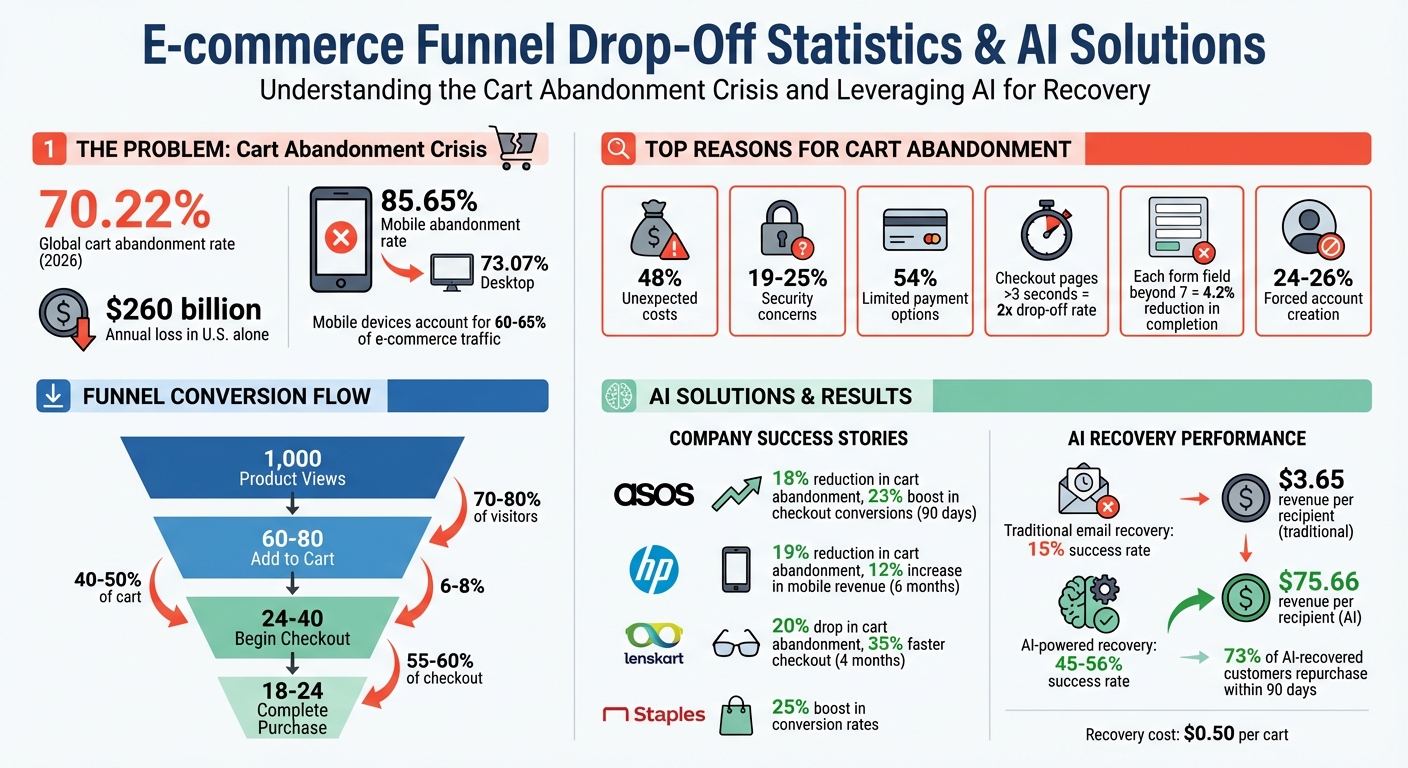
E-commerce Funnel Drop-Off Rates and AI Impact Statistics
Where Customers Drop Off in E-commerce Funnel
Drop-Off Rate Statistics
Funnel leaks happen at every stage, but they don’t all carry the same weight. Globally, the cart abandonment rate remains high, sitting at 70.22% in 2026 – a figure that hasn’t shifted much since 2006.
The largest drop-off often occurs early in the funnel, even before the checkout phase. While checkout abandonment gets a lot of focus, 40–50% of users who add items to their cart never even start the checkout process. This is a critical point of loss since these users can’t be reached through follow-up emails.
The situation is even more challenging for mobile shoppers. Mobile abandonment rates hit 85.65%, compared to 73.07% on desktop. Given that mobile devices account for 60–65% of e-commerce traffic, the added friction of smaller screens contributes to roughly 70% of cart abandonments.
Here’s a breakdown of the e-commerce funnel: 70–80% of visitors view a product, but only 6–8% add it to their cart. Of those, 40–50% begin checkout, and just 55–60% complete their purchase. This means that out of every 1,000 product views, only 18 to 24 purchases are completed. These numbers highlight the hurdles shoppers face, especially as they approach checkout.
Why Customers Abandon Their Carts
One of the biggest reasons for cart abandonment is unexpected costs, which 48% of shoppers identify as their primary frustration. Hidden fees, such as late-revealed shipping charges or taxes, often lead to what experts call a "betrayal" response.
"Unexpected costs trigger what behavioral economists call a ‘betrayal’ response – even if the total is fair, the surprise feels unfair."
- Muhammed Tüfekyapan, Founder, Growth Suite
Another major barrier is forced account creation, which discourages 24–26% of shoppers. This practice can signal a lack of trust and prioritization of data collection over user experience. A great example of the impact: Expedia increased its annual revenue by $12 million simply by removing one unnecessary form field during checkout.
Form friction adds to the problem. While the ideal checkout process involves 12–14 form elements, the average U.S. checkout includes over 23. Research shows that each additional field beyond seven reduces completion rates by 4.2%. Plus, checkout pages that take more than three seconds to load see drop-off rates more than double.
Security concerns also play a role, with 19–25% of shoppers citing them as a reason for abandoning their carts. However, today’s checkout anxiety is less about data theft and more about uncertainty. For example, vague delivery windows like "3–5 business days" can make customers hesitate, while specific estimates like "Arrives by Wednesday" build confidence. Additionally, limited payment options are a dealbreaker for 54% of customers when their preferred method isn’t available.
sbb-itb-6e49fcd
How AI Detects and Fixes Funnel Problems
Tracking User Behavior to Spot Drop-Off Signals
AI plays a key role in identifying where users encounter friction in the sales funnel, often before they leave. It picks up on subtle cues like micro-hesitation patterns – for instance, when someone hovers over a call-to-action button for several seconds or repeatedly edits a form field. These moments of uncertainty are flagged as potential problem areas. Machine learning also tracks navigation loops, where users bounce between the same pages, such as frequently switching between a pricing page and an FAQ. This behavior often signals unresolved questions.
Beyond these patterns, predictive models analyze additional details like mouse speed, cursor movement, and tab-switching frequency. On mobile, AI monitors behaviors such as rapid upward scrolling – a common sign a user is about to leave – or frequent app switching, which hints at distraction.
A great example of this in action is Lenskart, an eyewear company that tackled a weekend cart abandonment rate of 70% in 2022. By using Salesforce Einstein AI to track "cart hesitation" in real time, they sent WhatsApp reminders to customers showing signs of leaving. This approach led to a 20% drop in cart abandonment and a 35% faster checkout process within just four months.
With these insights, AI doesn’t just observe user behavior – it anticipates potential drop-offs and intervenes proactively.
Predicting Drop-Offs Before They Happen
AI’s ability to predict issues is a game changer. Using predictive analytics, it assigns intent scores to visitors based on factors like browsing history or price sensitivity. This allows businesses to focus on users most likely to convert but showing hesitation. For instance, AI models predicting lead form drop-offs have reached up to 88% accuracy.
When AI detects a high-risk signal, it acts immediately. For example, if a user lingers on a cart page for over 20 seconds without scrolling, the system might launch a chatbot or display a gentle reminder. These interventions are tailored to the user’s behavior, whether it’s offering a discount or simplifying a confusing checkout step.
In 2023, ASOS used Microsoft Azure and Adobe Experience Cloud to personalize customer experiences. By analyzing real-time browsing patterns and price sensitivity, they delivered customized discounts and dynamic delivery messages at critical moments of hesitation. This approach led to an 18% reduction in cart abandonment and a 23% boost in checkout conversions within 90 days.
"AI doesn’t guess. It learns. It observes tens of thousands of user journeys, notices behaviors you can’t, and adjusts in real-time."
- Artic Sledge
HP also saw success in 2023 by applying Adobe Sensei AI to tackle a 65% mobile drop-off rate. By identifying mobile-specific friction points and simplifying forms dynamically for struggling users, they achieved a 19% reduction in cart abandonment and a 12% increase in mobile revenue within six months.
Personalizing the User Experience with AI
Customized Product Recommendations and Messaging
AI has transformed how businesses anticipate user needs by analyzing real-time behaviors like mouse movements, scrolling patterns, and even pauses while typing. This allows e-commerce platforms to fine-tune product recommendations using browsing history and lookalike modeling, tailoring suggestions to individual preferences.
It doesn’t stop there – AI aligns content with the traffic source. For instance, someone landing on a site from Instagram might see different headlines and visuals compared to a visitor from a Google ad. This approach ensures the content matches the user’s intent, keeping them engaged. Instead of offering blanket discounts, AI can determine whether a shopper would respond better to a price reduction or reassurance about shipping, cutting unnecessary voucher costs by as much as 25%.
A great example of this is Yves Rocher. In 2025, the cosmetics brand used Bloomreach‘s AI to shift from generic top-seller lists to real-time, tailored recommendations. The result? An 11x increase in purchase rates. Similarly, cycling retailer Rapha Racing leveraged Bloomreach Engagement for personalized ad targeting, leading to a 31% spike in purchase events within just an hour of launching the campaign.
This kind of personalized approach lays the groundwork for real-time adjustments across the user journey, ensuring a seamless and engaging experience.
Adjusting Pages in Real Time
AI doesn’t just stop at recommendations – it can adapt entire page layouts on the fly to guide users through their journey. For example, it can reposition call-to-action buttons, streamline checkout forms, or spotlight free shipping thresholds based on a visitor’s behavior. On mobile devices, where abandonment rates can soar to 85.6%, AI can detect rapid upward scrolling (a signal someone might leave) and prompt a “save cart for later” option.
These adjustments are subtle yet effective, using frequency caps to ensure popups or notifications appear only once per session, maintaining user trust. One mid-sized Shopify retailer tested this strategy over 15 weeks in early 2026. By combining A/B testing with AI-driven recommendations, they boosted their conversion rate from 2.8% to 4.3% – a 53.6% jump – and increased their average order value from $75 to $92.
"AI gives you a way to [personalize] at scale, without adding pressure on your team. It turns the journey into a customer experience that keeps improving with every interaction."
- Chris Baldwin, VP Marketing, Insider One
HP also embraced this approach in 2026, using Insider One’s personalization engine to deliver tailored product suggestions and real-time offers to both new and returning visitors. This strategy helped them achieve an impressive 11.64% conversion rate.
Using AI to Speed Up A/B Testing
Generating Test Variations Automatically
Traditional A/B testing can feel like watching paint dry – it’s slow and labor-intensive. But AI flips the script, generating multiple content variations in seconds. Using conversion principles and brand guidelines, generative AI can instantly create dozens of options for headlines, product descriptions, and CTAs without requiring human input.
Beyond text, AI tools experiment with design elements like button colors, placements, and even checkout form layouts. They can also generate variations for images and videos. With simple natural language prompts such as “make this CTA more urgent,” marketers can quickly produce design tweaks or even code changes.
A great example of this in action comes from February 2026, when PageTest.AI showcased its capabilities during a live test for an app-generation service. Using a Chrome Extension, the team selected a CTA button and generated new variations on the spot. The original text, “Generate my app free,” only earned 2 clicks. But an AI-suggested alternative, “Make my app free and easy,” saw 11 clicks – a staggering 297% increase in engagement.
AI takes this even further with multivariate testing, evaluating countless combinations of headlines, images, and button colors in real time. What would take months to test manually, AI can do in a fraction of the time. Using machine learning-based multi-armed bandit algorithms, AI dynamically shifts traffic toward better-performing variations as results come in.
Once these variations are live, AI doesn’t stop – it immediately starts monitoring their impact.
Measuring Test Performance
After generating and launching test variations, AI quickly measures their effectiveness using key engagement metrics. It tracks data like clicks, time on page, and conversions to determine which versions perform best. Unlike traditional methods that focus only on immediate results, AI digs deeper – analyzing downstream outcomes like actual purchases or increased customer lifetime value, not just click-through rates.
"A/B testing helps you verify that more people click the red button than the green one, but the really valuable insight is which group is more likely to make a purchase later on."
Machine learning sifts through millions of data points to identify winning patterns, often cutting testing time by half. Speed matters, as shown by Lenovo’s Mobile UX Transformation program in February 2026. The program ran 36 A/B tests across five regions, addressing 43 website functionality gaps. The results? A 5% boost in overall conversion rates, a 12% lift in bottom-funnel conversions, and a 19% drop in bounce rates.
AI also minimizes false positives by running automated significance checks and validating predictive lift. This ensures that changes lead to sustained revenue growth, not just temporary spikes. By integrating data across devices and sources, AI provides a complete view of the user journey – something manual tracking struggles to achieve. It even picks up on subtle behaviors like hesitation, scrolling, or hovering, predicting which variations can prevent drop-offs before they occur.
Measuring the Business Impact of AI Optimization
Conversion Rate Improvements from AI
AI’s ability to analyze user behavior isn’t just impressive – it directly translates to better business results. By streamlining processes and tailoring customer interactions, AI optimization drives measurable changes in key metrics like checkout completions and customer retention while slashing Customer Acquisition Costs (CAC). For example, between January and March 2026, a North American fashion and lifestyle brand combined Shopify and Meta Ads data to achieve a 42% increase in checkout completions, a 33% rise in repeat buyers, and a 50% reduction in CAC – all in just 60 days.
Another standout case is Staples, which introduced an AI-powered on-page assistant in late 2025. This tool provided real-time answers to customer questions about product compatibility and features, leading to a 25% boost in conversion rates for certain tech categories. Shoppers who interacted with the AI assistant were also 25% more likely to complete their purchases.
AI doesn’t just stop at improving conversions – it’s a game-changer for recovering lost sales. Traditional email recovery campaigns typically reclaim around 15% of abandoned carts. In contrast, AI-powered recovery programs have success rates between 45% and 56%, nearly tripling the industry standard. Even better, 73% of customers recovered by AI make another purchase within 90 days, and top-performing campaigns generate $75.66 in revenue per recipient, compared to just $3.65 for traditional email sequences. These results highlight how AI can actively manage and improve the sales funnel.
Saving Time and Money with Automation
AI doesn’t just boost sales – it also saves businesses time and money by automating and optimizing operations. For example, AI significantly reduces the cost of funnel optimization and speeds up testing processes. Recovering abandoned carts with AI costs just $0.50 per cart – a fraction of traditional methods.
Take the case of a mid-sized boutique that used the AI tool Zanderio from October 2025 to January 2026. The boutique saw its monthly revenue jump from $23,596 to $27,740, a $4,144 increase, delivering an incredible 41.8x ROI from a tool that costs only $99 per month.
AI also helps businesses maintain healthy profit margins through smarter discount strategies. Traditional blanket discounts of 10% can lead to an 8–12% margin loss, but AI-powered solutions calculate the minimum discount each customer needs to convert, reducing margin loss to just 2–4%. Beyond this, AI tools can save time in other areas: one North American brand reported a 35% reduction in reporting time, while AI-driven customer support systems have been shown to cut response times by 70%.
Another area where AI shines is A/B testing. Traditional testing cycles that used to take weeks can now be completed in hours with AI, allowing teams to conduct up to 36 tests per year, compared to the typical 12–20 manual tests. This speed and efficiency empower businesses to adapt and improve faster than ever before.
The Best ECom Funnel In 2025!
Implementing the right conversion optimization strategies is essential for scaling your e-commerce store in the coming year.
Conclusion
AI has reshaped how brands approach e-commerce funnel optimization. By analyzing data, businesses can pinpoint exactly where users encounter friction – whether it’s cart abandonment or unclear product pages – helping them address these issues effectively. Predictive tools now allow companies to step in immediately when users show signs of leaving, taking action before potential customers slip away.
Beyond these interventions, automated optimization has revolutionized testing. It speeds up the process, enabling continuous improvements to the funnel. Real-time personalization takes it a step further by tailoring product descriptions and calls-to-action based on each visitor’s browsing patterns. This creates experiences that feel relevant and engaging for every shopper. The results are tangible: AI-powered recovery strategies can reclaim 15–30% of abandoned carts, with an average cost of just $0.50 per cart.
"In 2026, eCommerce CRO strategies that don’t leverage AI will be like running your store without email automation, technically possible but painfully inefficient." – ConvertCart
FAQs
Which funnel step should I fix first?
One of the biggest hurdles in the user journey often occurs at the checkout or cart stage. With cart abandonment rates hovering between 70% and 85%, this step represents a massive opportunity to recover lost revenue.
To address this, focus on understanding why users are leaving at this point. Tools that analyze user behavior can be incredibly helpful here. These tools can pinpoint problem areas – like confusing layouts, unexpected fees, or lengthy processes – and offer actionable insights to streamline the experience. Small tweaks in this critical step can lead to noticeable improvements in conversions.
How does AI spot a user about to leave?
AI can spot users who might leave by examining their behavior. Things like hesitation, long pauses, repeatedly navigating back and forth, or unusual session patterns often hint at confusion or frustration. By recognizing these signals, AI can predict when someone is likely to abandon their session and offer insights to address these issues, ultimately helping to keep users engaged.
How do I measure ROI from AI funnel changes?
To gauge ROI from AI-powered changes in your sales funnel, keep an eye on critical metrics like conversion rates, user engagement, and revenue growth directly linked to AI adjustments. The goal is to measure the incremental revenue generated by AI-driven interventions, rather than focusing on the total revenue recovered. Tools such as PageTest.AI make this easier by offering dashboards that track clicks, user behavior, and engagement. These insights allow you to calculate ROI based on measurable improvements in revenue or conversion rates.
Related Blog Posts
say hello to easy Content Testing
try PageTest.AI tool for free
Start making the most of your websites traffic and optimize your content and CTAs.
Related Posts

31-08-2026
 Becky Halls
Spiralyze alternatives: CRO agency or software in 2026?
Spiralyze makes an offer that’s hard to argue with. “30% lift in 90 days. No fee until we deliver.” More precisely: 10 tests, 3 wins, more than 30% lift in your first 90 days, and you pay nothing until they’ve done it. I’ll say plainly what most competitor pages wouldn’t. On risk alone, that’s a better offer than […]

31-08-2026
Becky Halls
AB Tasty alternatives: an honest comparison for 2026
AB Tasty is a strong platform with a well-liked support team, sitting at 4.4 on G2 across 418 reviews. Reviewers on TrustRadius describe it as better value than pricier AB Tasty alternatives, which in this category is a real compliment. It also has the most unusual buying process here. No published pricing, and no free […]
31-08-2026
Becky Halls
The best Optimizely alternative: a comparison for 2026
Optimizely is the most capable experimentation platform on the market. I don’t think that’s seriously disputed. Server-side testing, feature flags, personalization, statistical depth, and it all runs at genuine enterprise scale. In 2026 they’ve wrapped the whole thing in “agentic experimentation” branding and shipped an AI variation development agent, and the underlying Web Experimentation product […]