


What Is AI Mobile User Clustering?
What Is AI Mobile User Clustering?
 07-03-2026 (Last modified: 10-03-2026)
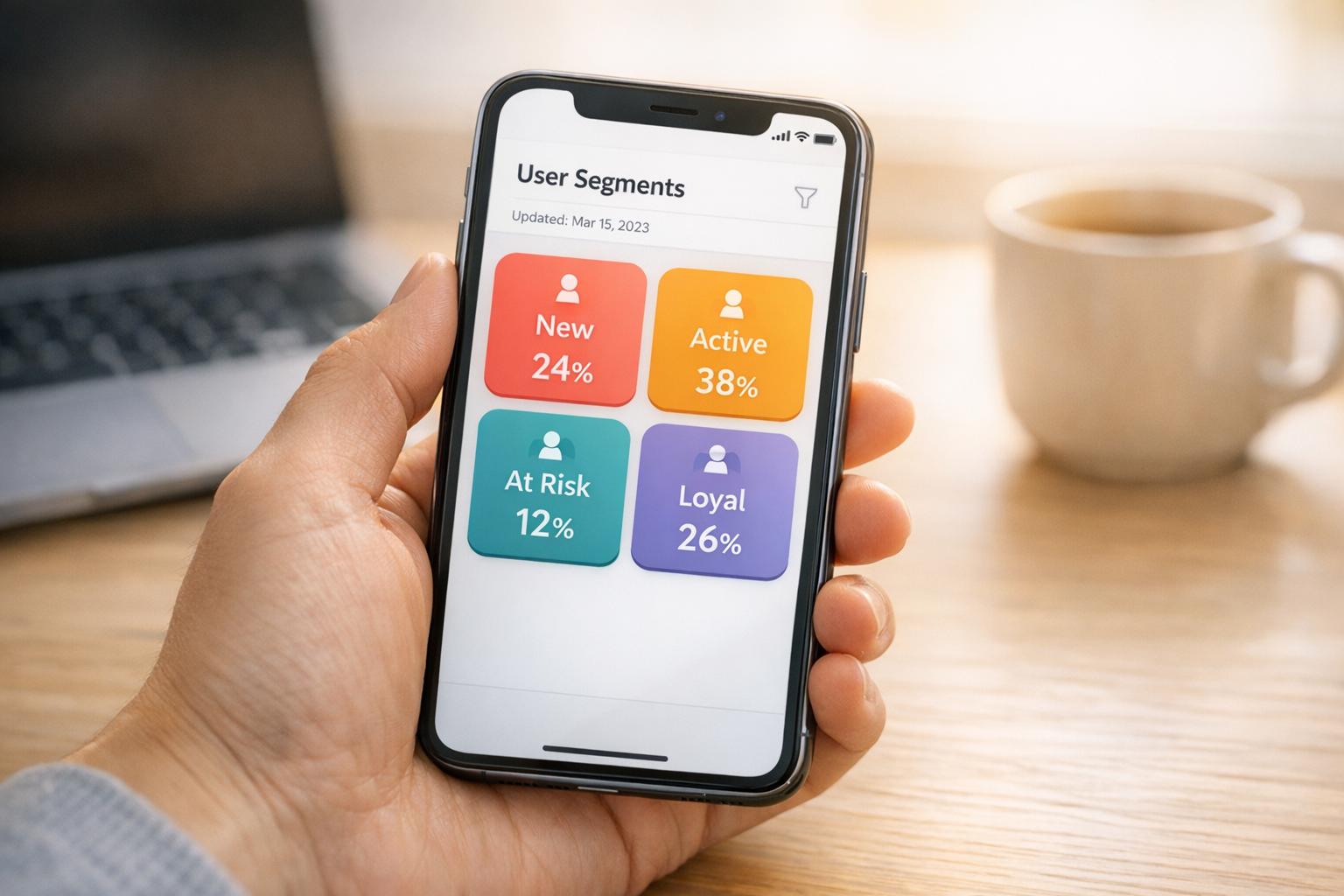
AI mobile user clustering is a machine learning method that groups mobile app users based on their behavior patterns, not predefined categories. By analyzing data like session length, navigation habits, and purchase frequency, it creates unbiased groupings that reveal user trends. Businesses use this technique to improve app performance, personalize user experiences, and boost marketing strategies for growth marketers.
Key Points:
- How It Works: Algorithms like K-Means and DBSCAN process user data to form clusters based on similarities.
- Benefits: Faster insights, better marketing precision, and real-time personalization.
- Applications: Identifying user pain points, predicting churn, and tailoring marketing campaigns and landing pages.
- Results: Companies report up to 85% sales growth and a 25% margin improvement with AI clustering.
AI clustering helps businesses understand user behavior at scale, offering smarter, data-driven strategies to enhance engagement and retention.
How Do AI Clustering Algorithms Organize Data Automatically? – AI and Machine Learning Explained
sbb-itb-6e49fcd
Methods and Algorithms for AI Mobile User Clustering
AI Mobile User Clustering Algorithms Comparison Chart
Common Clustering Algorithms for Mobile Users
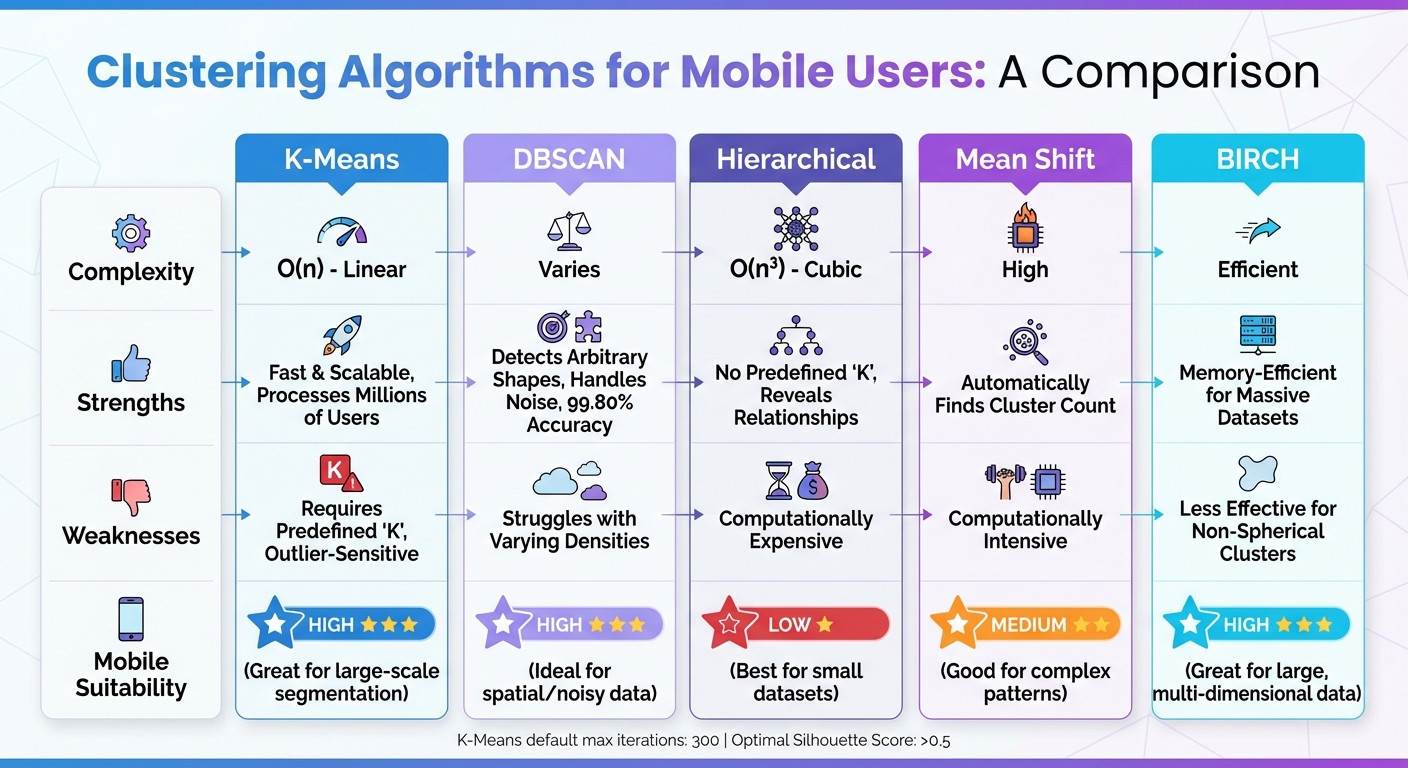
K-Means is a go-to method for segmenting users into k groups by assigning each user to the nearest centroid. It’s particularly effective for identifying natural user behavior patterns. With its linear complexity (O(n)), K-Means can efficiently process millions of mobile users – much faster than algorithms with O(n²) complexity. However, it does come with some challenges: you need to specify the number of clusters beforehand, and it’s sensitive to outliers.
DBSCAN (Density-Based Spatial Clustering of Applications with Noise) takes a different approach, grouping users based on density rather than distance to a central point. This makes it ideal for detecting anomalies like fraud or bot activity. As Andres Felipe Tellez Yepes, a Data Scientist & Software Engineer at Wizeline, points out:
“K-Means forces the creation of clusters even when none exist, while DBSCAN identifies natural clusters and can recognize noise, allowing for more flexible and accurate clustering in varied datasets.”
In a 2023 product review analysis, DBSCAN demonstrated 99.80% accuracy, slightly outperforming K-Means’ 99.50%.
Hierarchical Clustering creates a dendrogram – a tree-like structure – that reveals relationships between user groups at multiple levels. Unlike K-Means, it doesn’t require you to set the number of clusters in advance. However, its computational cost (O(n³)) makes it impractical for large datasets. It’s better suited for smaller projects where understanding the connections between segments is more important than scalability.
BIRCH (Balanced Iterative Reducing and Clustering Using Hierarchies) is designed for massive datasets. It compresses data into summaries, reducing memory usage and speeding up processing. This makes it a solid choice for applications with extremely large numbers of active users, even outperforming K-Means in terms of scalability.
Once you’ve chosen the right algorithm, the next step is preparing raw user data to ensure meaningful clustering results.
How to Prepare Mobile User Data for Clustering
The quality of clustering results depends heavily on how well the data is prepared. Much like AB testing for websites, successful segmentation requires clean, structured inputs to drive performance. Mobile data often comes as nested JSON from analytics tools, so the first step is to flatten these structures into usable columns, such as device_browser or geoNetwork_country. From there, aggregate event-level data – like clicks, scrolls, or purchases – into session-level metrics. Finally, roll these up into a user-level table where each row represents one user.
Standardization is a key step because clustering algorithms rely on distance measurements. Features with different scales – like annual revenue (up to $500,000) compared to support tickets (0–15) – can skew results unless standardized. Tools like StandardScaler or MinMaxScaler can help ensure all features are on a common scale.
Feature Engineering turns raw data into actionable metrics. For instance, instead of simply tracking “time in app”, you could derive metrics like “purchase acceleration” (how quickly users make a purchase after their first visit) or “engagement trends” (whether user activity is increasing or declining). In a 2023 analysis of the Bees Customer App, engineers used Principal Component Analysis (PCA) to reduce 21 metrics to 9 key variables, which still explained 69% of the cumulative variance.
Another critical step is removing highly correlated variables to avoid redundancy. For example, if “session time” and “pages visited” consistently move together, including both could give undue weight to that behavior. Similarly, outliers – like a user spending $50,000 when most spend under $500 – should either be excluded or treated as a unique segment. Proper data preparation ensures clustering algorithms work efficiently and yield accurate insights for decision-making.
Clustering Algorithm Comparison
| Algorithm | Strengths | Weaknesses | Mobile Suitability |
|---|---|---|---|
| K-Means | Fast and scalable | Requires predefined ‘K’; outlier-sensitive | High (Great for large-scale segmentation) |
| DBSCAN | Detects arbitrary shapes; handles noise | Struggles with varying densities | High (Ideal for spatial/noisy data) |
| Hierarchical | No predefined ‘K’; reveals relationships | Computationally expensive | Low (Best for small datasets) |
| Mean Shift | Automatically finds cluster count | Computationally intensive | Medium (Good for complex patterns) |
| BIRCH | Memory-efficient for massive datasets | Less effective for non-spherical clusters | High (Great for large, multi-dimensional data) |
To optimize K-Means, use the Elbow Method to find the point where improvements in cluster quality (measured by the within-cluster sum of squares) start to level off. Then, validate results with a Silhouette Score – values above 0.5 generally indicate well-separated clusters. In scikit-learn, the default maximum iterations for K-Means is 300, which is usually enough for convergence.
Applications of AI Mobile User Clustering
How AI Clustering Improves Mobile App Performance
AI clustering helps identify exactly where users face challenges in your app. Whether it’s slow load times in certain regions or navigation glitches on specific devices, clustering highlights these technical hurdles. For instance, older users might abandon their carts because of small fonts or an overly complicated checkout process.
Machine learning models take this a step further by predicting user behavior – like whether someone is likely to make a purchase or stop using the app – which is one of the primary AB testing benefits for long-term growth, so you can act before it’s too late. These AI-driven clusters adapt in real time as users interact with your app, allowing you to respond immediately to actions like leaving a cart behind or completing a tutorial.
A great example of this is the mobile app consultancy Nordstone, which worked with TapFit in January 2026. Under CEO Annie’s leadership, TapFit saw a 45% boost in decision-making speed thanks to real-time analytics and clustering. By using targeted push notifications, they increased sales by 70% and improved retention by 30%. This shows how turning raw user data into actionable insights can significantly enhance app performance.
And these performance improvements naturally pave the way for more personalized user experiences.
Personalization Through AI Mobile User Clustering
Clustering doesn’t just improve performance – it also enables precise personalization. Instead of relying solely on demographics, clustering creates “data personas” based on actual behavior. These micro-segments – like “Champions” (high engagement and spending), “Loyal Customers” (frequent visitors with moderate purchases), or “Window Shoppers” (low engagement and no purchases) – help brands craft highly targeted conversion rate optimization methods. Research shows that 80% of consumers are more likely to buy when they receive personalized experiences, while 75% feel frustrated when mobile stores fail to deliver personalization.
Take AvaTrade, for example. In January 2025, this trading app used behavioral segmentation to differentiate between users with real accounts and those using demo versions. By tailoring messages to each group, they achieved a 12% jump in real account registrations. Similarly, Bladestorm, a gaming utility app, used multilanguage segmentation to cater to users’ language preferences, leading to a 4.58% increase in revenue from push notification campaigns.
Real-time personalization takes things even further. Apps now analyze hundreds of signals – like tap speed, session length, feature usage patterns, location, and even battery level – to predict what users want at any given moment. Notifications tailored to a user’s context, such as the time of day or their motion activity, can boost engagement by 60% compared to generic messages. As David Wischnewski from ContextSDK puts it:
“Personalization is not just about delivering content that matches a user’s interests; it’s also about timing and context”.
Benefits of AI Mobile User Clustering
Better Precision and Scalability
AI clustering identifies natural user groups by analyzing a wide range of signals, steering clear of rigid, manually set thresholds. Instead of relying on static rules, AI digs into data points like visit frequency, discount sensitivity, and category preferences to uncover patterns that might escape human observation.
This technology can handle massive datasets with ease, processing millions of users in just minutes. It also keeps segments up-to-date by integrating new data in real time. According to research, 81% of marketers adopted AI for its efficiency, and 76% reported improvements in customer lifetime value or return on ad spend after implementing AI-driven targeting.
With this level of precision and scalability, AI opens the door to highly targeted marketing strategies.
Better User Segmentation for Marketing
Building on its ability to process data at scale, AI segmentation helps marketers develop precise micro-segments. These micro-segments replace broad categories with more specific behavioral clusters. For instance, you can identify “Champions” who frequently engage and spend generously or “Window Shoppers” who browse often but rarely make purchases. Each cluster allows for tailored marketing actions, such as sending exclusive offers to loyal customers or re-engagement discounts to less active users.
The impact of such targeted efforts is clear. 62% of marketers have reported improved ad relevance thanks to AI-powered audience segmentation. Additionally, AI-generated ad copy leveraging clustering data has delivered conversion rates 23% to 47% higher than human-written versions in enterprise tests. As Dennis Mink, CMO of Bidease, notes:
“AI is moving from a testing tool to the backbone of segmentation strategy. Teams using it for targeting are seeing higher returns and clearer insight into why campaigns succeed”.
Examples of AI Mobile User Clustering in Practice
The practical benefits of AI-driven clustering are evident in real-world applications. For example, a major telecom provider used clustering to distinguish between user groups like “data hoarders” and “social butterflies.” By tailoring retention offers to each group’s behavior, they achieved a 15% reduction in churn. This success came from focusing on behavioral insights rather than traditional demographic data and acting on those insights quickly, rather than waiting for periodic reviews.
Conclusion
Key Takeaways
AI-powered mobile user clustering eliminates the need for manual segmentation by introducing a real-time decision-making engine. This technology groups users based on their behavioral intent, enabling companies to predict actions like churn, upgrades, or purchases.
With the ability to process millions of users in just minutes, this approach uncovers behavioral patterns that might otherwise go unnoticed. Considering that nearly 70% of users churn within the first 24 hours after installing an app, acting swiftly through personalized, timely interventions is crucial. Implementing proven conversion optimization strategies can further refine these touchpoints.
The impact on business performance is clear. Companies that adopt behavioral clustering have reported sales growth of up to 85% and gross margin improvements exceeding 25%. Personalization based on user behavior can increase conversion rates by as much as 3.5 times compared to generic messaging, while churn prediction models can reduce churn by 18% to 25%. Udit Verma, Co-Founder & CMO of Apptrove, highlights the advantage of this approach:
“As traditional attribution weakens, AI-driven predictive segmentation gives marketers a smarter way to scale, by dynamically grouping users based on expected value, intent, and growth potential.”
FAQs
What data do I need to start clustering mobile users?
To group mobile users effectively, you’ll need information about their behavior and characteristics. This includes details like browsing habits, click activity, device types, traffic sources, and how engaged they are. Adding deeper insights, such as behavioral tendencies or psychographic data, can further sharpen the clustering process.
How do I choose between K-Means and DBSCAN?
Choose K-Means when your data naturally forms clear, spherical clusters, and you already know the exact number of clusters you’re working with. On the other hand, go with DBSCAN if your data includes noise, has clusters with irregular shapes, or if you’re unsure about the number of clusters. DBSCAN is particularly effective at handling noisy datasets and doesn’t require you to set the number of clusters beforehand, making it a better fit for more complex scenarios.
How can I validate that my clusters are meaningful?
To make sure your clusters make sense and serve a purpose, verify that they represent actual user behavior instead of just arbitrary groupings. Look at metrics like cohesion (how similar the data points within each cluster are) and separation (how distinct the clusters are from one another). You can also compare the clusters to known user behaviors or test how they react to specific actions. Tools like scatter plots or heatmaps can be incredibly useful for visualizing whether the clusters match your business objectives and user patterns.
Related Blog Posts
say hello to easy Content Testing
try PageTest.AI tool for free
Start making the most of your websites traffic and optimize your content and CTAs.
Related Posts

31-08-2026
 Becky Halls
Spiralyze alternatives: CRO agency or software in 2026?
Spiralyze makes an offer that’s hard to argue with. “30% lift in 90 days. No fee until we deliver.” More precisely: 10 tests, 3 wins, more than 30% lift in your first 90 days, and you pay nothing until they’ve done it. I’ll say plainly what most competitor pages wouldn’t. On risk alone, that’s a better offer than […]

31-08-2026
Becky Halls
AB Tasty alternatives: an honest comparison for 2026
AB Tasty is a strong platform with a well-liked support team, sitting at 4.4 on G2 across 418 reviews. Reviewers on TrustRadius describe it as better value than pricier AB Tasty alternatives, which in this category is a real compliment. It also has the most unusual buying process here. No published pricing, and no free […]
31-08-2026
Becky Halls
The best Optimizely alternative: a comparison for 2026
Optimizely is the most capable experimentation platform on the market. I don’t think that’s seriously disputed. Server-side testing, feature flags, personalization, statistical depth, and it all runs at genuine enterprise scale. In 2026 they’ve wrapped the whole thing in “agentic experimentation” branding and shipped an AI variation development agent, and the underlying Web Experimentation product […]