


How AI Creates Personalized Email Content

How AI Creates Personalized Email Content
 26-02-2026 (Last modified: 11-09-2026)
AI is transforming email marketing by tailoring personalized email content to individual recipients based on their data, like browsing habits and purchase history. This approach drives better engagement, with businesses seeing up to 15% revenue growth and 30% higher marketing efficiency. Instead of generic emails, AI helps craft messages that feel relevant, boosting open rates, clicks, and conversions significantly.
Here’s how AI improves email personalization:
- Data Analysis: AI uses demographics, behavior, and engagement metrics to create detailed user profiles.
- Advanced Segmentation: Dynamic micro-segments target specific groups with precision.
- Dynamic Templates: AI customizes email templates to align with user data and brand identity.
- Content Variations: AI generates multiple email versions for testing and optimization.
- Testing and Refinement: AI conducts multivariate tests to identify the best-performing content.
For example, companies like Amazon and DFS have seen higher conversion rates by using AI for personalized recommendations. Tools like PageTest.AI enhance this process by optimizing email and landing page content, helping marketers achieve better results with minimal effort.
AI doesn’t replace human marketers – it simplifies data-heavy tasks, allowing teams to focus on strategy and creativity. Start small with techniques like send-time optimization and A/B testing for subject lines for quick wins.
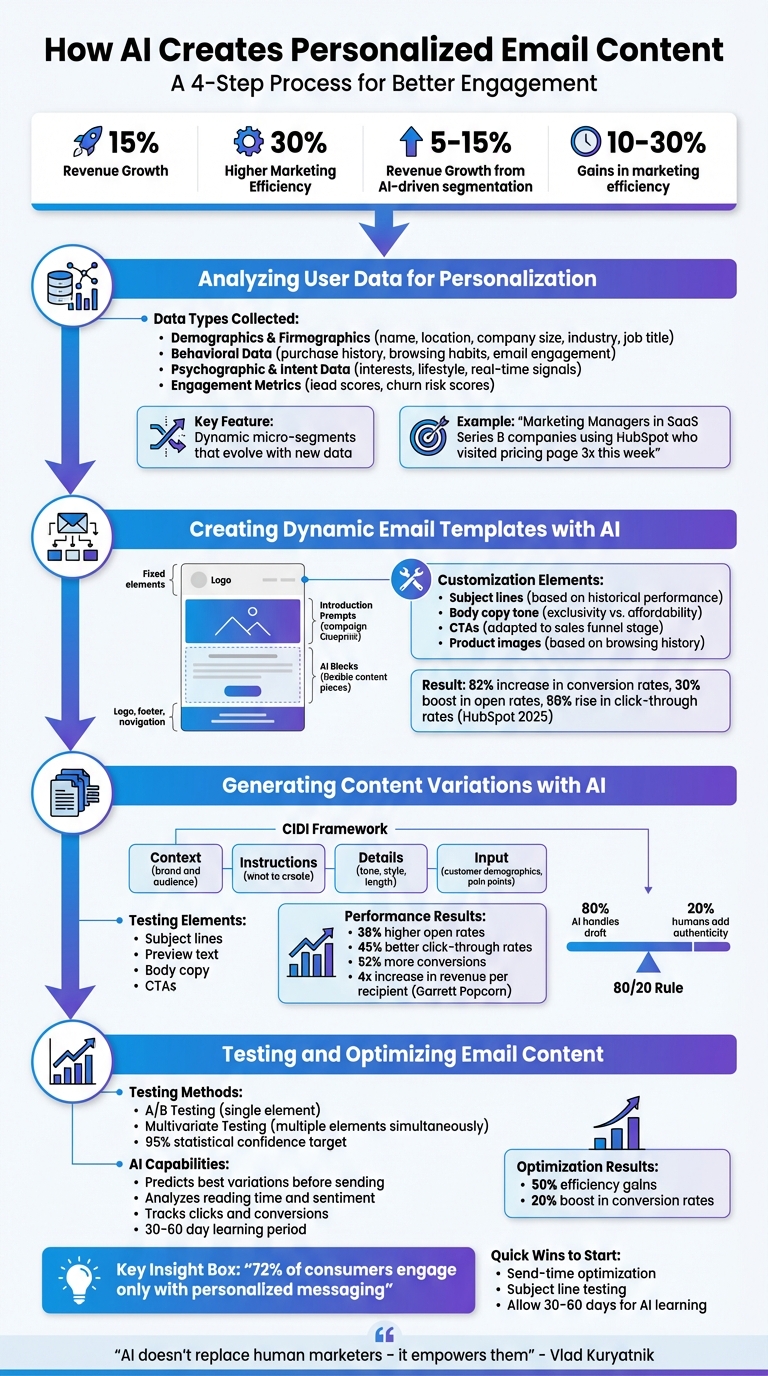
4-Step AI Email Personalization Process: From Data Analysis to Optimization
How to Create Personalized Email Campaigns Using AI Agent
sbb-itb-6e49fcd
Step 1: Analyzing User Data for Personalization
To craft personalized emails, AI relies on a solid foundation of user data. Simply put, the better the data, the better the results. As Sheila Kloefkorn, CEO of KEO Marketing, explains:
“AI quality depends on data quality”.
This means pulling together email engagement metrics, CRM records, website activity, and purchase history to give AI a detailed view of each subscriber.
Types of User Data for Email Segmentation
AI uses various types of data to create detailed user profiles:
- Demographics and firmographics: Basic information like name, location, company size, industry, and job title.
- Behavioral data: Tracks user actions, including purchase history, browsing habits, items saved for later, and email engagement (like opens and clicks).
- Psychographic and intent data: Goes deeper into interests, lifestyle preferences, challenges, and real-time signals like visiting a pricing page or downloading a resource.
- Engagement metrics: Includes lead scores and churn risk scores to help AI predict future behavior.
The strongest strategies blend first-party data – collected directly from sources like your website, CRM, and email platform – with external enrichment tools that add details like firmographics. Many companies use Customer Data Platforms (CDPs) to unify data from emails, websites, and apps, creating a complete, centralized profile for each user. This approach ensures AI works with a full picture rather than fragmented insights.
Using AI for Advanced Segmentation
AI goes beyond traditional segmentation methods. Instead of grouping users into broad categories like “age 25–34” or “California residents”, it creates dynamic micro-segments that evolve as new data comes in. For instance, rather than targeting “all marketing managers”, AI might identify a group like “Marketing Managers in SaaS Series B companies using HubSpot who visited the pricing page three times this week”. These highly specific segments lead to better conversion rates because the messaging aligns closely with the audience’s needs.
Machine learning processes massive amounts of historical and real-time data to uncover patterns that might go unnoticed by humans. Natural Language Processing (NLP) helps analyze customer feedback and sentiment, revealing the emotions behind interactions. Predictive analytics takes things a step further by forecasting behaviors – like identifying which subscribers are likely to churn or upgrade to a premium plan. Businesses that use AI-driven segmentation often experience 5–15% revenue growth and 10–30% gains in marketing efficiency.
One simple yet effective tactic is predictive send-time optimization. Instead of sending emails at the same time to everyone, AI determines the best time for each subscriber based on their past behavior. This small adjustment can significantly boost engagement without requiring changes to the email content itself.
Advanced segmentation like this sets the stage for creating dynamic, personalized email templates, which is the next step in the process.
Step 2: Creating Dynamic Email Templates with AI
After analyzing user data and building segments, the next step is crafting email templates that cater to each group. These templates take your segmented data and transform it into messages that connect with specific audiences. AI makes this process faster and more precise by generating templates that align with your brand’s style while adapting content for individual recipients. The aim? To ditch the one-size-fits-all approach and create emails that feel genuinely relevant.
Building AI-Driven Email Templates
AI starts with your brand’s foundation. By feeding brand guidelines, style preferences, and messaging documents into AI tools, marketers can ensure that every template stays consistent with the brand’s voice – even when producing hundreds of unique variations.
Typically, this involves using a modular HTML template. Fixed elements like your logo, footer, and navigation remain untouched, while dynamic sections – such as hero images, headlines, and body copy – adjust based on the recipient’s data. This setup maintains your brand identity while allowing for personalization where it matters most.
Modern AI email systems focus on two critical components: Introduction Prompts and AI Blocks. The Introduction Prompt serves as the campaign’s blueprint, outlining the strategy, audience, and key messaging. AI Blocks, on the other hand, are the flexible content pieces that adapt to each recipient’s unique profile. As Courtney Smith from 6sense puts it:
“AI Blocks handle individual-level personalization. They adapt to each buyer’s unique data.”
When creating AI prompts, clarity is key. Define your goals, audience segment, lifecycle stage, and context (like CRM data). It’s also helpful to specify constraints, such as word count, and outline the desired tone or voice. Training the AI with examples of your brand voice and clear do’s and don’ts ensures the output remains polished and on-brand.
Once the dynamic blocks are built, the next step is tailoring them to meet the needs of specific audience segments.
Customizing Content for Audience Segments
Dynamic templates connect with your CRM, pulling real-time data to create highly personalized content. Beyond just inserting a recipient’s name, these templates can include company names, industry-specific details, and even references to recent user actions. This level of personalization makes each email feel tailor-made.
AI fine-tunes several key parts of the email. Subject lines can be adjusted based on historical performance, while the body copy shifts its tone and emphasis – for instance, focusing on exclusivity for high-end buyers or affordability for budget-conscious audiences. Calls to action adapt to where the recipient is in the sales funnel, and product images can be selected based on browsing or purchasing history.
Conditional logic, like “if-then” rules, adds another layer of customization. For example, “If Job Title is ‘Manager,’ then highlight X benefit.” Fallback options ensure the email still makes sense if specific data points are missing.
To keep things manageable, limit each AI block to three data fields. Use a preview panel to test how the dynamic template looks for different audience types – such as varying industries, job roles, or company sizes – to catch any inconsistencies before hitting send.
The impact of such personalization is clear. In 2025, HubSpot’s demand generation team used GPT-4 to analyze user behavior and deliver hyper-personalized course recommendations. This approach led to an 82% increase in conversion rates, a 30% boost in open rates, and a 50% rise in click-through rates. Similarly, e-commerce brands that segmented lists based on detailed customer personas reported a 41% jump in revenue per email.
With dynamic templates ready, the next step is creating tailored content variations to maximize engagement.
Step 3: Generating Content Variations with AI
Once you’ve established your dynamic templates, AI takes the reins to create multiple email variations tailored to the unique needs of your audience segments. This step goes beyond basic personalization – it’s about crafting targeted versions of your emails that address specific pain points, preferences, and goals for each segment. The ultimate aim? To test what resonates most effectively, all while staying true to your brand’s voice.
Creating Variations for A/B Testing
AI can quickly produce different versions of key email elements – like subject lines, preview text, body copy, and CTAs (calls to action). This is done using structured prompts that align with your campaign objectives. A helpful approach is the CIDI framework (Context, Instructions, Details, Input), which guides the AI by providing:
- Context about your brand and audience
- Clear instructions for what to create
- Specific details like tone, style, or length
- Input data, such as customer demographics or pain points
For instance, AI can generate several subject line options in seconds. You might try including the recipient’s first name in one, their company name in another, or even experiment with emojis to see what grabs attention. And the results speak for themselves: in 2026, B2B marketers using AI-driven email optimization reported 38% higher open rates, 45% better click-through rates, and 52% more conversions compared to traditional methods.
Real-world examples back this up. In 2025, Massachusetts-based seafood retailer Svenfish credited 82% of their year-to-date revenue to AI-powered tools that simplified content creation and testing. According to Product Manager Sreevats R., these tools not only streamlined operations but also boosted efficiency. Similarly, Garrett Popcorn achieved a 4x increase in revenue per recipient by using AI-driven segmentation to create tailored messaging, outperforming non-segmented campaigns.
The secret lies in the 80/20 rule: let AI handle 80% of the initial draft, then add the final 20% of human editing to ensure the message feels authentic and emotionally engaging. As Tom Bilyeu, CEO of Impact Theory, wisely notes:
“In a world where everyone’s emails sound like AI wrote them, the advantage goes to those who train AI to sound exactly like them”.
Once these variations are generated, AI can layer in real-time user data to make each email even more personalized.
Adding User Context to Variations
AI doesn’t just churn out random variations – it uses real-time user data to ensure every email is relevant. By connecting with your CRM, AI pulls in details like lifecycle stages, engagement history, and recent actions to tailor each version to the recipient’s behavior.
Dynamic content tokens replace generic placeholders with personalized information. Instead of a one-size-fits-all message, your email might reference a recipient’s specific industry challenges, recent website visits, or past purchases. Conditional logic (using “if-then” rules) takes this even further, adjusting the email’s value proposition based on the recipient’s role. For example: “If Job Title is ‘Marketing Manager,’ then emphasize lead generation benefits”.
Behavioral triggers add yet another layer of precision. AI workflows can monitor for specific actions – like visiting a pricing page or abandoning a cart – and automatically generate follow-up emails that are contextually relevant.
To avoid hiccups, always include fallback content for dynamic tokens. If a recipient’s CRM record is missing certain data, the email will still read naturally with backup text. Before hitting send, preview your variations as at least five different contacts to confirm their relevance and accuracy. This extra step ensures your emails hit the mark.
Step 4: Testing and Optimizing Email Content
Once you’ve created personalized email variations, the next crucial step is testing and refining them to ensure your audience gets the best possible content. This process isn’t just about improving performance – it’s about turning testing into an ongoing cycle of improvement. With AI, this step becomes faster and more efficient, identifying top-performing versions in hours rather than days. This allows you to tweak campaigns in real time and phase out content that doesn’t resonate.
A/B and Multivariate Testing with AI
Traditional A/B testing pits two versions of a single element – like one subject line against another – to see which performs better. AI takes this further with multivariate testing, which evaluates multiple elements at once. Think subject lines, images, CTAs, and body copy – all tested simultaneously to find the best combinations for your audience.
AI also handles the heavy lifting by calculating statistical significance (typically aiming for 95% confidence) and minimizing the risk of acting on random data spikes. It even leverages past engagement data to predict which variations will resonate most with specific audience segments before you hit send. Companies using AI-driven testing have reported up to 50% efficiency gains and a 20% boost in conversion rates.
The result? You not only get actionable insights but also a clear direction for improving your content.
Refining Content Based on AI Insights
Testing isn’t a one-and-done process – it’s a cycle where each email informs the next. AI helps by analyzing engagement metrics like reading time and response sentiment to fine-tune future content automatically. To make the most of this, it’s important to perform website AB testing by testing one variable at a time – such as tweaking a CTA or shortening a subject line – so you can clearly see what’s working.
By tracking clicks and conversions back to specific AI-generated suggestions in your CRM, you can identify patterns that work and feed those successes back into your AI system. Keep in mind that AI tools often need a learning period of 30–60 days to hit their stride.
One marketer using Salesforce shared this insight:
“Instead of testing only subject lines, I can also test user behavior, allowing me to be more strategic with every send”.
This strategic advantage comes from treating AI as a collaborative partner. While AI handles testing, metrics, and pattern recognition, human oversight remains crucial for sensitive content like pricing or compliance. This balance ensures your campaigns stay aligned with your brand voice while benefiting from AI’s precision.
Using AI Tools for Email Optimization
Once you’ve created and tested personalized email variations, tools like PageTest.AI can take your campaigns a step further by refining the content on your landing pages. These AI-powered platforms, accessible even through no-code solutions, enable marketers to quickly generate and test email variations. They can also analyze CRM data – like customer lifecycle stages and engagement history – ensuring content aligns with actual buyer behavior. This streamlined process builds on the testing strategies already discussed.
Using PageTest.AI for Content Variations
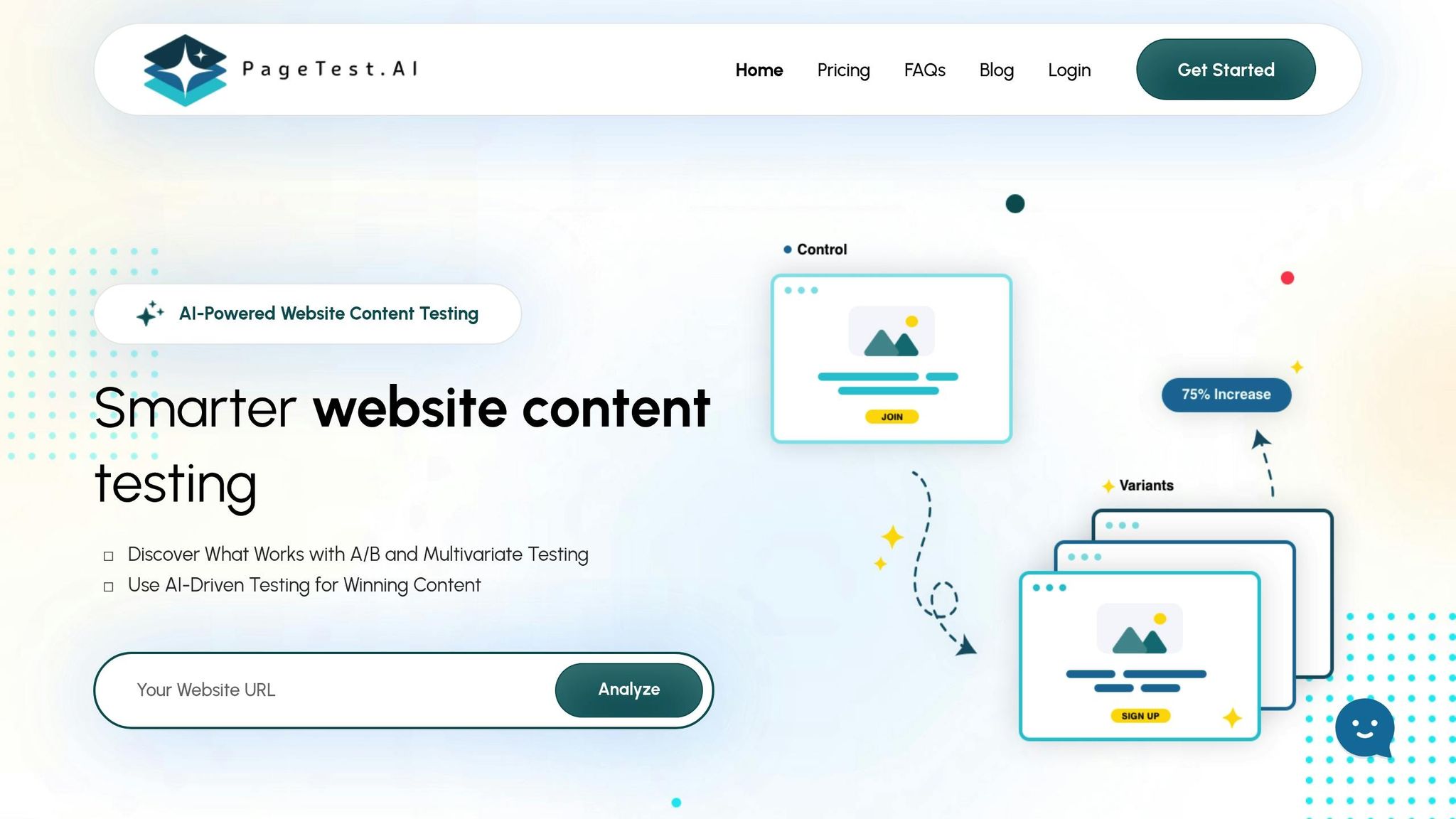
PageTest.AI simplifies the process of optimizing landing pages and lead capture forms connected to your email campaigns. With its Chrome extension, you can click on any text element – like headlines, CTAs, or body copy – and instantly generate AI-suggested variations, making testing more approachable.
To integrate PageTest.AI, you can either add a lightweight JavaScript snippet to your site or use their WordPress plugin. Testing has shown the snippet doesn’t harm site performance; in fact, performance scores often remain steady or slightly improve. Dave Swift, founder of DaveSwift.com, shared his thoughts:
“It’s a genuinely useful tool that makes A/B testing and multivariate testing accessible to people who would otherwise never bother with it”.
PageTest.AI focuses solely on text-based testing, so it doesn’t support images, colors, or layout changes. To get the most out of it, prioritize testing high-impact elements like headlines and primary CTA buttons. The platform also includes a priority system to manage traffic allocation when running multiple tests at once. Once you’ve explored its features, you can review the pricing plans to find the best fit for your business.
PageTest.AI Pricing and Plans
PageTest.AI offers four pricing tiers tailored to different business needs:
| Plan | Monthly Price | Test Impressions | Tests | Pages | Websites | Ideal For |
|---|---|---|---|---|---|---|
| Starter | $299 | 10,000 | Unlimited | Unlimited | Unlimited | Individuals and small teams |
| Growth | $499 | 50,000 | Unlimited | Unlimited | Unlimited | Growing teams needing seats + video support |
| Done For You | $1,999 | Unlimited | Unlimited | Unlimited | Unlimited | Agencies managing multiple clients, full setup done for you |
Every plan includes unlimited pages, tests and websites — the only difference between tiers is monthly test-impression volume, and every plan starts with a 5-day free trial that requires a card at signup. The Starter plan at $299 per month is a budget-friendly way in at 10,000 impressions. If your business is scaling, the Growth plan at $499 per month provides 50,000 impressions with team seats and video call support. Meanwhile, marketing agencies can benefit from the Done For You plan at $1,999 per month, which supports unlimited impressions and has setup handled for you.
Conclusion
AI has reshaped how marketers approach personalized email campaigns. By analyzing customer data, creating dynamic templates, generating content variations, and continuously testing performance, AI transforms email marketing from a manual process into a predictive and tailored customer engagement strategy. Businesses using AI-driven personalization are seeing measurable improvements across key metrics, highlighting the technology’s real-world impact on campaign success.
The magic happens when AI’s analytical capabilities are paired with human creativity and oversight. As Vlad Kuryatnik, Digital Marketing Consultant, aptly states:
“AI doesn’t replace human marketers – it empowers them”.
AI takes care of data-heavy tasks like analysis and content generation, while humans focus on maintaining the brand’s voice and emotional connection with the audience. This collaboration paves the way for immediate improvements in campaign performance.
If you’re just starting, focus on quick wins like predictive send-time optimization and subject line testing. These often deliver the fastest and most noticeable ROI. Platforms like PageTest.AI can extend these optimizations to landing pages, enabling you to test headlines, CTAs, and body copy with AI-generated variations. The no-code setup makes it easy for anyone, even without prior testing experience, to run A/B tests. Keep in mind, the effectiveness of AI relies heavily on data quality. Consolidating email engagement data with CRM records and website behavior gives AI the foundation it needs to make accurate predictions. Allow 30–60 days for AI systems to gather enough behavioral data to reach peak performance.
With 72% of consumers engaging only with personalized messaging, the future of email marketing belongs to brands that embrace AI while retaining human insight. Adopting AI tools quickly is no longer optional if you want to stay ahead. By blending AI’s precision with human creativity, marketers can not only enhance email campaigns but also improve the entire digital experience, using tools like PageTest.AI to drive results across the board.
FAQs
What data do I need to start AI email personalization?
To get started with AI-driven email personalization, the first step is collecting customer data that sheds light on their behavior, preferences, and actions. Some crucial data points include browsing history, purchase history, engagement metrics, and location. This information allows AI tools to segment your audience, craft content that feels tailored to individual recipients, and even anticipate future actions. Together, these elements lay the groundwork for creating impactful, personalized email campaigns.
How do dynamic email templates change per recipient?
Dynamic email templates use AI to personalize content for each recipient. By analyzing data such as user behavior, preferences, and demographics, AI crafts tailored elements like customized subject lines or product recommendations. These templates also test different content variations and refine them based on performance metrics like open rates and click-through rates. The result? Emails that adapt in real-time to each recipient, making them more engaging and increasing the chances of conversion.
How long does AI testing take to improve results?
The time it takes to refine AI results depends on your objectives and how much data you’re working with. Generating initial content is quick – AI can do this in just seconds. But when it comes to fine-tuning, like running A/B tests, you’re looking at days or even weeks. This is because gathering enough data to reach meaningful conclusions takes time. While AI accelerates many steps, making noticeable progress relies on continuous analysis and achieving statistical significance.
Related Blog Posts
say hello to easy Content Testing
try PageTest.AI tool for free
Start making the most of your websites traffic and optimize your content and CTAs.
Related Posts

31-08-2026
 Becky Halls
Spiralyze alternatives: CRO agency or software in 2026?
Spiralyze makes an offer that’s hard to argue with. “30% lift in 90 days. No fee until we deliver.” More precisely: 10 tests, 3 wins, more than 30% lift in your first 90 days, and you pay nothing until they’ve done it. I’ll say plainly what most competitor pages wouldn’t. On risk alone, that’s a better offer than […]

31-08-2026
Becky Halls
AB Tasty alternatives: an honest comparison for 2026
AB Tasty is a strong platform with a well-liked support team, sitting at 4.4 on G2 across 418 reviews. Reviewers on TrustRadius describe it as better value than pricier AB Tasty alternatives, which in this category is a real compliment. It also has the most unusual buying process here. No published pricing, and no free […]

31-08-2026
Becky Halls
The best Optimizely alternative: a comparison for 2026
Optimizely is the most capable experimentation platform on the market. I don’t think that’s seriously disputed. Server-side testing, feature flags, personalization, statistical depth, and it all runs at genuine enterprise scale. In 2026 they’ve wrapped the whole thing in “agentic experimentation” branding and shipped an AI variation development agent, and the underlying Web Experimentation product […]