


Expert Guide: What is LLM.txt?
Expert Guide: What is LLM.txt?
 21-08-2025 (Last modified: 07-09-2026)
Why LLM.txt is Suddenly a Big Deal
Remember when robots.txt felt like a nerdy side file only devs cared about? Well, say hello to its AI-savvy cousin: LLM.txt.
In 2025, Large Language Models (LLMs) like ChatGPT, Claude, and Gemini aren’t just scraping the web – they’re answering for it. If you want your site’s content to play nice (or play at all) with AI tools, you need to give them a roadmap.
And that’s where LLM.txt comes in! Think of it as:
-
📖 A guidebook telling AI what your site is about
-
🛡️ A filter on what should (or shouldn’t) be used
-
🎯 An opportunity to get your content positioned in AI answers
Google, OpenAI, Anthropic are all looking at these files and I think it’s safe to say others will follow suit. You could choose to ignore it and hope it goes away BUT your site then risks becoming invisible in the AI search era.
How to Create Your LLM.txt File
LLM.txt isn’t rocket science and pretty much anyone can create the file if you follow the simple steps outlined below. It’s literally just a plain text file you drop into your site’s root directory. Let’s walk it out…
Step 1: Fire up a text editor
Open Notepad, VS Code, or even the classic TextEdit. Save the file as:
Step 2: Add your instructions
Here’s a starter template:
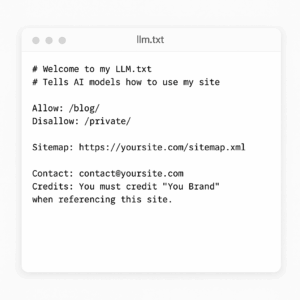
What’s happening here?
-
✅ “Allow” gives AI free reign to use certain content.
-
🚫 “Disallow” blocks areas (like private dashboards).
-
🗺️ “Sitemap” points AI to the good stuff.
-
✍️ “Credits” & “Contact” give transparency (and maybe backlinks 👀).
Step 3: Upload to your root domain
Pop the file into your site’s main directory (same place as robots.txt).
So if your domain is:
You should now have:
https://yoursite.com/llm.txt
Step 4: Test it
Open your browser, type in the URL, and confirm it’s visible. If you see your LLM.txt rules? Congrats, you’re officially AI-crawl ready!!
Why Bother With LLM.txt?
-
Future-proofing: As AI search grows, this becomes a trust + authority signal.
-
Control: Decide what AI models can chew on.
-
Credits: Potential to secure attribution back to your brand.
-
SEO synergy: Works alongside your
robots.txtand sitemap for full coverage.
Over 70% of marketers now expect AI-driven search engines to become the #1 way people discover content in the next 2 years (Source: BrightEdge).
FAQ: LLM.txt Made Simple
Q: Do I need LLM.txt if I already have robots.txt?
A: Yep. Robots.txt is for crawlers; LLM.txt is specifically for AI models. They’re cousins, not twins.
Q: Can I block AI models completely?
A: Technically, yes – use “Disallow: /” in LLM.txt. But be warned: that means your site won’t appear in AI answers.
Q: Will this guarantee backlinks from AI tools?
A: No guarantees (yet). But adding “Credits” is a smart nudge, and some AI providers have signaled they’ll respect it.
Q: Where should I put the file?
A: Root directory of your site, same as robots.txt. Example: https://yoursite.com/llm.txt.
Q: Can I list multiple sitemaps?
A: Of course! Just add more “Sitemap:” lines.
Final Word
AI search is rewriting the SEO rulebook. If robots.txt was your way of whispering to Googlebot, then LLM.txt is your way of shouting “Hey ChatGPT, this is who we are and how we want to be seen.”
So don’t wait. Spin up that file, drop it in your root, and claim your place in the AI search era. For the fuller LLM.txt walkthrough, 3way covers the setup step by step.
Because in 2025, being invisible to humans is bad. But being invisible to AI? Fatal.
say hello to easy Content Testing
try PageTest.AI tool for free
Start making the most of your websites traffic and optimize your content and CTAs.
Related Posts

31-08-2026
 Becky Halls
Spiralyze alternatives: CRO agency or software in 2026?
Spiralyze makes an offer that’s hard to argue with. “30% lift in 90 days. No fee until we deliver.” More precisely: 10 tests, 3 wins, more than 30% lift in your first 90 days, and you pay nothing until they’ve done it. I’ll say plainly what most competitor pages wouldn’t. On risk alone, that’s a better offer than […]

31-08-2026
Becky Halls
AB Tasty alternatives: an honest comparison for 2026
AB Tasty is a strong platform with a well-liked support team, sitting at 4.4 on G2 across 418 reviews. Reviewers on TrustRadius describe it as better value than pricier AB Tasty alternatives, which in this category is a real compliment. It also has the most unusual buying process here. No published pricing, and no free […]

31-08-2026
Becky Halls
The best Optimizely alternative: a comparison for 2026
Optimizely is the most capable experimentation platform on the market. I don’t think that’s seriously disputed. Server-side testing, feature flags, personalization, statistical depth, and it all runs at genuine enterprise scale. In 2026 they’ve wrapped the whole thing in “agentic experimentation” branding and shipped an AI variation development agent, and the underlying Web Experimentation product […]