


Website Content Readability Checker
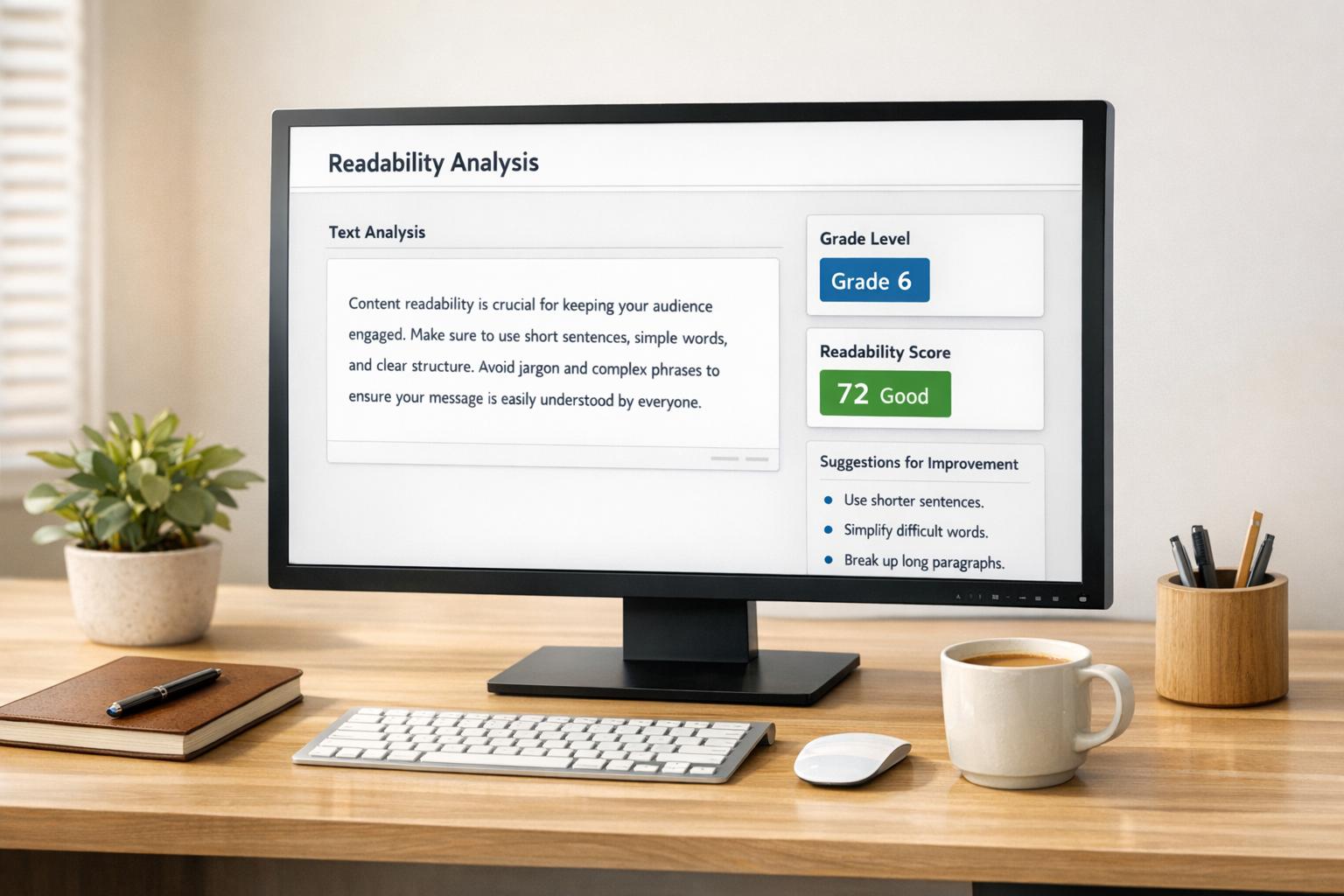
Website Content Readability Checker
 27-12-2025 (Last modified: 09-01-2026)
Make Your Content Easier to Read with a Website Content Readability Checker
Good content fails more often because it’s hard to read than because it’s badly written. A website content readability checker helps you spot where your writing creates friction and shows you how accessible your content really is for real users.
Quick snapshot:
-
A website content readability checker measures how easy your content is to understand
-
Highlights long sentences, dense wording, and unnecessary complexity
-
Helps align your writing with your actual audience, not an imagined one
-
Useful for blogs, landing pages, product pages, and documentation
We’ve reviewed plenty of pages where the ideas were solid, but the delivery made people work too hard. Readability fixes often improve engagement faster than any design change.
Why readability is a performance issue, not a writing one
Readability isn’t about intelligence. It’s about effort. The harder someone has to work to understand your content, the more likely they are to leave.
A website content readability checker helps answer simple but critical questions:
-
Can users grasp the main point quickly?
-
Are sentences doing too much work?
-
Is jargon creeping in without explanation?
-
Does the structure help scanning, or block it?
Studies consistently show that users skim first and decide later. Most people read around 20–30% of a page on average. If your key message is buried inside long paragraphs, it won’t land.
In our experience, reducing sentence length and tightening introductions alone often improves scroll depth and time on page without changing a single idea.
What a website content readability checker actually measures
A website content readability checker analyses your text using established readability formulas, including:
-
Flesch-Kincaid Grade Level
These formulas look at:
-
sentence length
-
word complexity
-
syllable density
-
overall text structure
You paste in your content and get an immediate breakdown of how demanding it is for the reader.
We’ve seen content written for “general audiences” regularly score at university level. That gap explains why engagement sometimes underperforms even when traffic looks healthy.
What readability scores really mean in practice
Readability scores aren’t about passing or failing. They’re about alignment.
As a rough guide:
-
Grade 6–8
Clear, accessible, and suitable for most web content. -
Grade 9–12
Fine for more informed or professional audiences, but requires strong structure. -
Above Grade 12
Often signals unnecessary complexity for most marketing and informational pages.
The useful part isn’t the number itself. It’s where spikes appear. If certain sections jump dramatically in difficulty, that’s usually where users slow down or drop off.
We’ve found the best-performing content often sits slightly simpler than the audience expects. Clarity almost always wins.
Common readability issues the checker uncovers
A website content readability checker regularly flags issues like:
-
overly long sentences
-
stacked clauses and filler phrases
-
heavy jargon without context
-
dense blocks of text
-
weak paragraph structure
These problems rarely come from bad writing. They come from trying to say too much at once.
We’ve improved engagement simply by breaking one paragraph into three and removing a handful of unnecessary words. The meaning stayed the same. The friction disappeared.
How to improve readability without dumbing things down
After running your content through the checker, focus on small, practical changes:
-
shorten sentences
-
swap complex words for simpler ones where possible
-
break up long paragraphs
-
use subheadings to guide scanning
-
remove filler phrases
-
read sections out loud to catch awkward flow
Readability isn’t about stripping depth. It’s about making depth easier to access.
In our experience, the strongest content feels effortless to read, even when the ideas are complex.
Why readability supports engagement, SEO, and AI visibility
Search engines and AI systems increasingly favour content that:
-
clearly answers questions
-
keeps users engaged
-
is easy to summarise and reference
A strong website content readability checker score aligns naturally with these outcomes. Clear content is easier for users to consume and easier for AI systems to process, summarise, and recommend.
We’ve noticed clearer content lead to more stable performance during algorithm changes, especially when competing pages were dense or overwritten.
FAQs
What is a website content readability checker?
It’s a tool that analyses how easy your content is to read using established readability formulas, helping you adjust tone, structure, and complexity.
Does readability affect SEO directly?
Not directly, but it strongly affects engagement, which influences how content performs over time. Clearer content tends to keep users on the page longer.
Is simpler always better?
Not always, but clearer almost always is. The goal is to match the reading level to your audience and purpose, not to oversimplify.
say hello to easy Content Testing
try PageTest.AI tool for free
Start making the most of your websites traffic and optimize your content and CTAs.
Related Posts

09-10-2026
 Becky Halls
VWO and AB Tasty Are Now Wingify: What the Merger Actually Means for Your Testing Stack
If you run A/B tests on VWO or AB Tasty, you’ve probably noticed the logins moved, the branding changed, and a new name, Wingify, started showing up in your inbox. Here’s what actually happened, what’s still unclear, and where a smaller, published-price tool like PageTest.AI fits if you’re reconsidering your stack because of it. The […]

31-08-2026
Becky Halls
Spiralyze alternatives: CRO agency or software in 2026?
Spiralyze makes an offer that’s hard to argue with. “30% lift in 90 days. No fee until we deliver.” More precisely: 10 tests, 3 wins, more than 30% lift in your first 90 days, and you pay nothing until they’ve done it. I’ll say plainly what most competitor pages wouldn’t. On risk alone, that’s a better offer than […]

31-08-2026
Becky Halls
AB Tasty alternatives: an honest comparison for 2026
AB Tasty is a strong platform with a well-liked support team, sitting at 4.4 on G2 across 418 reviews. Reviewers on TrustRadius describe it as better value than pricier AB Tasty alternatives, which in this category is a real compliment. It also has the most unusual buying process here. No published pricing, and no free […]