


User Behavior Impact Calculator
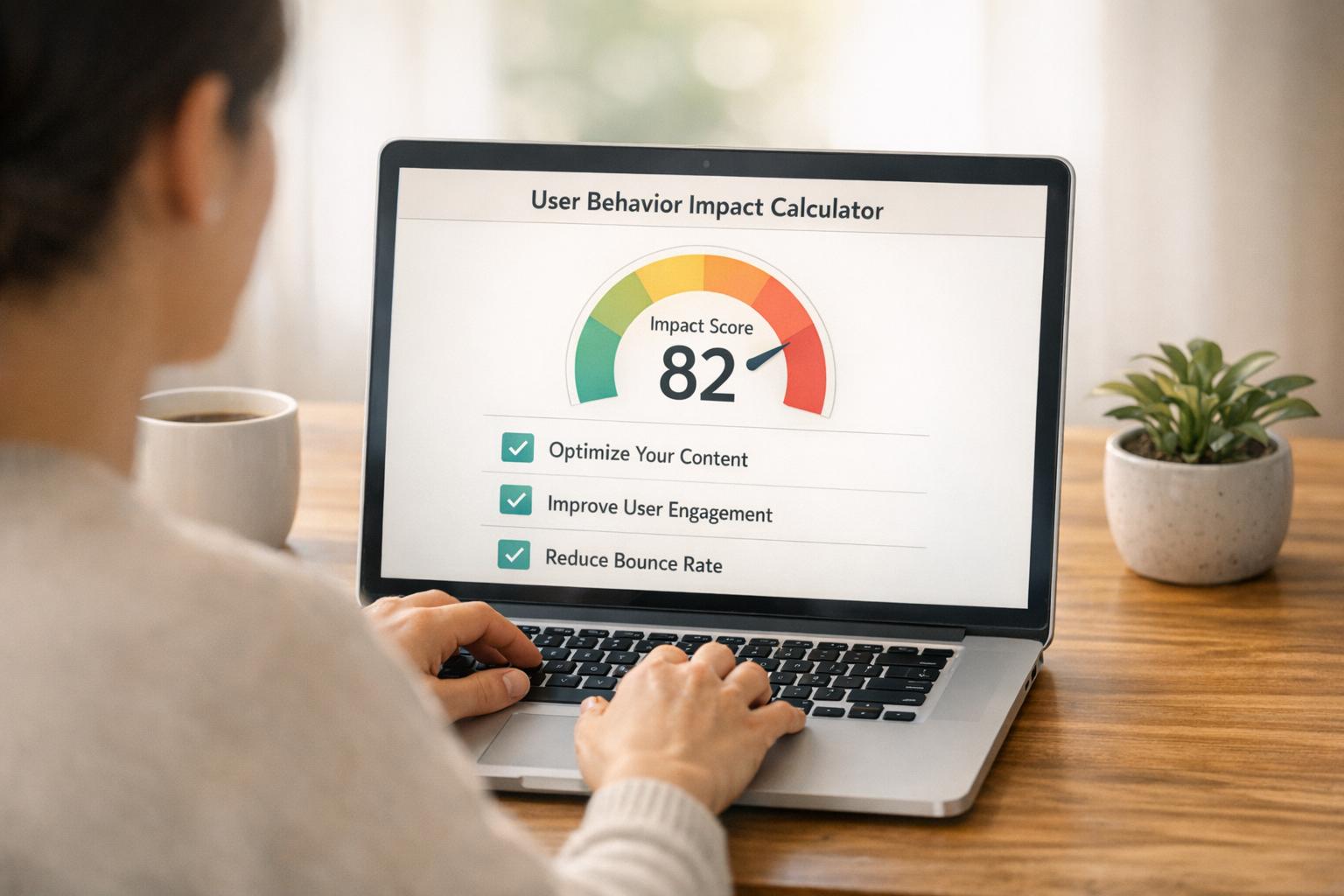
User Behavior Impact Calculator
 10-02-2026 (Last modified: 16-02-2026)
Unlock Website Success with User Behavior Insights
Traffic is easy to measure. Revenue is obvious.
What sits in between is where most businesses lose clarity.
That middle layer – user behaviour – is what actually determines whether visitors convert or disappear.
A User Behavior Impact Calculator helps you quantify how changes in engagement metrics affect your bottom line. Instead of treating bounce rate, time on page, or click-through rate as abstract numbers, you see their real business impact.
Because behaviour isn’t just a metric… It’s leverage.
Why does user behaviour matter more than traffic?
More traffic doesn’t automatically mean more customers.
You can double visitors and see no revenue change if:
-
bounce rate stays high
-
CTAs aren’t clicked
In our experience, improving user behaviour metrics often delivers better ROI than increasing traffic volume.
We’ve seen sites increase revenue simply by improving engagement by a few percentage points. The traffic stayed the same. The behaviour improved.
That’s the difference between growth and noise.
What does a User Behavior Impact Calculator actually measure?
A User Behavior Impact Calculator connects engagement metrics to financial outcomes.
It helps you model how changes in:
-
bounce rate
-
click-through rate
-
time on page
-
interaction depth
-
conversion rate
…translate into revenue impact.
Instead of asking:
“How do we reduce bounce rate?”
You start asking:
“If bounce rate drops by 5%, how much more revenue could that produce?”
That shift changes how teams prioritise optimisation.
How do small behaviour changes create big revenue shifts?
Small improvements compound.
For example:
-
A 3% lift in click-through
-
A 4% lift in on-page engagement
-
A 2% lift in conversion
Individually, those feel minor. Together, they can significantly increase revenue without any additional ad spend.
We’ve seen teams focus on headline tweaks, CTA placement, or layout adjustments and unlock disproportionate results. Becky Halls, Strategist at PageTest.ai
The key isn’t redesigning everything. It’s reducing friction in the right place.
Why do businesses underestimate behavioural impact?
Because behaviour feels soft.
Revenue feels concrete. Rankings feel visible. Engagement feels abstract.
In reality:
-
Behaviour predicts conversion
-
Engagement signals friction
-
Click patterns reveal confusion
We’ve found that engagement metrics often move before revenue does. They act as early indicators. Ian Naylor, Founder at PageTest.ai
When scroll depth drops, conversions often follow. When click maps show hesitation, signups stall soon after.
The calculator helps make that connection visible.
How should you use a User Behavior Impact Calculator?
A practical workflow looks like this:
-
Gather baseline metrics
Bounce rate, CTR, conversions, revenue. -
Model realistic improvements
What happens if bounce drops 5%?
What if CTR improves 3%? -
Identify the highest-leverage metric
Which behaviour change moves revenue most? -
Test one variable at a time
Headlines, CTAs, layout, structure. -
Recalculate and refine
In our experience, this process prevents wasted effort. Instead of optimising randomly, you focus where impact is highest.
Where does testing fit into behaviour optimisation?
Testing turns projections into proof.
Once you’ve identified which behavioural metric has the biggest potential impact, you can test:
-
headline clarity
-
CTA wording
-
page structure
-
section order
-
trust signals
-
form length
We’ve seen behavioural gains come from surprisingly small adjustments – moving a CTA, clarifying a benefit, shortening an intro.
The calculator gives you the “why.”
Testing gives you the “what works.”
Can this work for small businesses too?
Absolutely.
You don’t need millions of visitors. Behaviour modelling works at any scale because it’s about percentage change, not raw numbers.
For smaller businesses, behavioural optimisation is often the fastest way to grow without increasing ad spend.
In our experience, smaller sites benefit even more because improvements are easier to measure and implement.
Final takeaway
If you’re serious about growth, stop asking only:
“How do we get more traffic?”
Start asking:
“What happens if more of our existing visitors behave differently?”
A User Behavior Impact Calculator helps you see the revenue impact behind engagement metrics.
Because better behaviour isn’t a vanity improvement.
It’s a growth strategy.
say hello to easy Content Testing
try PageTest.AI tool for free
Start making the most of your websites traffic and optimize your content and CTAs.
Related Posts

31-08-2026
 Becky Halls
Spiralyze alternatives: CRO agency or software in 2026?
Spiralyze makes an offer that’s hard to argue with. “30% lift in 90 days. No fee until we deliver.” More precisely: 10 tests, 3 wins, more than 30% lift in your first 90 days, and you pay nothing until they’ve done it. I’ll say plainly what most competitor pages wouldn’t. On risk alone, that’s a better offer than […]

31-08-2026
Becky Halls
AB Tasty alternatives: an honest comparison for 2026
AB Tasty is a strong platform with a well-liked support team, sitting at 4.4 on G2 across 418 reviews. Reviewers on TrustRadius describe it as better value than pricier AB Tasty alternatives, which in this category is a real compliment. It also has the most unusual buying process here. No published pricing, and no free […]

31-08-2026
Becky Halls
The best Optimizely alternative: a comparison for 2026
Optimizely is the most capable experimentation platform on the market. I don’t think that’s seriously disputed. Server-side testing, feature flags, personalization, statistical depth, and it all runs at genuine enterprise scale. In 2026 they’ve wrapped the whole thing in “agentic experimentation” branding and shipped an AI variation development agent, and the underlying Web Experimentation product […]