


5 Benefits of AI-Generated Landing Page Variations

5 Benefits of AI-Generated Landing Page Variations
 24-03-2026 (Last modified: 29-09-2026)
AI-generated landing pages are transforming digital marketing by making it faster and easier to create, test, and optimize content. Here’s why they matter:
- Boost Conversion Rate Optimization: AI helps test and refine headlines, CTAs, and layouts, leading to strategies to increase site conversion by up to 36%. Personalized CTAs can perform 202% better than generic ones.
- Save Time: Generate and test landing page variations up to 10x faster. No coding or technical skills needed.
- Tailored Personalization: AI adjusts content dynamically for different audience segments, improving engagement and sales by up to 30%.
- Data-Driven Insights: Real-time analytics highlight what works and why, enabling smarter decisions.
- Cross-Platform Optimization: AI ensures responsive designs and faster load times, critical for mobile users who now drive over 80% of traffic.
AI tools like PageTest.AI simplify this process, offering no-code solutions that deliver results quickly. Whether you’re a small business or an enterprise, these tools make it easier to improve performance and grow revenue.
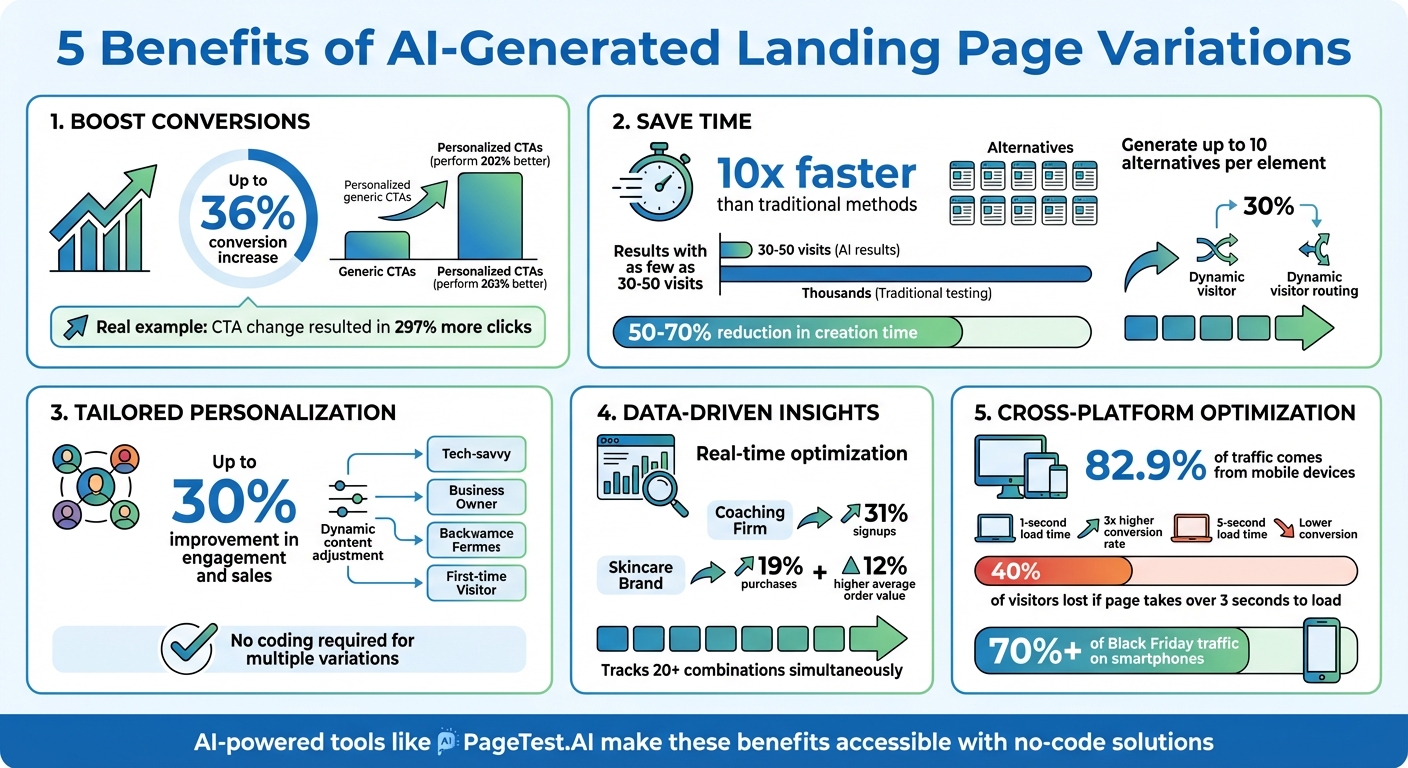
5 Key Benefits of AI-Generated Landing Pages: Statistics and Performance Metrics
We Used AI to Build the World’s Best Landing Page – in Minutes
sbb-itb-6e49fcd
1. Higher Conversion Rates
Using AI to create landing page variations can directly lead to more conversions. Instead of relying on guesswork to decide which headline or call-to-action (CTA) will work best, AI allows you to test multiple versions and analyze real visitor behavior to find the top performer. By examining metrics like scroll depth, time spent on the page, and click activity, AI identifies which elements drive the most engagement. This data-driven approach often translates into impressive results.
For instance, Unbounce Smart Traffic has shown that dynamically routing visitors can increase conversions by 30%. Broader studies suggest conversion improvements of up to 36%. HubSpot’s analysis of 93,000 CTAs revealed that personalized CTAs outperform generic ones by a massive 202%.
Real-world examples back up these findings. Winc, a wine subscription service, saw better results after adding a delivery box to its hero image, making its value proposition clearer. In another case, changing a CTA from “Generate my app free” to “Make my app free and easy” boosted clicks by an incredible 297%.
Unlike traditional A/B testing, which can take weeks to yield results, AI optimizes continuously in real time. It learns from each user interaction, directing more traffic to the versions that perform better. This means you can start seeing higher conversions almost immediately.
To get the most out of AI, focus on conversion optimization strategies like testing small but impactful changes in your messaging. Use AI to refine elements like headlines, hero copy, and CTAs while staying true to your brand’s voice. You could try swapping hero images (e.g., product shots vs. lifestyle visuals), experimenting with different layouts, or tailoring CTAs for specific audience segments. Even businesses with lower traffic can benefit since AI quickly identifies winning variations, making advanced testing accessible to everyone. Tools like PageTest.AI simplify this process by offering no-code solutions for generating and optimizing landing page variations.
2. Faster Page Creation and Testing
Creating and testing landing pages the old-fashioned way can take weeks. Designers draft mockups, developers code variations, and copywriters craft alternate messaging. By the time everything is ready, market conditions might have already shifted. AI changes the game entirely, slashing this timeline by generating professional-quality landing pages up to 10x faster than traditional methods.
AI streamlines the process by combining automated content generation with no-code tools. With a simple point-and-click interface, you can instantly create and deploy multiple test variations – no coding or technical expertise required. Instead of spending hours tweaking headlines or crafting different call-to-action (CTA) options, AI can generate up to 10 alternatives for any element you’re testing, providing significant AB testing benefits for business growth. For example, in March 2026, PageTest.AI ran automated tests on four websites, generating 187 content variations that garnered 11,000 impressions – all without any manual coding or developer assistance.
“As a marketer I have struggled so much with AB testing… I love that you have a chrome extension, it makes it so much easier!”
- Werner Geyser, Founder of Influencer Marketing Hub
PageTest.AI’s Chrome extension makes testing even simpler. Marketers can highlight elements directly on live web pages – like headlines, buttons, or product descriptions – and launch tests in just minutes. This eliminates the need for lengthy preparation and lets you focus on results.
Another key advantage is how quickly AI can deliver meaningful insights. While traditional A/B testing often requires thousands of visitors to achieve statistical significance, AI-powered systems can start optimizing performance with as few as 30 to 50 visits. This makes advanced testing accessible even for businesses with lower traffic, saving months of waiting and enabling quicker decision-making.
“It’s never been easier, code-free website content testing, just point and click simple!”
- David Hall, CEO of AppInstitute
3. Better Personalization for Different Audiences
AI doesn’t just speed up content creation; it also makes personalization far more effective by tailoring landing pages to different audience segments. Think about it: a small business owner hunting for a quick fix has completely different needs than an enterprise buyer planning long-term investments. Traditional landing pages often treat every visitor the same, but AI flips the script. By analyzing user data – like location, browsing behavior, referral source, and demographics – it can dynamically adjust elements like headlines, images, and CTAs to better suit each segment’s preferences.
And the results? They speak for themselves. AI-driven visitor routing can increase sales and signups by as much as 30% by matching visitors to the most relevant page variation for their profile. This level of personalization doesn’t just meet individual needs – it also delivers the kind of conversion improvements we touched on earlier.
Take PageTest.AI, for instance. It allows you to create multiple tailored variations of your content without writing a single line of code. Imagine testing role-specific CTAs like “Schedule Enterprise Demo” — pointing prospects to an evergreen booking flow like Webinar Flow — for larger buyers versus “Start Free Trial” for smaller businesses. AI handles the heavy lifting by generating up to 10 alternatives for any element and tracking which versions resonate best with specific audience groups.
Now, manually creating 20+ landing pages? That’s a tall order for most teams. But AI simplifies this, using automated workflows and proven conversion rate optimization methods to optimize content. It dynamically allocates traffic to the highest-performing variations, all while cutting creation time by 50–70%. Features like dynamic content blocks adjust messaging in real time based on visitor attributes, ensuring each person gets the most relevant version of your page.
To make the most of this, start by segmenting your audience using the user data you already have. Then, let AI handle the rest: generating controlled variants around your core messaging, swapping in dynamic content blocks, and analyzing performance metrics to identify what works best for each group. This data-driven strategy eliminates guesswork and keeps optimization running smoothly across all platforms.
4. Data-Driven Optimization and Insights
AI takes testing to the next level by not just generating variations but also explaining why certain versions outperform others. Traditional A/B testing might tell you which page “won”, but it often leaves you guessing about user behavior. AI changes the game by analyzing user actions – like where they click, how far they scroll, and when they leave – giving you a full picture of what’s happening on your site.
One of AI’s standout advantages is speed. Instead of waiting weeks for results, you get real-time updates on issues like sudden spikes in mobile bounce rates. For example, a business coaching firm running lead generation campaigns in June 2025 discovered, through AI, that Facebook ad visitors were abandoning a six-field intake form. Despite high engagement with testimonials, this form was a roadblock. By cutting the form down to three fields and moving testimonials higher on the page, the firm saw a 31% boost in completed signups in just 10 days. Similarly, an online skincare brand used AI to spot high exit rates on pages featuring ingredient lists. By placing customer reviews directly below the ingredients and tweaking the CTA color for mobile users, they achieved a 19% jump in purchases and a 12% increase in average order value within a week.
These examples highlight how AI-powered analytics turn insights into measurable results. Tools like PageTest.AI track key metrics such as click-through rates, scroll depth, time spent on pages, and specific URL visits. In one case, the platform tested 187 content variations across over 11,000 impressions, analyzing more than 20 combinations of images, headlines, and CTAs simultaneously. This level of precision revealed which element pairings drove the most engagement.
AI-driven heatmaps are also incredibly useful for pinpointing problem areas, like steep drop-offs in scroll depth, before you even start running paid traffic. Segment-specific insights can help you fine-tune your content hierarchy. For instance, if AI shows that a particular audience prioritizes security, you can move trust signals higher on the page for those visitors.
“AI doesn’t remove the need to test, but it makes testing more targeted, data-backed, and continuous.”
- Swami, Author
With AI, every visitor interaction becomes a learning opportunity, making optimization smarter and more precise. This data-driven approach eliminates guesswork and ensures consistent, measurable improvements.
5. Easy Testing Across Multiple Platforms
Optimizing landing pages for every device manually can be a real time sink. AI takes the hassle out of this process by automatically generating responsive designs that adjust seamlessly to different screen sizes – no extra effort required. This feature is especially crucial since 82.9% of all landing page traffic now comes from mobile devices, and over 70% of U.S. Black Friday traffic happens on smartphones. Responsive designs not only improve user experience but also contribute to faster load times, which are essential for boosting conversions.
Here’s a compelling stat: a B2B landing page that loads in just 1 second can achieve a conversion rate up to three times higher than one that takes 5 seconds to load. AI tools ensure lean performance by automatically compressing images and optimizing code, which keeps your pages loading fast. And it’s worth noting – pages that take over 3 seconds to load can lose up to 40% of visitors. These speed improvements make a big difference, especially when you’re catering to users across multiple platforms.
“Smart Traffic… automatically routes each visitor to the landing page where our algorithm says they’re most likely to convert.” – Unbounce
AI-powered platforms also excel at personalizing and optimizing traffic distribution. They analyze factors like device type, location, and referral source, and they can start delivering actionable insights with as few as 30–50 visits, unlike traditional testing methods that require thousands of visits to be effective.
Tools like PageTest.AI integrate effortlessly with platforms such as WordPress, Wix, and Shopify. They track metrics like scroll depth and click-through rates across devices, helping you identify issues like forms that work fine on desktop but fail on iOS. By adopting a “thumb-first” design approach and testing under real mobile data speeds – not just office Wi-Fi – you can ensure a smooth and consistent experience for every visitor, regardless of how they access your site.
Conclusion
AI-generated landing page variations have become a game-changer for marketers, offering a faster, more cost-effective way to stay competitive. With tools that enable instant content creation, automated testing, and real-time personalization, tasks that once took entire teams months to complete can now be done in a fraction of the time.
Statistics back up the effectiveness of this approach. Personalized experiences can increase conversions by up to 36%, while targeted calls-to-action (CTAs) can boost engagement by nearly 300%. These numbers highlight the power of integrating AI into your testing and optimization strategies.
This method also establishes a cycle of continuous improvement. Each successful test sets a higher standard, creating an ongoing process of refinement through AI-powered multivariate testing.
Scaling your efforts has never been easier with tools like PageTest.AI. Its no-code platform allows you to launch tests in minutes, and the Free for Life plan provides 10,000 monthly impressions across unlimited domains. Whether you use the Chrome extension or plugins for WordPress and Shopify, you can begin optimizing without any upfront costs.
The true benefit goes beyond saving time or cutting expenses – AI enables you to scale optimization in ways that were previously out of reach. From personalizing content for specific traffic sources to optimizing for mobile users or testing across multiple platforms, AI simplifies the complexity. This ongoing, streamlined process turns your landing pages into high-performing assets, helping you focus on strategy and growth.
AI-Generated Landing Page – FAQs
How much traffic is needed for AI testing to work?
AI testing thrives when there’s enough traffic to produce reliable and statistically significant results. The exact traffic needed varies based on your conversion goals and the scope of your test. However, in general, higher traffic levels lead to quicker and more precise outcomes.
What landing page elements should I test first?
Start by experimenting with key elements such as headlines, calls-to-action (CTAs), and images. These are the components that most directly influence user engagement and conversions. Prioritizing these areas allows you to quickly pinpoint what resonates with your audience and boosts performance on your landing pages.
How can I personalize an AI-generated landing page without creating multiple versions?
AI-powered tools like PageTest.AI let you create personalized landing pages on the fly. They tweak elements like headlines, images, and calls-to-action based on what users do – whether it’s their clicks, searches, or other behaviors. This means you don’t need to build countless static pages. Instead, you can deliver tailored experiences at scale, improving engagement and driving more conversions.
AI-Generated Landing Page – Related Blog Posts
say hello to easy Content Testing
try PageTest.AI tool for free
Start making the most of your websites traffic and optimize your content and CTAs.
Related Posts

31-08-2026
 Becky Halls
Spiralyze alternatives: CRO agency or software in 2026?
Spiralyze makes an offer that’s hard to argue with. “30% lift in 90 days. No fee until we deliver.” More precisely: 10 tests, 3 wins, more than 30% lift in your first 90 days, and you pay nothing until they’ve done it. I’ll say plainly what most competitor pages wouldn’t. On risk alone, that’s a better offer than […]

31-08-2026
Becky Halls
AB Tasty alternatives: an honest comparison for 2026
AB Tasty is a strong platform with a well-liked support team, sitting at 4.4 on G2 across 418 reviews. Reviewers on TrustRadius describe it as better value than pricier AB Tasty alternatives, which in this category is a real compliment. It also has the most unusual buying process here. No published pricing, and no free […]

31-08-2026
Becky Halls
The best Optimizely alternative: a comparison for 2026
Optimizely is the most capable experimentation platform on the market. I don’t think that’s seriously disputed. Server-side testing, feature flags, personalization, statistical depth, and it all runs at genuine enterprise scale. In 2026 they’ve wrapped the whole thing in “agentic experimentation” branding and shipped an AI variation development agent, and the underlying Web Experimentation product […]