


How AI Improves Mobile Retention Campaigns
How AI Improves Mobile Retention Campaigns
 14-03-2026 (Last modified: 14-03-2026)
AI is transforming how mobile apps retain users by predicting churn, personalizing outreach, and automating campaigns. Key takeaways:
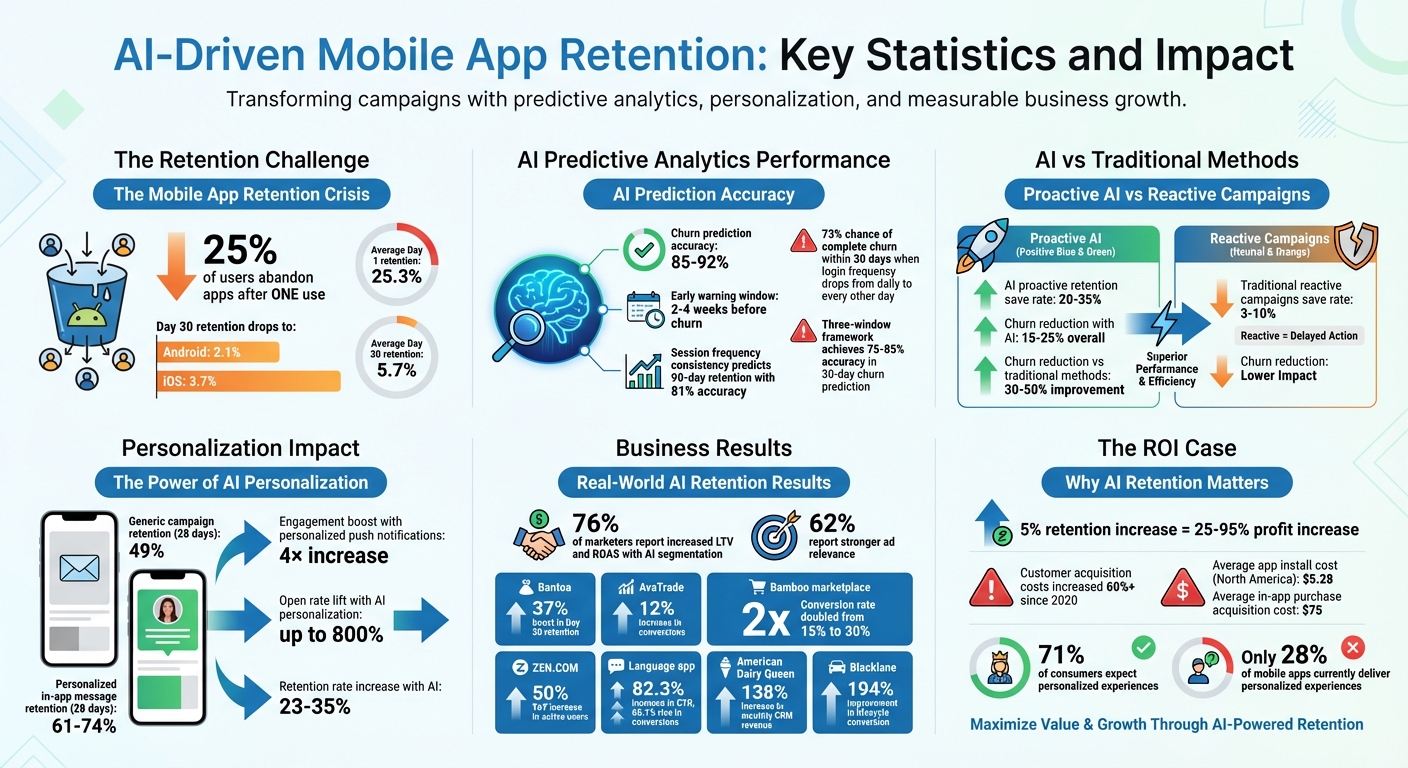
- User Retention Challenge: 25% of users abandon apps after one use, with retention dropping to 2.1% (Android) and 3.7% (iOS) by day 30.
- AI’s Role: Predictive analytics assigns churn risk scores, enabling timely interventions weeks before disengagement.
- Personalization: AI creates dynamic, behavior-based user segments, delivering tailored messages that boost engagement by 4×.
- Automation: AI-driven workflows and cross-channel orchestration ensure timely, relevant messages without manual effort.
- Results: Apps using AI report retention increases of 23–35%, higher click-through rates, and reduced churn.
AI simplifies retention by analyzing user behavior, predicting risks, and automating actions, saving costs and improving user engagement.
AI-Driven Mobile App Retention: Key Statistics and Impact Metrics
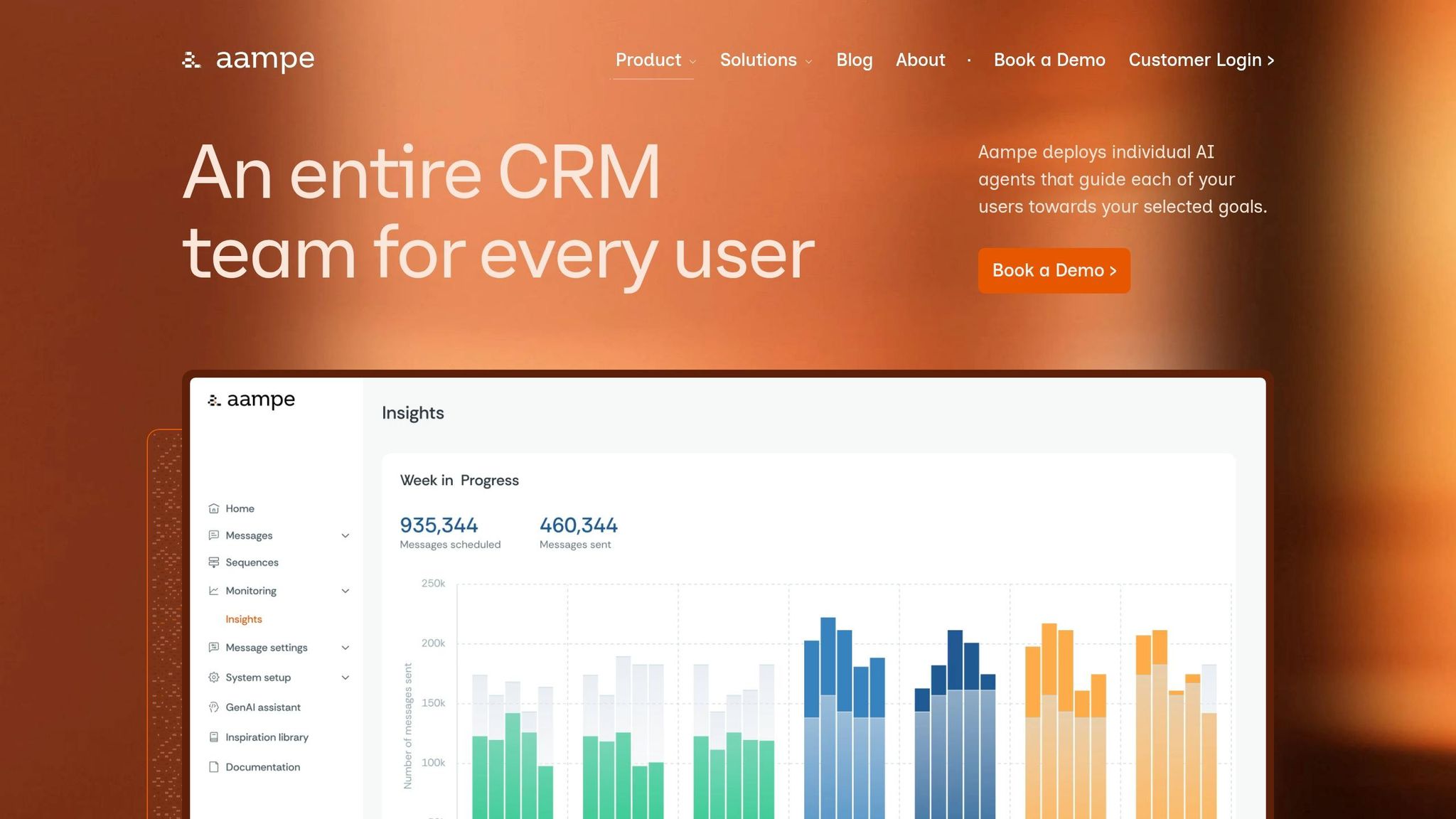
Transform Your App’s Retention And Engagement with Aampe’s Head of Growth, Jim Laurain
sbb-itb-6e49fcd
Using Predictive Analytics to Understand User Behavior
Predictive analytics changes the game for user retention. Instead of passively watching users drift away, AI assigns a churn probability score (from 0.0 to 1.0), comparing the behavior of past churners to what active users are doing right now. This allows you to step in and take action weeks before a user decides to leave – typically 2 to 4 weeks ahead of their final decision.
Raw numbers, like total logins, often miss the bigger picture. What really matters is the rate of change – how quickly engagement patterns shift. For example, if a user moves from logging in daily to every other day, there’s a 73% chance they’ll churn completely within 30 days. AI excels at spotting these subtle changes in behavior that human analysts might overlook. By identifying these shifts early, you can create personalized strategies and overcome engagement challenges to keep users active.
"We no longer ask: ‘How many users did we lose?’ Instead, we ask a better question: ‘Which users are we about to lose today?’" – Del Rosario, ML Engineer
Modern AI models take this a step further by analyzing hundreds of behavioral variables at once. They create a unique baseline for each user, flagging deviations from their "normal" behavior rather than relying on generic benchmarks. With 85-92% accuracy in predicting churn, these models can help reduce overall churn rates by 15-25%. This level of predictive insight sets the stage for the detailed metrics we’ll dive into next.
Key Metrics to Analyze
AI focuses on several critical metrics to predict user behavior effectively:
- Session frequency consistency: This measures how regular a user’s app usage is. Low variation (or high consistency) suggests a strong habit, predicting 90-day retention with 81% accuracy. When this consistency falters, it signals potential churn.
- Feature engagement: Both the depth (how much users rely on your app’s core features) and breadth (how many different tools they use) are monitored. A noticeable drop in core feature usage often serves as an early warning sign.
- Technical issues: Experiencing more than two app crashes within 48 hours is a strong indicator of churn risk.
- Micro-intent events: Small actions like saving an item, following a topic, or returning within 24 hours of a first visit help AI understand what users aim to achieve. These insights make future behavior easier to predict.
How AI Improves Predictive Accuracy
AI enhances its accuracy by using a dynamic three-window framework, which goes beyond traditional static thresholds. Here’s how it works:
- P1: Analyzes past behavior to establish patterns.
- P2: Examines current activity for real-time insights.
- P3: Predicts future behavior over the next 7 to 14 days.
By comparing these windows, AI detects changes in engagement – whether they’re accelerating or declining – that static models often miss. This approach achieves 75-85% accuracy in predicting churn within a 30-day window and can lower churn rates by 30-50% compared to traditional methods. Even better, proactive retention strategies powered by AI deliver a 20-35% save rate, while reactive campaigns ("we want you back" emails) only succeed 3-10% of the time.
"A mediocre model that triggers timely interventions outperforms a brilliant model that sits in a data warehouse unconnected to customer-facing workflows." This integration is a core focus for growth marketers looking to optimize marketing funnels. – DigitalApplied
Algorithms like XGBoost and LightGBM are commonly used for structured data. They excel at handling missing values and provide clear insights into which features drive churn. This transparency is crucial – modern "explainable AI" doesn’t just flag a user with an 83% churn risk. It also explains why: for example, "83% risk driven by declining feature usage over the past 14 days". With this context, your team can craft targeted interventions rather than sending out generic, ineffective messages.
Segmenting Users with AI Insights
When you combine predictive insights with user segmentation, you take retention strategies to the next level. After identifying users at risk of disengagement, the next step is grouping them based on their real-time behavior. Unlike traditional demographic-based segmentation, AI-powered tools analyze live behavioral signals – things like clicks, scroll activity, session depth, and how often users interact with specific features. These real-time updates ensure that user groups stay aligned with what people are doing right now.
AI-driven segmentation is constantly evolving. Audience groups update in real time as new data flows in. For instance, if a user abandons their cart, they could be instantly added to a "High-Intent Cart Abandoners" group, triggering a tailored push notification within minutes. This kind of speed and precision makes a big difference: brands using personalized in-app messages report retention rates of 61%–74% within 28 days, compared to just 49% for generic campaigns. The ability to adapt dynamically to user behavior is what makes AI segmentation so impactful.
Dynamic Segmentation Techniques
AI doesn’t just group users based on basic data – it dives deep into real-time actions like in-app navigation, purchase history, location, and device usage. Machine learning algorithms can even create "lookalike" audiences by identifying patterns among your most valuable users and matching them with similar profiles in your wider audience. On top of that, natural language processing (NLP) can analyze user sentiment in reviews or support tickets, allowing you to segment by emotional cues.
Mobile sensors like GPS and accelerometers add another layer of precision. For example, a fitness app could detect whether a user is stationary or actively exercising and adjust its messaging accordingly. This level of detail results in micro-segments – extremely specific groups such as "Discount-Driven Shoppers" or "Feature Power Users" – that would be nearly impossible to identify manually.
| Aspect | Traditional Segmentation | AI Customer Segmentation |
|---|---|---|
| Data Input | Assumptions/demographics | Real-time user behavior |
| Execution Style | Static and rule-based | Adaptive and real-time |
| Maintenance | Manual updates | Automated and predictive |
| Targeting Approach | Broad targeting | Hyper-personalized |
| Signals Used | Location, industry, age | Clicks, scrolls, session depth, sentiment |
These advanced techniques make it possible to achieve results that were once out of reach.
Benefits of AI-Driven Segmentation
The results speak for themselves. 76% of marketers have reported increases in Customer Lifetime Value (LTV) and Return on Ad Spend (ROAS) after implementing AI in their segmentation strategies. Additionally, 62% have noticed stronger ad relevance thanks to improved audience targeting. The reason? AI ensures that every user gets messages tailored to their current intent and engagement level.
"AI is moving from a testing tool to the backbone of segmentation strategy. Teams using it for targeting are seeing higher returns and clearer insight into why campaigns succeed." – Dennis Mink, CMO, Bidease
Real-world examples illustrate the impact. Bantoa, a fashion e-commerce app, saw a 37% boost in Day 30 retention by using behavioral segmentation to send personalized push notifications to registered users. Similarly, AvaTrade segmented users into "registered account" and "demo version" groups, sending tailored messages to each. This strategy led to a 12% increase in conversions to real account registrations. The secret lies in connecting every AI-generated segment to a specific automated action, whether it’s a push notification, in-app prompt, or email.
Creating Personalized Campaign Content with AI
Once advanced segmentation is complete, the next logical step is using AI to create content tailored to each user’s behavior. By analyzing real-time actions like sessions, clicks, and purchases, AI can craft messages that truly connect with specific user groups. This approach addresses a major gap in retention strategies: currently, only 28% of mobile apps deliver personalized experiences. With AI, content can adapt dynamically, ensuring it remains relevant and impactful.
AI-Generated Content Variations
AI tools make it possible to quickly produce multiple versions of push notifications, headlines, and body copy through Natural Language Processing (NLP). These tools fine-tune emotional tone, optimize persuasive language, and even select visuals that align with the message. For example, AI might pair a specific shoe style with a promotional message for a new collection, ensuring both text and imagery work seamlessly together.
Multivariate testing, powered by AI, takes the guesswork out of A/B testing. Instead of testing just two options, AI can simultaneously analyze five or more variants and automatically shift traffic to the top performer. A great example comes from an Indian e-commerce app that used this method for a bread delivery campaign. One variant, emphasizing "36-hour delivery" without an image, achieved a 30% click-through rate – an impressive 255.87% boost over the expected 8.43%.
PageTest.AI offers a no-code platform for generating content variations, tracking engagement, and automatically optimizing performance. E-commerce brand Suitsupply used AI-powered email campaigns and saw engagement rates increase by 5–7× and conversions jump by 5–10× compared to their standard messaging.
"Personalization is a huge thing for Suitsupply in general. We need to find the perfect fit." – Wouter Hol, Platform E-Commerce Manager at Suitsupply
Improving Engagement with Personalization
AI doesn’t just stop at creating diverse content – it uses real-time data to tailor each message down to the smallest detail. Personalization here goes far beyond simply adding someone’s first name. AI dynamically incorporates live data, such as recently viewed products, inventory updates, or even usage stats, into messages to make them instantly relevant. It also factors in signals like location or local "quiet hours" to ensure the timing feels natural.
The impact of this level of personalization is striking. Personalized push notifications can boost engagement by as much as 4× compared to generic messages. Apps that use AI-driven personalization have reported retention rate increases between 23% and 35%, with some achieving an astonishing 800% lift in open rates. Fintech company ZEN.COM, for instance, saw a 50% year-over-year increase in active users by using AI to guide customers through onboarding tasks.
"The multi-channel approach allows us to test and refine our strategies through A/B testing, helping us understand what value propositions motivate our users." – Michał Dąbrowski, Communications & Product Growth Manager at ZEN.COM
Bamboo, an online marketplace, achieved remarkable results by using AI to deliver personalized cross-channel messages. Their year-over-year conversion rate doubled from 15% to over 30%, and abandoned deposits dropped by 12%. The secret lies in linking every AI-generated user segment to a specific automated action, whether it’s a push notification, in-app prompt, or email. This ensures campaigns remain timely, relevant, and effective.
To get the best results, highlight the key benefit right at the start of your message rather than burying it at the end. A language-learning app applied this strategy with AI-generated push notifications and automated testing, leading to an 82.3% increase in click-through rates and a 68.1% rise in conversions compared to their previous manual campaigns.
Automating and Deploying AI-Driven Retention Campaigns
With the predictive insights and dynamic segmentation mentioned earlier, AI takes retention campaigns to the next level by automating and managing them in real time. Instead of relying on manual workflows or rigid "if-then" rules, AI uses real-time signals – like user sessions, clicks, and milestones – to determine the next best action. This means teams no longer need to micromanage each campaign. AI handles the timing, channels, and even when to stop sending messages, freeing up marketers to focus on strategy while the system seamlessly handles execution across thousands – or even millions – of users. A key part of this automation lies in event-driven triggers.
Event-Driven Triggers
AI-powered triggers are designed to react to specific user behaviors, such as completing a task, installing an app, or even periods of inactivity (like not opening an app for seven days). These triggers can also instantly halt workflows once a user converts. For example, if someone makes a purchase, AI will immediately stop sending "abandoned cart" reminders across all channels – no delay, no overlap.
Timing is another area where AI shines. If a message is set to go out at an inconvenient hour (like 2:00 AM local time), AI can delay delivery until the user is more likely to engage. To keep things fresh, AI rotates message variations within workflows, ensuring users don’t see the same notification repeatedly, which helps prevent fatigue. By setting clear conversion goals – like "Purchase completed" or "Workout finished" – AI can automatically remove users from the campaign as soon as they meet the objective.
AI also enables more advanced workflows by incorporating wait times and conditional logic. For instance, if a push notification goes ignored, the system might escalate to an email 48 hours later, creating a more effective and responsive campaign.
But automating individual workflows is just the beginning. AI also optimizes communication across multiple channels.
Cross-Channel Orchestration
AI-driven cross-channel orchestration ensures that messages are sent through the most effective and efficient channels, whether that’s email, SMS, push notifications, or in-app messages. It predicts which channel a user is most likely to respond to and adjusts accordingly, treating messaging frequency as a unified system across all touchpoints. This prevents users from being overwhelmed by repeated or conflicting messages.
For example, the investment platform Bamboo implemented a multi-channel AI strategy in July 2025, which doubled their year-over-year conversion rates from 15% to over 30%. They also reduced abandoned deposits by 12%. Similarly, ZEN.COM used a combination of in-app and push notifications with improved AI segmentation, leading to a 50% year-over-year increase in active users.
AI also ensures compliance and brand consistency by incorporating region-aware quiet hours and tone adjustments. For users who haven’t opted into push notifications or email, in-app messages provide a non-intrusive way to deliver high-context nudges without requiring opt-in. Apps that adopt full-funnel messaging strategies see 15–25% lower churn rates compared to those that skip lifecycle marketing.
Tracking and Optimizing Campaign Performance with AI
Once your campaigns are live, keeping a close eye on their performance becomes essential to maintain and enhance user engagement. AI steps in here, working behind the scenes to track and refine your campaigns in real time. This means you don’t have to spend hours sifting through data manually – AI delivers instant insights so you can tweak and improve campaigns while they’re still running.
Key Metrics to Monitor
AI builds on earlier user behavior data to fine-tune every interaction based on how your campaigns are performing in real time. It keeps a watchful eye on critical metrics like retention rates (averaging 25.3% on Day 1 but dropping to 5.7% by Day 30), DAU/MAU ratios (where over 20% is considered strong, and over 25% is exceptional), churn rates, lifetime value (LTV), and average revenue per user (ARPU).
Through behavioral signals, AI assigns churn risk scores to users, allowing you to take action before they leave. This proactive approach is vital because retaining an existing user is far more cost-effective than acquiring a new one. For context, the average app install in North America costs $5.28, while securing an in-app purchase can cost as much as $75. Monitoring these metrics not only helps you spot issues early but also highlights the financial impact of your campaigns.
Iterative Optimization with AI
AI doesn’t just monitor – it continuously improves your campaigns through automated testing and learning. Unlike traditional A/B testing, where you manually test one variable at a time, AI can test multiple message variations simultaneously. It automatically scales the most effective ones and retires the weaker options. For example, American Dairy Queen Corporation boosted its monthly CRM revenue by 138% using AI-powered A/B testing.
Platforms like PageTest.AI take optimization a step further by enabling multivariate testing for website and landing page elements. This is particularly useful for retention campaigns that drive users from push notifications to specific landing pages. With PageTest.AI, you can test different headlines, CTAs, and product descriptions without needing to write a single line of code. The platform tracks user interactions – such as clicks and engagement – helping you pinpoint which combinations drive the best results. This creates a powerful feedback loop: AI-driven campaigns direct users to AI-optimized pages, ensuring every touchpoint delivers maximum impact.
AI’s real-time optimization capabilities mean it can adjust campaigns instantly when user behavior shifts. For instance, in 2025, Blacklane achieved a 194% improvement in lifecycle conversion and a 94% increase in CRM revenue by leveraging AI for real-time segmentation and cross-channel messaging. This approach helped them activate new users and keep existing ones engaged. The beauty of AI is that it doesn’t wait for you to notice a problem – it identifies and resolves issues on its own, ensuring your retention campaigns stay effective and responsive. These adjustments feed back into your campaigns, creating a continuous cycle of improvement.
Conclusion
AI transforms mobile retention from a reactive guessing game into a proactive, data-informed strategy. Why does this matter? A 5% boost in retention can drive profit increases ranging from 25% to 95%. This is especially crucial given that customer acquisition costs have soared by more than 60% since 2020. With AI’s predictive analytics, segmentation capabilities, and automated content tools, you can take action 14–21 days before users are likely to disengage, sidestepping expensive win-back campaigns.
This precision-targeted approach not only minimizes churn but also cuts costs – an essential advantage in today’s hyper-competitive market. And with 71% of consumers expecting personalized experiences, AI becomes indispensable for delivering tailored messages at scale. By generating customized content, automatically rotating high-performing variants, and fine-tuning campaigns in real time based on user behavior, AI enhances engagement while reshaping the economics of growth.
"We are now at the point where competitive advantage will derive from the ability to capture, analyze, and utilize personalized customer data at scale and from the use of AI to understand, shape, customize, and optimize the customer journey." – Harvard Business Review
AI’s ability to personalize and optimize in real time ensures campaigns guide users seamlessly – from push notifications to conversion-focused experiences. For campaigns that lead users to landing pages, PageTest.AI takes optimization a step further. It allows you to test headlines, CTAs, and product descriptions without needing any coding, ensuring every click is set up for maximum conversion. This creates a powerful synergy where AI-driven campaigns align perfectly with AI-optimized web pages, amplifying the effectiveness of every user interaction.
FAQs
What data do I need to predict churn accurately?
To accurately predict churn, pay close attention to behavioral signals. These include how often users engage, the time gaps between their support tickets, and noticeable shifts in how they use the product. These patterns serve as crucial data points for creating predictive models that work effectively.
How can AI segmentation avoid over-messaging users?
AI-powered segmentation helps avoid overwhelming users with excessive messages by constantly fine-tuning audience groups based on predictive insights. This approach ensures that messages are delivered at the right time and are relevant to the recipient. By aligning communication with real user behavior, AI keeps engagement levels high while reducing the risk of message fatigue.
How do I tie retention messages to on-site conversion testing with PageTest.AI?
Use PageTest.AI’s AI-powered tools to craft and test retention messages tailored to user behavior. Effortlessly generate multiple content variations for specific user segments and implement them across your site. The platform takes care of directing traffic toward the best-performing messages, ensuring they’re always improving. Dive into user interaction data – like clicks and drop-offs – to fine-tune your messaging. Plus, integrate retention strategies with on-site conversion testing to amplify results.
Related Blog Posts
say hello to easy Content Testing
try PageTest.AI tool for free
Start making the most of your websites traffic and optimize your content and CTAs.
Related Posts

31-08-2026
 Becky Halls
Spiralyze alternatives: CRO agency or software in 2026?
Spiralyze makes an offer that’s hard to argue with. “30% lift in 90 days. No fee until we deliver.” More precisely: 10 tests, 3 wins, more than 30% lift in your first 90 days, and you pay nothing until they’ve done it. I’ll say plainly what most competitor pages wouldn’t. On risk alone, that’s a better offer than […]

31-08-2026
Becky Halls
AB Tasty alternatives: an honest comparison for 2026
AB Tasty is a strong platform with a well-liked support team, sitting at 4.4 on G2 across 418 reviews. Reviewers on TrustRadius describe it as better value than pricier AB Tasty alternatives, which in this category is a real compliment. It also has the most unusual buying process here. No published pricing, and no free […]

31-08-2026
Becky Halls
The best Optimizely alternative: a comparison for 2026
Optimizely is the most capable experimentation platform on the market. I don’t think that’s seriously disputed. Server-side testing, feature flags, personalization, statistical depth, and it all runs at genuine enterprise scale. In 2026 they’ve wrapped the whole thing in “agentic experimentation” branding and shipped an AI variation development agent, and the underlying Web Experimentation product […]