


AI Content Personalization: Expert Guide

AI Content Personalization: Expert Guide
 02-03-2026 (Last modified: 02-03-2026)
AI content personalization uses technologies like machine learning and predictive analytics to deliver tailored digital experiences. Instead of generic content, it reacts to user behavior – clicks, searches, and more – to predict and serve what each person needs in real time. This approach boosts engagement, sales, and retention.
Key Insights:
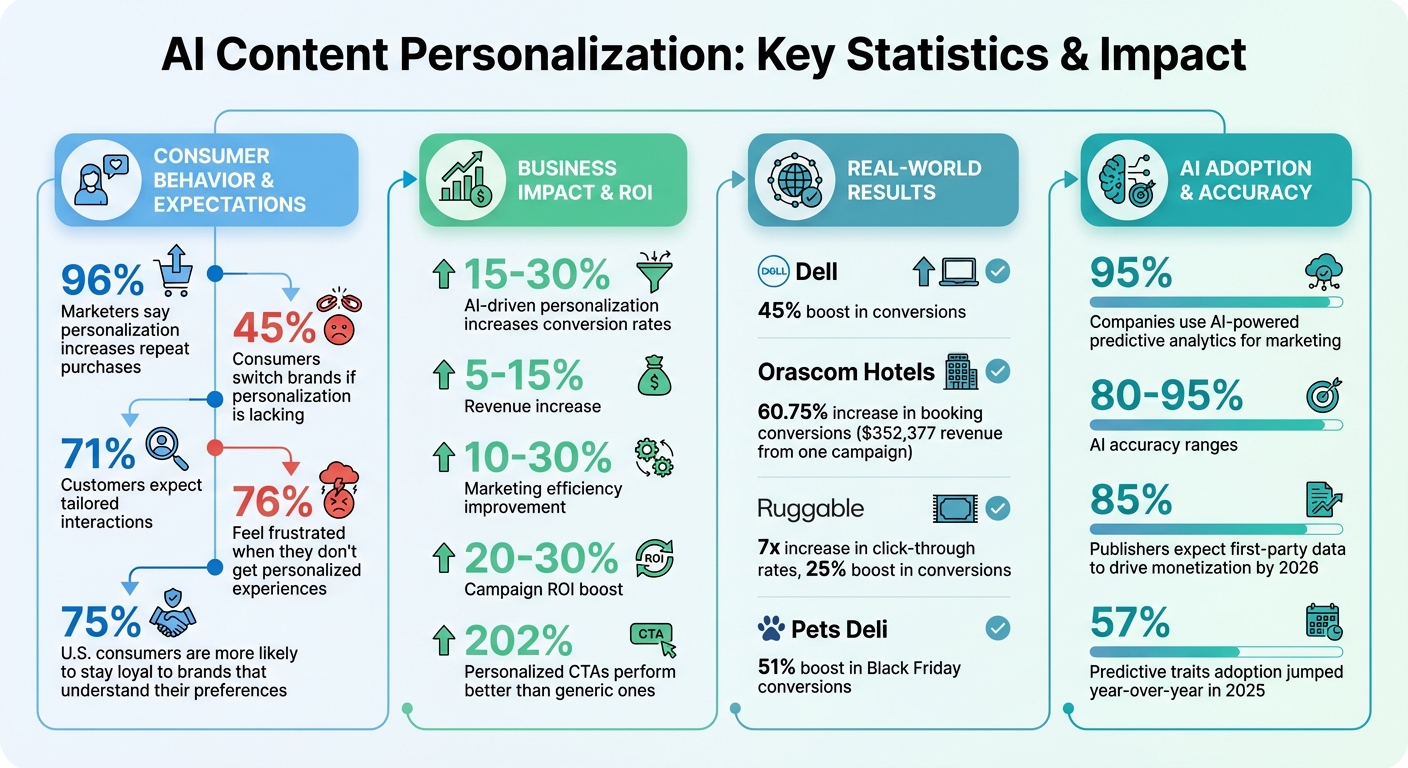
- 96% of marketers say personalization increases repeat purchases.
- 45% of consumers switch brands if personalization is lacking.
- AI-driven personalization can increase conversion rates by 15-30% and revenue by 5-15%.
How It Works:
- Unified Profiles: Combine data from all user interactions.
- Predictive Analytics: Forecast user behavior and intent.
- Real-Time Updates: Adjust content instantly based on live behavior.
Benefits:
- Higher conversion rates (e.g., Dell saw a 45% boost in conversions).
- Improved customer loyalty and reduced acquisition costs.
- Efficient content testing with tools like PageTest.AI.
AI personalization is no longer optional – it’s a necessity for businesses aiming to remain competitive.
AI Content Personalization Statistics and ROI Impact 2025-2026
So What? Generative AI for Content Personalization
Core Components of AI-Powered Personalization
AI’s ability to analyze data and respond dynamically has completely changed how businesses approach personalization. Instead of relying on broad audience categories, three key elements – unified customer profiles, predictive analytics, and real-time adaptation – allow companies to tailor experiences down to the individual level.
Unified Customer Profiles
A unified customer profile brings together every interaction a user has with a brand. This includes everything from website activity and email clicks to purchase history and CRM records, all consolidated into a single, cross-device view. But it’s not just about storing data – it’s about resolving identities across platforms and channels to create a seamless understanding of each customer’s journey.
Customer Data Platforms (CDPs) play a major role here. They pull first-party data from various touchpoints to build a comprehensive customer record. Today’s advanced systems even use vector databases to store semantic embeddings, which help capture the intent behind user actions, making the data far more actionable.
Predictive Analytics and Likelihood Scoring
Predictive analytics takes personalization a step further by forecasting what users are likely to do next. By assigning likelihood scores to actions – like making a purchase, unsubscribing, or engaging with specific offers – these systems help brands anticipate customer needs. It’s no wonder that 95% of companies now incorporate AI-driven predictive analytics into their marketing efforts, with accuracy rates often reaching between 80% and 95%.
These models analyze a mix of behavioral patterns, transaction histories, and contextual signals to create intent-based profiles. Even for brand-new visitors, predictive systems analyze factors like referral sources, device types, and location data to personalize experiences from the very first interaction.
“We’ve never had more customer data, yet most brands still treat people like demographics rather than individuals.”
- Zach Chmael, CMO, Averi
Real-Time Adaptation
Personalization loses its edge when it becomes static. Real-time adaptation solves this by allowing AI to adjust instantly as user behavior changes. For example, if someone spends extra time on a pricing page, the system recalculates their intent and updates content on the spot.
This level of responsiveness is powered by real-time decision engines that process incoming data in milliseconds. Advanced systems also integrate short-term and long-term memory, enabling them to adapt during live sessions while remembering preferences for future visits. Companies using these adaptive strategies have reported impressive results, including a 20–30% boost in campaign ROI and a 5–15% increase in revenue.
Building User Segments
Once you’ve unified user profiles and incorporated predictive analytics, the next step is grouping users into meaningful segments. But effective segmentation isn’t just about broad categories like “millennials” or “high earners.” Instead, it’s about combining multiple layers of data to create groups that respond differently to your content. These refined segments form the foundation for delivering experiences tailored to specific user identities and behaviors.
Defining Segments with Demographics and Behavior
Demographics tell you who the user is, but behavior reveals what they do and why. For example, two 35-year-olds from Chicago might appear identical at first glance. But if one browses pricing pages on their phone at 2:00 a.m., while the other reads case studies on a desktop during business hours, they clearly have different needs – and require entirely different content.
The most effective segments blend these data types. Take Orascom Hotels Management as an example. In February 2026, they targeted returning visitors with property-specific messaging and summer promotions. By combining visit history, interest in specific properties, and seasonal timing, they achieved a 60.75% boost in booking conversions, generating $352,377 in revenue from just one campaign. This wasn’t a generic “returning visitors” segment – it was a precise mix of user data and timing.
When creating segments, specificity is key. For instance, you might target users who are “Visitors from California” AND “Viewed pricing page” AND “More than twice in the past week”. This level of detail ensures your personalized content reaches the right person at the right moment. Research shows personalized calls-to-action can perform up to 202% better than generic ones, but this only works when segmentation is detailed enough to deliver content that truly resonates.
From these detailed profiles, contextual data can further refine how and when your content is delivered.
Using Contextual Data for Deeper Insights
Contextual signals – like device type, time of day, referral source, or location – add an extra layer of precision to your segments. A user browsing on their phone during a lunch break behaves differently than the same person on a desktop at 10:00 p.m. Similarly, someone arriving via a Google ad likely has a different intent than someone clicking through from an email newsletter.
This contextual layer also addresses the “cold start” problem – the challenge of personalizing content for brand-new visitors with no prior history. Even without behavioral data, you can use referral source, device type, or location to tailor content right from their first interaction. For instance, if someone lands on your site from a LinkedIn ad about enterprise solutions, you can immediately show them B2B-focused content, even before they’ve clicked anything else.
When defining segments, include a detailed description that captures user motivations – like “Electric car enthusiasts interested in sustainability.” This helps AI tools create content variations that align with the specific interests of each group. Such context allows predictive models to uncover patterns that might go unnoticed, like how discount sensitivity correlates with nighttime browsing or how feature comparison pages signal interest in enterprise upgrades.
“All data in aggregate is crap.”
- Avinash Kaushik, Author and Analytics Expert
Start small. Focus on one or two key behavioral patterns – such as purchase frequency or preferred content categories – and refine those before moving to more complex, multi-dimensional clusters. Over time, as your system adapts, you can add more contextual refinements that adjust in real time as user behavior evolves.
Real-Time Personalization Strategies
After creating your customer segments, the next step is where the magic happens – adapting content while users are actively navigating your site. Real-time personalization, executed in mere milliseconds, can dramatically boost both engagement and revenue. Consider this: 71% of customers now expect tailored interactions, and 76% feel frustrated when they don’t get them. Let’s dive into how real-time strategies use behavioral insights and dynamic content updates to achieve these results.
Behavioral Pattern Analysis
AI doesn’t just observe what users do in real time – it interprets their actions. By tracking metrics like pages visited, time spent, scroll depth, and clicks, it identifies user intent on the spot. This process often follows the Intent Engine Pattern: clickstream data flows into a Customer Data Platform (CDP), where semantic “embeddings” are stored in a Vector Database. These insights then feed into an AI model that generates personalized content on the fly. This setup captures not only the actions users take but also the intent or “vibe” behind them.
Machine learning models can even predict future behavior based on these patterns. For instance, if a customer typically reorders a product every 60 days, the system might prompt a special offer on day 55. Natural Language Processing (NLP) adds another layer by analyzing search queries to uncover intent. For example, a search for “eco-friendly” doesn’t just match keywords – it identifies a preference for sustainability. These insights feed directly into dynamic content updates, ensuring every interaction feels relevant and timely.
Dynamic Content Adjustment
Once behavioral insights are in place, dynamic content adjustments take over, instantly tailoring elements like headlines, images, and calls-to-action (CTAs) to match live user behavior. A great example comes from Ruggable, which used Contentful to update landing pages dynamically based on paid ad sources. The result? A 7x increase in click-through rates and a 25% boost in conversions (Source: Contentful Case Study, 2025).
Platforms like PageTest.AI make this process even simpler with no-code solutions that let you test and optimize website elements in real time. The tool generates AI-driven variations for headlines, CTAs, button text, and product descriptions while tracking performance metrics like clicks and engagement. Using Multi-Armed Bandit (MAB) algorithms, PageTest.AI automatically shifts traffic toward the best-performing content, reducing exposure to underperforming variations.
For first-time visitors without browsing history, contextual signals – like referral source, device type, location, and time of day – enable immediate personalization. For instance, someone arriving from a targeted ad can see tailored content from their very first page view.
Pets Deli demonstrated the power of this approach by using Contentful Personalization to offer returning customers exclusive prices and promotions, achieving a 51% boost in Black Friday conversions (Source: Contentful Case Study, 2025). The key lies in creating modular content libraries – interchangeable components like headlines, visuals, and CTAs that can be swapped dynamically. Tools like PageTest.AI integrate seamlessly with website builders, making it easy to implement this modular strategy without requiring technical expertise.
To get started, focus on high-impact areas like landing pages or product pages that generate the most traffic from paid campaigns. Test personalized experiences against non-personalized ones to measure actual incremental gains. Every interaction – whether a click or a skip – feeds back into the AI system, refining customer profiles and improving future predictions. This continuous feedback loop ensures your content adapts and improves with every user interaction.
sbb-itb-6e49fcd
Implementing AI Personalization with PageTest.AI
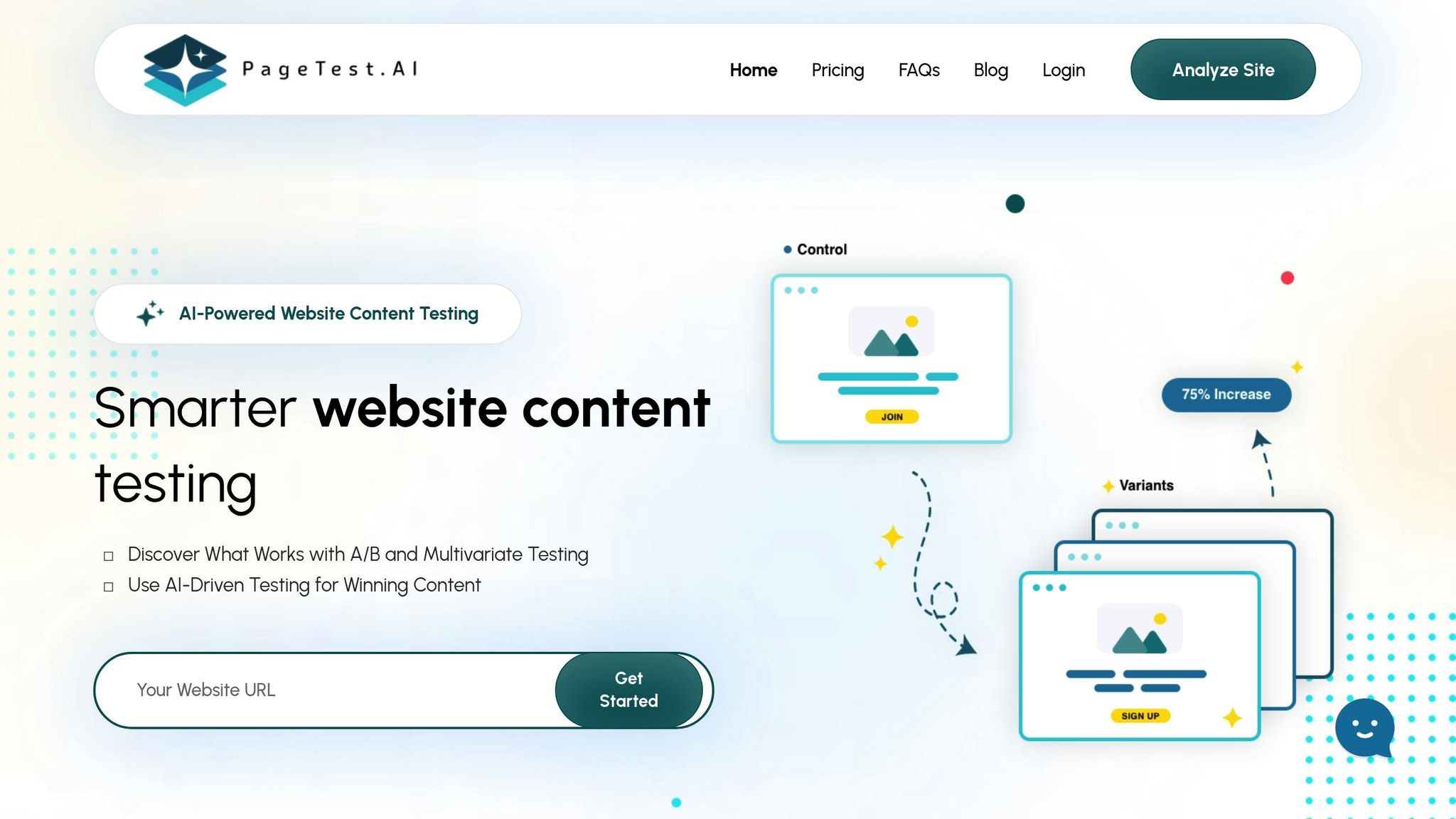
PageTest.AI transforms real-time insights into actionable tests for website content, making it easier than ever to optimize user experiences.
Overview of PageTest.AI
PageTest.AI is a no-code platform designed to simplify conversion rate optimization through AI-driven personalization. Forget waiting on developers or wrestling with complex coding – this tool lets you launch A/B and multivariate tests in minutes using a Chrome extension and a lightweight JavaScript snippet. The platform’s AI generates up to 10 optimized variations for elements like headlines, CTAs, button text, and product descriptions, all based on real conversion data. It tracks multiple engagement metrics – clicks, scroll depth, time on page, and visits to key URLs (like thank-you pages) – to pinpoint what resonates with your audience.
The tool is compatible with major platforms like WordPress, Shopify, Wix, Magento, and Google Tag Manager. Plus, its asynchronous JavaScript ensures your site speed remains unaffected. With a simple point-and-click interface, you can test any element, and the AI provides instant suggestions. For instance, in a 2025 case study, PageTest.AI ran 187 content variations across four websites, generating over 11,000 test impressions. One standout result came from changing a CTA from “Generate my app free” to “Make my app free and easy”, which boosted engagement by 297% – from 2 clicks to 11 (Source: PageTest.AI Case Study, 2025).
This streamlined process not only accelerates testing but also highlights the platform’s core features and functionalities.
Key Features and Benefits
PageTest.AI’s AI-powered Success Engine takes optimization a step further by analyzing visitor behavior in real time. It doesn’t just track immediate clicks – it maps out broader user journeys, ensuring conversions on other pages (like checkouts or registrations) are accounted for. The platform’s intuitive, color-coded dashboard makes it easy to identify winners: green for improvements, red for underperformers, and a gold trophy for top-performing variations.
Traffic prioritization ensures high-impact tests get more exposure without compromising data accuracy. The platform adheres to a strict rule: each unique visitor is exposed to only one test variation, preventing skewed results.
“As a marketer I have struggled so much with AB testing… I love that you have a chrome extension, it makes it so much easier!” – Werner Geyser, Founder of Influencer Marketing Hub
For businesses managing multiple sites, PageTest.AI scales effortlessly.
“Knowing we can test every call to action and optimize our SEO efforts is very satisfying” – David Hall, CEO of AppInstitute
The platform also enables multivariate testing, allowing you to test multiple elements at once to uncover the best-performing combinations.
Pricing and Plans
PageTest.AI offers four pricing tiers to fit various business needs, with all prices listed in USD per month:
| Plan | Price | Test Impressions | Websites | Pages | Tests |
|---|---|---|---|---|---|
| Starter | $299 | 10,000 | Unlimited | Unlimited | Unlimited |
| Growth | $499 | 50,000 | Unlimited | Unlimited | Unlimited |
| Done For You | $1,999 | Unlimited | Unlimited | Unlimited | Unlimited |
Every plan includes unlimited pages, tests and websites — the only difference between tiers is monthly test-impression volume, and every plan starts with a 5-day free trial that requires a card at signup. The Starter plan ($299/month) covers 10,000 impressions with chat support. For growing businesses, the Growth plan ($499/month) provides 50,000 impressions with team seats and video call support. Agencies managing larger portfolios can opt for the Done For You plan ($1,999/month), which includes unlimited impressions and setup handled for you.
All paid plans come with AI content suggestions, multivariate testing, and full integration support, making it easy to implement real-time personalization strategies.
Advanced Strategies Using Predictive Analytics
Predictive analytics takes personalization to the next level by shifting from reactive responses to proactive strategies. By anticipating users’ next steps, businesses can grow revenue with more accurate forecasting. Beyond real-time adjustments, advanced predictive analytics opens up new ways to drive revenue. With proactive insights, continuous testing sharpens these predictions, turning them into measurable performance gains.
Continuous Testing and Optimization
Continuous testing creates a feedback loop where every customer interaction helps improve AI models. These models should be retrained every 90 days to keep up with changing customer behavior. For instance, 95% of companies now rely on AI-powered predictive analytics for marketing, and this approach has been shown to increase conversion rates by 25–30% across digital platforms.
To measure the impact of personalized experiences, compare them against a control group. This method often results in noticeable improvements: businesses using continuous testing report higher booking conversions and revenue, with personalized experiences contributing over 40% of total campaign revenue.
“Personalized content is no longer optional. It’s a competitive differentiator. Personalization transforms the customer experience from generic to unforgettable.” – Mike Ford, CEO, Skydeo
Tools like PageTest.AI make this process manageable. Its multivariate testing features, powered by an AI Success Engine, analyze visitor behavior in real time. This goes beyond tracking clicks to understanding full user journeys, optimizing for key actions like checkouts, registrations, and form submissions. To ensure accuracy, always reserve a 10–15% holdout group for measuring lift.
While continuous testing fine-tunes overall engagement, dynamic segmentation ensures content is tailored to specific audiences.
Segment-Specific Content Delivery
Static segmentation is outdated. Dynamic segmentation updates audience groups in real time based on user behavior. For example, a casual browser can quickly shift to a high-intent prospect after viewing pricing details. Predictive analytics supports this by assigning likelihood scores to actions like conversions, churn, or interest in specific products.
In 2025, the adoption of predictive traits jumped by 57% year-over-year, with AI accuracy ranging from 80% to 95%. Companies using predictive analytics report 20–30% higher ROI on campaigns. AI-driven personalization further boosts revenue by 5–15% and improves marketing efficiency by 10–30%.
The technology behind these solutions is just as critical. The “Intent Engine” model integrates a Customer Data Platform for event tracking with vector databases that interpret the meaning behind user actions. This setup enables AI to understand not just what users do but why they do it. As 85% of publishers expect first-party data to drive monetization by 2026, building strong first-party data systems is essential.
“The breakthrough isn’t the AI – it’s the architecture: unified customer data feeding machine learning models that score intent, then autonomous systems executing without manual triggers.” – Authoritative Source, Predictive AI Personalization 2026
PageTest.AI aligns perfectly with this approach. By testing content variations for specific segments – like crafting headlines for high-intent users or customizing CTAs for price-conscious shoppers – you can identify what resonates most with each group. Features like traffic prioritization and a user-friendly dashboard ensure impactful tests receive maximum exposure without compromising data quality.
Conclusion
AI-driven personalization has become a game-changer for businesses looking to stay competitive. The numbers speak for themselves: personalized calls-to-action can perform up to 202% better than generic ones, and 75% of U.S. consumers are more likely to stay loyal to brands that truly understand their preferences.
Key Takeaways
AI personalization offers five key benefits that businesses can’t afford to ignore:
- Higher conversion rates: By tailoring offers to match where visitors are in their buying journey, personalization helps reduce decision-making friction at critical moments.
- Stronger customer loyalty: When brands respect customers’ time and preferences, they build lasting relationships that drive retention.
- Improved efficiency: AI takes over the heavy lifting of data processing and segmentation, freeing up teams to focus on strategy.
- Deeper insights: AI uncovers hidden friction points and identifies high-intent customer segments that traditional analytics often miss.
- Lower acquisition costs: Aligning ad messaging with landing page content boosts Quality Scores, bringing down cost-per-click and improving ROI.
Real-world examples bring these benefits to life. Orascom Hotels Management saw a 60.75% increase in booking conversions, while Dell achieved a 45% boost in conversions across all channels through targeted personalization. These results highlight the tangible impact of AI-driven strategies.
Next Steps for Implementation
Ready to get started? Focus first on high-traffic pages like your homepage and key landing pages. These areas provide the quickest return on investment and generate valuable data to refine your approach. Don’t forget to test personalized experiences against non-personalized control groups to measure the true impact.
To simplify the process, tools like PageTest.AI make personalization accessible – even for teams without technical expertise. Starting at $299/month for the Starter plan (or $1,999/month for the fully managed Done For You tier), the platform offers a no-code solution. Its Chrome extension lets you visually select and test content elements, while the dashboard tracks key metrics like clicks, engagement, and scroll depth. By analyzing visitor behavior in real time, you can optimize for conversions – whether it’s checkouts, registrations, or other critical actions. AI personalization has never been easier to implement.
FAQs
What data do I need to start AI personalization?
To kick off AI personalization, you’ll need first-party data – this includes details like customer interactions, browsing habits, purchase history, demographics, and engagement patterns. Additionally, contextual data plays a key role. Information such as page content, referral sources, and device types helps fine-tune personalization, especially when dealing with new users. Make sure your data collection adheres to privacy laws and emphasizes quality. This ensures better outcomes for AI-driven personalization efforts.
How can I personalize for first-time visitors?
To make a great first impression on new visitors, AI-powered strategies can tailor content based on their initial interactions and contextual clues like the page they landed on, how they got there, or the device they’re using. AI tools can tweak things like headlines, calls-to-action (CTAs), or product suggestions instantly, making the experience more relevant. By blending first-party data with AI-generated content, you can craft personalized experiences that not only capture attention but also drive conversions and encourage loyalty right from the start.
How do I measure the real lift from personalization?
To truly understand the impact of personalization, you need to compare how personalized content performs against non-personalized (control) content within the same audience and time frame. Focus on key metrics like conversion rate or revenue per visitor to gauge effectiveness. Use this formula to calculate the lift:
Lift (%) = ((KPIpersonalized − KPIcontrol) ÷ KPIcontrol) × 100
For accurate results, it’s crucial to set up a clear control group and follow a reliable A/B testing process. This ensures your findings are based on solid, unbiased data.
Related Blog Posts
say hello to easy Content Testing
try PageTest.AI tool for free
Start making the most of your websites traffic and optimize your content and CTAs.
Related Posts

31-08-2026
 Becky Halls
Spiralyze alternatives: CRO agency or software in 2026?
Spiralyze makes an offer that’s hard to argue with. “30% lift in 90 days. No fee until we deliver.” More precisely: 10 tests, 3 wins, more than 30% lift in your first 90 days, and you pay nothing until they’ve done it. I’ll say plainly what most competitor pages wouldn’t. On risk alone, that’s a better offer than […]

31-08-2026
Becky Halls
AB Tasty alternatives: an honest comparison for 2026
AB Tasty is a strong platform with a well-liked support team, sitting at 4.4 on G2 across 418 reviews. Reviewers on TrustRadius describe it as better value than pricier AB Tasty alternatives, which in this category is a real compliment. It also has the most unusual buying process here. No published pricing, and no free […]

31-08-2026
Becky Halls
The best Optimizely alternative: a comparison for 2026
Optimizely is the most capable experimentation platform on the market. I don’t think that’s seriously disputed. Server-side testing, feature flags, personalization, statistical depth, and it all runs at genuine enterprise scale. In 2026 they’ve wrapped the whole thing in “agentic experimentation” branding and shipped an AI variation development agent, and the underlying Web Experimentation product […]