


7 Ways Core Web Vitals Impact Conversions
7 Ways Core Web Vitals Impact Conversions
 13-01-2026 (Last modified: 13-01-2026)
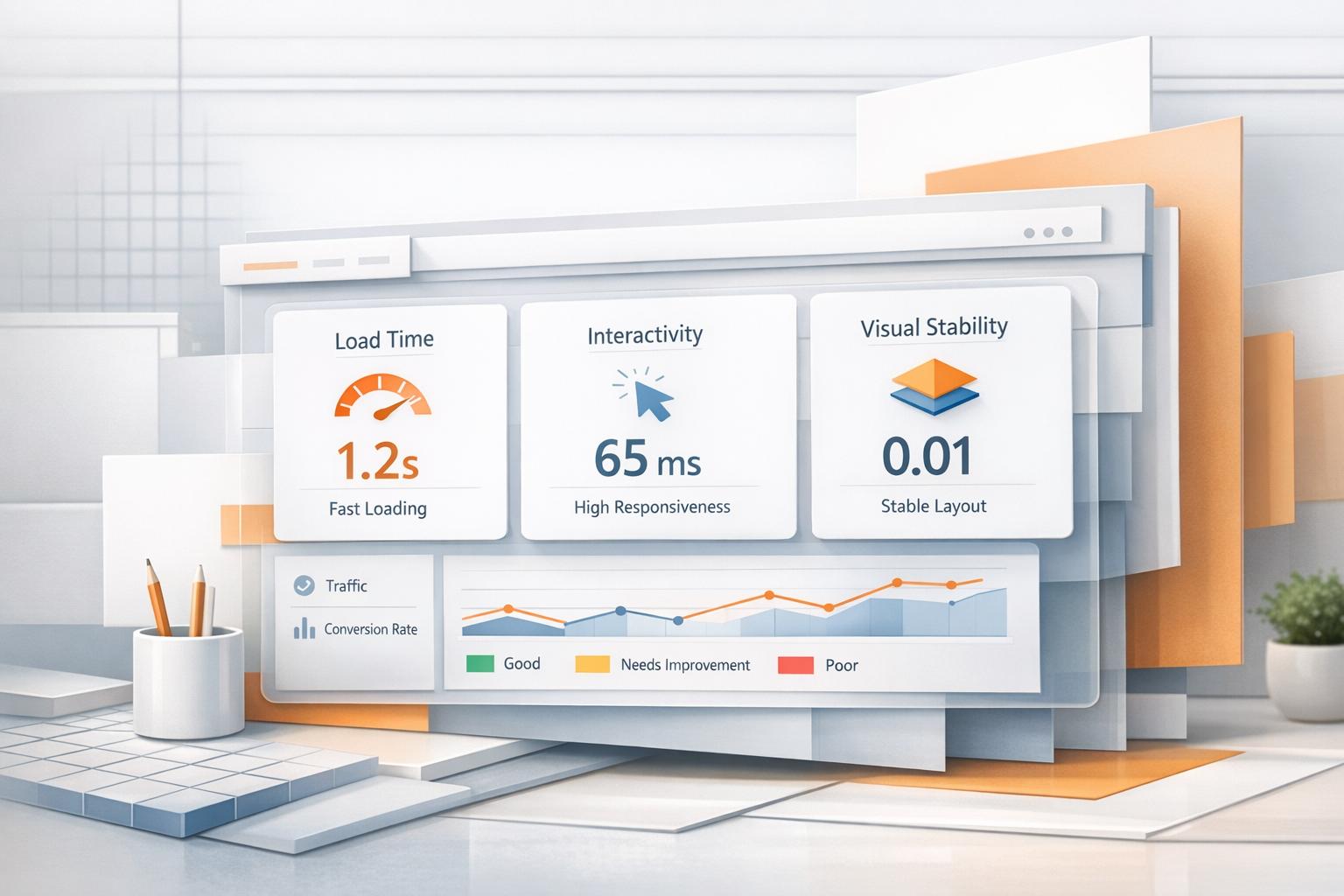
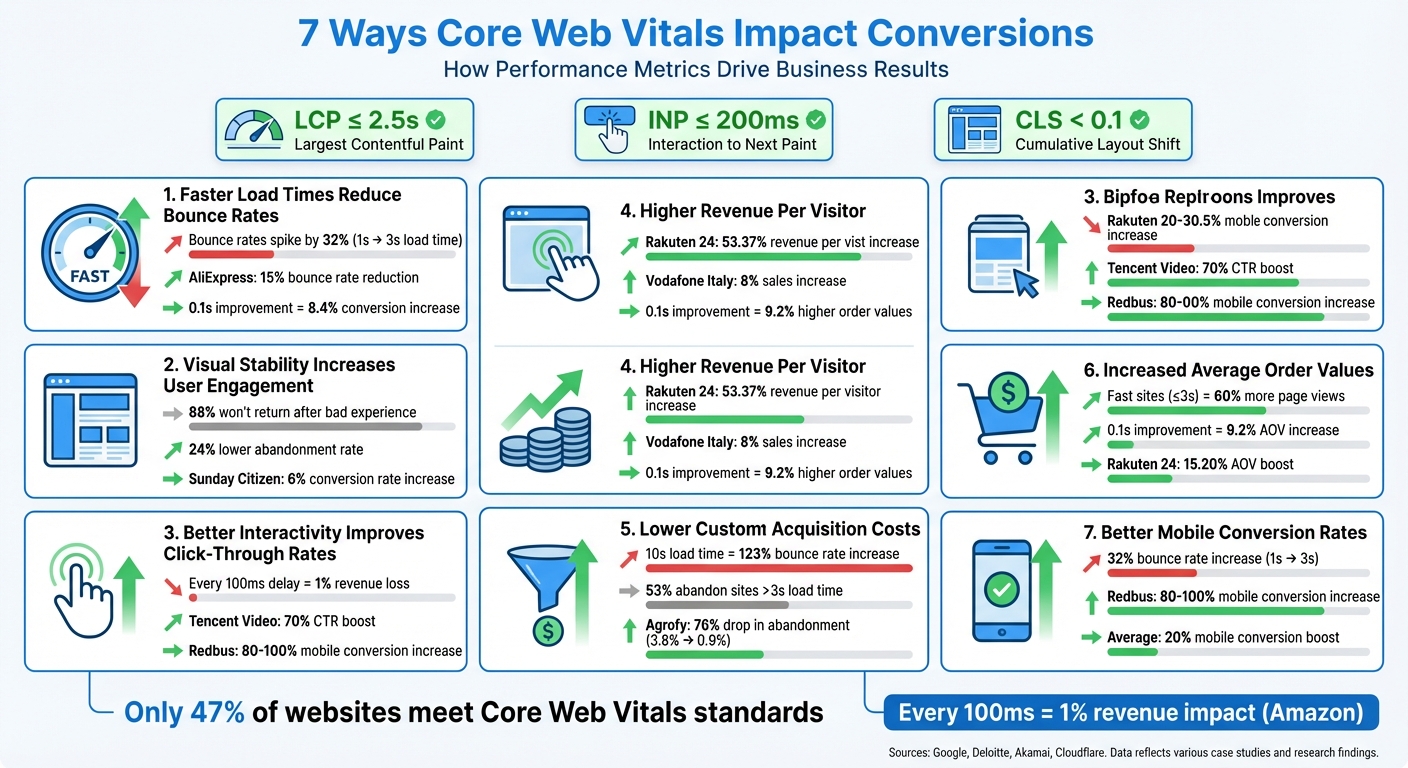
Core Web Vitals are key website performance metrics that directly influence user experience and business outcomes. These include Largest Contentful Paint (LCP) for load speed, Interaction to Next Paint (INP) for responsiveness, and Cumulative Layout Shift (CLS) for visual stability. Meeting Google’s benchmarks (LCP ≤ 2.5s, INP ≤ 200ms, CLS < 0.1) can reduce bounce rates, improve engagement, and increase conversions. Here’s a quick breakdown of how optimizing these metrics helps:
- Faster Load Times: Reduces bounce rates by up to 32%.
- Visual Stability: Prevents layout shifts that frustrate users, boosting engagement.
- Improved Interactivity: Faster responses keep users on-site and increase click-through rates.
- Higher Revenue Per Visitor: Faster sites lead to more purchases and higher order values.
- Lower Customer Acquisition Costs: Better performance makes ad spend more efficient.
- Increased Average Order Values: Smooth experiences encourage higher spending.
- Better Mobile Conversion Rates: Mobile users demand speed; optimized sites convert more.
For example, Vodafone Italy improved sales by 8% after reducing LCP by 31%, and Redbus saw a 100% boost in mobile conversions by improving interactivity. Optimizing Core Web Vitals isn’t just about speed – it’s about turning visitors into loyal customers.
How Core Web Vitals Impact Conversion Rates: 7 Key Performance Metrics
1. Faster Load Times Reduce Bounce Rates
Impact on User Behavior
Did you know that as load times increase from 1 to 3 seconds, bounce rates spike by 32%? That’s a huge drop-off in potential engagement. First impressions matter, and new visitors are especially quick to abandon a sluggish site. For instance, pages that take 3 seconds to load lose 50% more visitors compared to those loading in just 2 seconds. When your main content doesn’t load quickly enough, users often assume the page isn’t worth their time. This behavior is directly tied to performance metrics like Largest Contentful Paint (LCP).
Specific Core Web Vitals Metric Involved
Speaking of LCP, this metric measures how long it takes for the largest and most important element – such as a hero image, headline, or product photo – to fully load on the screen. Google’s benchmark is clear: LCP should occur within 2.5 seconds of the page starting to load. Unfortunately, many websites fall short of this target, with delays reaching up to 1,290 milliseconds at the 75th percentile. These delays don’t just frustrate users – they directly cut into your chances of converting them into customers.
Effect on Conversion Rates
Speed improvements don’t just enhance user experience – they drive results. Take AliExpress, for example: by doubling their LCP performance, they reduced bounce rates by 15%. Rakuten 24 saw even more dramatic results, with a 33.13% boost in conversion rates and a 35.12% drop in exit rates after optimizing LCP and other Core Web Vitals. And here’s the kicker: even a tiny 0.1-second improvement in load time can increase conversions by 8.4% and raise average order values by 9.2% for eCommerce sites. Travel sites experience similar benefits, with conversion rates climbing by as much as 10.1% from the same speed boost. Faster load times don’t just keep users on your site – they turn casual visitors into loyal customers.
2. Visual Stability Increases User Engagement
Specific Core Web Vitals Metric Involved
Cumulative Layout Shift (CLS) measures how stable a page’s visual elements are by tracking unexpected layout movements. To meet Google’s standards, a score of 0.1 or below is required. When images, ads, or other content unexpectedly shift positions, users can unintentionally click on the wrong elements – like an ad or an unintended link – leading to frustration and, often, a quick exit. These sudden shifts can erode user trust, ultimately reducing engagement.
Impact on User Behavior
Here’s a striking fact: 88% of online consumers won’t return to a site after a single bad experience, including those caused by disruptive layout shifts. Such unpredictable movements can make a site feel unreliable and unprofessional. For example, Yahoo! Japan addressed layout instability and saw a 15% increase in page views per session. Similarly, Ameba Manga improved their CLS score tenfold, which led to users reading 2 to 3 times more comics. A stable layout creates a seamless experience, encouraging users to stay longer and engage more.
Effect on Conversion Rates
Better layout stability doesn’t just enhance user experience – it directly boosts conversions. Studies reveal a 0.305 positive correlation between strong CLS scores and goal completions. Websites that meet Core Web Vitals thresholds, including CLS, experience a 24% lower abandonment rate. For instance, Sunday Citizen optimized their CLS in 2024, achieving a 61% improvement, which led to a 4% decrease in bounce rate and a 6% rise in conversion rates. Similarly, Carpe, a skincare brand, improved their CLS by 41% between June 2021 and June 2024, resulting in a 5% increase in conversions and a 15% boost in total revenue. Even ad revenue can see gains – iCook enhanced their CLS by 15% by using fixed-size ad slots, earning 10% more ad revenue.
3. Better Interactivity Improves Click-Through Rates
Specific Core Web Vitals Metric Involved
Interaction to Next Paint (INP) tracks how long it takes for the browser to respond visually after a user clicks, taps, or presses a key. This metric officially replaced First Input Delay (FID) on March 12, 2024, to provide a more comprehensive measure of responsiveness during the entire visit. For a smooth user experience, an INP score of 200 milliseconds or less is recommended. Scores between 200ms and 500ms indicate room for improvement, while anything above 500ms significantly hampers user satisfaction.
Impact on User Behavior
When users interact with a page – like clicking a button or link – they expect an almost instant response, ideally within 100 milliseconds. Any delay beyond this point can lead to frustration. JavaScript tasks that exceed 50 milliseconds block the main thread, interrupting user interactions and creating a sense of lag. This disruption breaks the natural “flow of action”, making it harder for users to complete tasks smoothly. Such interruptions not only frustrate users but also discourage them from continuing their journey on the site, impacting overall engagement.
Effect on Conversion Rates
The consequences of poor interactivity go beyond user annoyance – they directly affect business outcomes. Amazon revealed that every additional 100 milliseconds in response time caused a 1% drop in revenue. On the flip side, improvements in interactivity can lead to impressive gains. For instance, Tencent Video saw a 70% boost in click-through rates (CTR) for videos after meeting Core Web Vitals benchmarks. Similarly, in 2021, the Indian bus ticketing platform Redbus dramatically improved its mobile conversion rates – by 80-100% – after reducing their Total Blocking Time from 1,200ms to 700ms and cutting Time to Interactive from 8 seconds to 4 seconds. These gains were achieved by optimizing third-party scripts and adopting microservices.
“INP keeps users in the flow of action, preventing their frustration and deflation of your balloon before it even takes off.” – Nightwatch
4. Higher Revenue Per Visitor
Specific Core Web Vitals Metric Involved
Each of the three Core Web Vitals metrics plays a role in driving revenue per visitor. Studies show a strong correlation between Largest Contentful Paint (LCP) (0.313), Cumulative Layout Shift (CLS) (0.253), and Interaction to Next Paint (INP) (0.171) with revenue potential. Among these, loading speed (LCP) has the most significant impact.
Impact on User Behavior
When it comes to user behavior, site performance is a game-changer. Speed and stability directly influence how visitors interact with a site. For example, fast-loading websites (3 seconds or less) result in visitors viewing 60% more pages. On the flip side, delays of just over a second can break focus and lead to abandonment rates as high as 47%.
Effect on Conversion Rates
Improving Core Web Vitals can significantly impact revenue and conversions. For instance, Rakuten 24 achieved a 53.37% increase in revenue per visitor, a 15.20% boost in average order value, and a 33.13% rise in conversions. Similarly, Vodafone Italy saw an 8% sales increase after improving LCP by 31%. Even a small improvement, like reducing mobile load time by 0.1 seconds, can lead to a 9.2% increase in retail order values and a 1.9% boost in travel-related transactions.
“Core Web Vitals emerge not as traffic drivers but as the user journey’s subtle enhancers, leading to a tapestry that captivates and converts.” – Portent
How to Pass Google Core Web Vitals and Boost Conversions
sbb-itb-6e49fcd
5. Lower Customer Acquisition Costs
Strong Core Web Vitals not only improve bounce rates and engagement but also play a key role in cutting customer acquisition costs.
Specific Core Web Vitals Metrics That Matter
Core Web Vitals directly influence how much you spend to acquire customers. Largest Contentful Paint (LCP) affects whether visitors from paid ads stick around long enough to see your offer. Cumulative Layout Shift (CLS) eliminates those annoying layout changes that lead to accidental clicks and frustrated users. Interaction to Next Paint (INP) ensures that critical actions, like submitting forms or clicking “Add to Cart”, happen instantly, reducing the risk of losing users at the last moment. Together, these metrics create a seamless user experience, guiding potential customers from their first interaction to final conversion.
How User Behavior Is Impacted
Poor Core Web Vitals can drain your advertising budget. A site that takes 10 seconds to load can see bounce rates soar by 123%. Plus, 53% of mobile users will abandon a site if it doesn’t load within 3 seconds. Even worse, 88% of users are unlikely to return after a bad experience, such as unexpected layout shifts. Here’s a real-world example: Agrofy improved its Core Web Vitals in 2020, reducing product page abandonment rates from 3.8% to 0.9%. That’s a staggering 76% drop, making their advertising spend far more efficient.
Boosting Conversion Rates
Optimizing Core Web Vitals can increase conversions without requiring additional traffic, which directly reduces your cost per acquisition. For instance, in 2024, Carpe tackled render-blocking issues, improving their LCP by 52% and CLS by 41%. The result? A 5% jump in conversion rates and 10% more traffic.
“Effective CRO enables you to achieve more conversions without the need to attract more visitors… lowering the average cost per acquisition.” – Niko Kaleev, User Experience Content Expert, NitroPack
Enhanced Core Web Vitals also improve organic search rankings, reducing dependence on paid advertising. With only 47% of websites currently meeting Core Web Vitals standards, optimizing your site gives you a clear edge over competitors who are losing traffic due to poor performance. In fact, pages that rank in the top spot on Google are 10% more likely to meet Core Web Vitals criteria than those ranked at position 9.
6. Increased Average Order Values
Specific Core Web Vitals Metrics Involved
Improving your site’s performance with Core Web Vitals can have a direct impact on how much customers spend during each visit. For example, optimizing Largest Contentful Paint (LCP) ensures that key product images and descriptions load quickly, creating a seamless first impression. Reducing Cumulative Layout Shift (CLS) eliminates those annoying page jumps that disrupt the shopping experience, while enhancing Interaction to Next Paint (INP) makes actions like clicking “Add to Cart” feel instant and reliable. Together, these tweaks create a smooth and enjoyable shopping experience, encouraging customers to explore more products and engage further with your site.
Impact on User Behavior
Fast-loading pages keep shoppers engaged. When a site loads in 3 seconds or less, users tend to view about 60% more pages compared to slower sites. This extended browsing not only increases the likelihood of product discovery but also encourages customers to spend more during their visit.
Effect on Conversion Rates
There’s a clear connection between improved Core Web Vitals and higher average order values (AOV). Even a small improvement in speed – like shaving off 0.1 seconds – can increase AOV by 9.2% and boost page views per session by 8.6%. For instance, Rakuten 24 achieved a 15.20% rise in AOV and a 53.37% increase in revenue per visitor by optimizing metrics like LCP, INP, and CLS. Similarly, Vodafone Italy enhanced LCP by 31% through server-side rendering and cutting down on render-blocking JavaScript, leading to an 8% boost in sales.
Good CLS scores also play a role, with a moderate correlation (0.305) to successful goal completions. Beyond the numbers, it’s worth noting that 59% of customers are willing to spend more for an excellent experience, and 83% rank the overall experience as equally important as the products themselves.
7. Better Mobile Conversion Rates
Specific Core Web Vitals Metrics Involved
Optimizing for mobile is critical because mobile devices often face challenges like limited processing power and unreliable network connections. To meet user expectations, Largest Contentful Paint (LCP) should load within 2.5 seconds, Cumulative Layout Shift (CLS) must stay below 0.1, and Interaction to Next Paint (INP) should respond within 200 milliseconds. With 73% of mobile pages relying on images for their LCP and 35% struggling with delays in image discovery, improving image load times becomes a top priority. These metrics directly influence how users perceive the experience on mobile devices.
Impact on User Behavior
Mobile users demand speed – responses within 100 milliseconds are the expectation. Anything slower leads to frustration and dissatisfaction. For instance, bounce rates jump by 32% when load times increase from 1 to 3 seconds. On mobile, visual stability is especially crucial; layout shifts can cause users to tap on the wrong buttons or ads, eroding trust and leading to immediate abandonment. In fact, research shows a moderate positive correlation (0.305) between better CLS scores and higher goal completions.
Effect on Conversion Rates
The effect on mobile conversion rates is dramatic. For example, Redbus, a travel platform, saw an 80–100% increase in mobile conversions after improving its Core Web Vitals. Even a small delay – just 100 milliseconds – can reduce conversion rates by 7%. Mobile users are less forgiving; if your site doesn’t load almost instantly, they leave.
On average, fully optimizing Core Web Vitals can result in a 20% boost in mobile conversion rates. This is especially impactful when you consider that only 47% of websites currently pass the Core Web Vitals assessment. Amazon’s research highlights the stakes: every 100 milliseconds of extra load time can cost 1% in revenue. By focusing on mobile Core Web Vitals, businesses not only retain users but also see measurable improvements in conversions and revenue.
Using AI Tools to Optimize Core Web Vitals
Modern platforms are now combining tools for improving Core Web Vitals with content testing, streamlining both into a single process. For instance, PageTest.AI uses AI-powered A/B testing alongside techniques like synchronous load and body hide to maintain Core Web Vitals scores. By adding just one script to your website’s header, the system can identify elements and implement changes in under 50 milliseconds. This approach transforms faster load times and smoother user interactions into tangible business outcomes.
With no-code testing, you can experiment with headlines, CTAs, button text, and product descriptions – all without needing a developer. The platform also automates tasks like image compression, lazy loading, and CSS/JS minification, which directly improve metrics like Largest Contentful Paint (LCP) and Cumulative Layout Shift (CLS). At the same time, it generates AI-based content variations while ensuring quick and seamless rendering. These automated processes not only enhance performance but also set a solid foundation for tracking results.
Performance tracking takes these optimizations a step further. Beyond basic conversion metrics, PageTest.AI monitors user actions like clicks, engagement, time spent on a page, and scroll depth. These insights reveal how your content and Core Web Vitals impact user behavior. Plus, the platform integrates effortlessly with popular website builders like WordPress, Wix, and Shopify, making it accessible for a wide range of users.
Conclusion
Core Web Vitals play a pivotal role in shaping user experience and driving conversions. Faster load times reduce bounce rates, stable layouts keep visitors engaged, and responsive interactions turn clicks into meaningful actions. By improving Core Web Vitals, businesses can see measurable gains in conversion rates and revenue – especially on mobile, where performance improvements often lead to noticeable results.
The link between performance and revenue is undeniable. Pages that load in under 2.5 seconds foster trust and encourage higher spending per order. In fact, with 53% of mobile users abandoning pages that take longer than three seconds to load, every millisecond matters.
Modern tools make these improvements easier to achieve. For instance, PageTest.AI streamlines the process by combining performance optimizations with content testing. It automates tasks like image compression, lazy loading, and CSS optimization, all while enabling you to test headlines and CTAs without writing any code.
Investing in Core Web Vitals offers long-term benefits, including lower customer acquisition costs, increased organic traffic, and more efficient use of marketing budgets.
“Decision makers should treat this as a long term investment into growth of their business. Delivering a fast and seamless navigation experience delights users and helps turn them into loyal and returning customers.” – web.dev
Ultimately, focusing on Core Web Vitals transforms user experience into tangible business growth.
FAQs
How do Core Web Vitals impact conversions?
Core Web Vitals impact conversions by improving how users experience your website. Faster loading pages (Largest Contentful Paint), steady visual elements (Cumulative Layout Shift), and seamless interactions (Interaction to Next Paint) help minimize bounce rates and keep visitors engaged.
When users land on a website that’s quick, reliable, and visually stable, they’re more inclined to stick around, browse, and take meaningful actions – like completing a purchase or signing up. This smoother experience not only builds trust but also leads to better conversion results.
What are the recommended Core Web Vitals benchmarks for better performance?
To hit the “good” thresholds for Core Web Vitals and ensure your site performs at its best, aim for these benchmarks:
- Largest Contentful Paint (LCP): Keep it at 2.5 seconds or less to ensure quick loading of the main content.
- Cumulative Layout Shift (CLS): Maintain a score of less than 0.1 to avoid unexpected layout shifts that frustrate users.
- Interaction to Next Paint (INP): Target 100 milliseconds or less for smooth and responsive interactions.
Meeting these standards helps create a fast, stable, and user-friendly experience – key factors in boosting engagement and driving conversions.
What are the best ways for businesses to improve their Core Web Vitals?
To boost Core Web Vitals, businesses should begin by pinpointing performance issues with tools like PageSpeed Insights or Search Console. These tools provide insights into where metrics such as Largest Contentful Paint (LCP), Cumulative Layout Shift (CLS), and Interaction to Next Paint (INP) may be underperforming. From there, specific improvements can be made:
- Cut server response times by upgrading to faster hosting or using a Content Delivery Network (CDN).
- Optimize images with compressed, next-gen formats and implement lazy-loading to improve load speed.
- Prevent layout shifts by setting explicit width and height attributes for media elements.
- Simplify CSS and JavaScript by deferring non-critical resources and eliminating render-blocking elements.
After implementing these technical fixes, it’s essential to measure their effect on user behavior and conversions. Tools like PageTest.AI can help test and refine key website elements – think headlines, CTAs, or button text. Pairing performance enhancements with A/B testing ensures that faster load times not only improve user experience but also lead to tangible increases in engagement and revenue.
Related Blog Posts
say hello to easy Content Testing
try PageTest.AI tool for free
Start making the most of your websites traffic and optimize your content and CTAs.
Related Posts
05-03-2026
 Ian Naylor
Cumulative Layout Shift: Debugging Guide
Fix layout shifts by setting media dimensions, reserving ad/embed space, optimizing fonts, and using Chrome DevTools and PerformanceObserver to lower CLS.

03-03-2026
Ian Naylor
How to Use AI for Dynamic Content Personalization
Step-by-step guide to using AI to collect behavior data, segment users, create personalized headlines and CTAs, run tests, and optimize conversions.

02-03-2026
Ian Naylor
AI Content Personalization: Expert Guide
AI personalization uses unified profiles, predictive analytics, and real-time updates to serve tailored content that boosts conversions.