


Semantic Search: Boosting Conversions with AI

Semantic Search: Boosting Conversions with AI
 21-03-2026 (Last modified: 11-09-2026)
Semantic search has redefined how search engines work – shifting from exact keyword matches to understanding user intent and context. This evolution, powered by AI technologies like NLP and machine learning, is helping businesses improve their website conversions. Here’s why it matters:
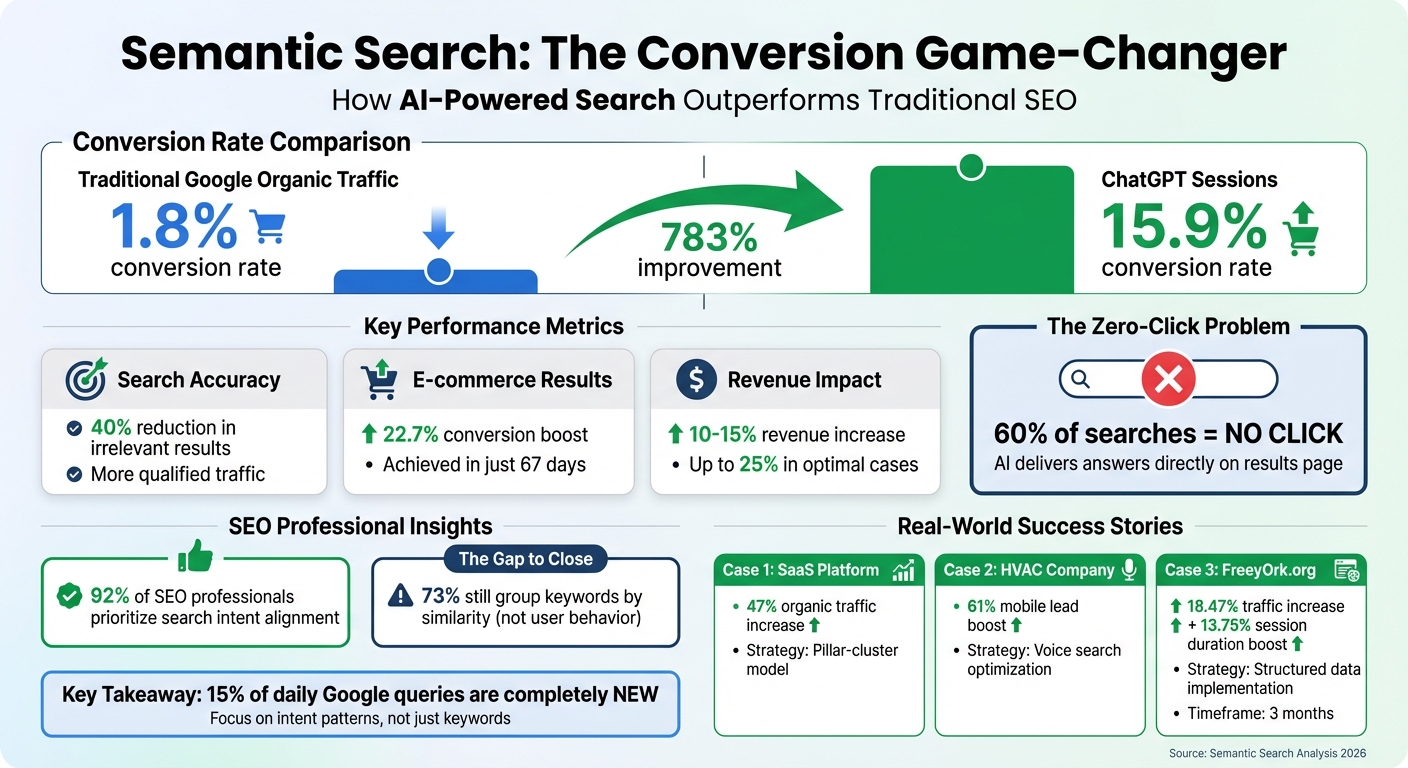
- Improved Search Accuracy: Semantic search reduces irrelevant results by up to 40%, leading to more qualified traffic.
- Better Conversions: Businesses using semantic search have reported conversion rate increases, with one e-commerce site seeing a 22.7% boost in just 67 days.
- AI-Driven Insights: Tools like ChatGPT show conversion rates as high as 15.9%, compared to 1.8% for traditional organic traffic.
To succeed, businesses need to focus on creating content that aligns with user intent, organizes information into topic clusters, and uses structured data like schema markup. AI tools can further optimize conversions by testing and refining content variations in real time.
Key Takeaways:
- Stop focusing solely on keywords; prioritize user intent and deeper content.
- Use AI to test and refine content for better engagement and conversions.
- Leverage semantic search strategies like topic clusters, schema markup, and short and long-tail keywords to stay competitive.
The future of search lies in intent-driven, AI-supported content strategies that deliver both value to users and measurable business results.
Semantic Search vs Traditional SEO: Key Performance Metrics and Conversion Statistics
How AI Powers Semantic Search and Conversion Optimization
AI and Semantic Search Algorithms
AI has transformed search engines by moving beyond simple keyword matching to actually understanding the meaning behind words. Using vector embeddings, search engines map words into numerical space, grouping related concepts together. This process calculates cosine similarity between queries and content, making it easier to connect similar ideas and structure content with conversions in mind.
Generative AI takes things a step further by expanding a single search query into multiple related questions. It pulls data from various sources to provide a more complete answer. This is why search engines now often display direct answers on results pages instead of just links to external content.
Interestingly, about 60% of search queries no longer result in a click because AI delivers answers directly on the search results page. For businesses, this trend highlights the importance of structuring content in a way that AI can easily interpret and extract key details.
Understanding how these mechanisms work is crucial for using AI insights to boost conversions.
AI-Driven Insights for Conversion Optimization
AI’s ability to process language at a deeper level is now being used to optimize conversions by delivering highly personalized content. The results are striking – ChatGPT sessions, for example, boast a conversion rate of 15.9%, compared to just 1.8% for traditional Google organic traffic. This sharp difference underscores how aligning search results with user intent can dramatically improve outcomes.
AI also improves conversion rates by analyzing user behavior in real time. It adjusts content displays based on browsing history, location, or past purchases. This level of hyper-personalization can increase revenue by 10–15%, and in some cases, by as much as 25%. On top of that, AI can pinpoint which products a user is most likely to buy and prioritize those in the search results.
Content structure plays a critical role too. Features like integrated FAQ sections and well-aligned meta descriptions not only improve user experience but also make content more likely to be cited by AI. These strategies highlight the importance of semantic alignment in boosting visibility and performance within an AI-driven search environment.
sbb-itb-6e49fcd
Practical Strategies to Optimize Content for Semantic Search
Focus on User Intent and Long-Tail Keywords
Instead of chasing exact keyword matches, focus on the underlying needs of your audience. Here’s a striking statistic: 92% of SEO professionals emphasize aligning content with search intent as critical for rankings. Yet, surprisingly, 73% of content creators still group keywords based on similarity rather than user behavior.
To better align with user intent, try a three-step analysis:
- Primary Intent: What is the immediate problem they’re trying to solve?
- Contextual Intent: What broader situation are they dealing with?
- Progressive Intent: What’s the next logical step they’re likely to take?
Take the example of someone searching for “best CRM software.” Their immediate intent might be to compare options, their broader concern could involve managing a growing sales team, and their next step might be finding software that integrates with their existing tools.
To avoid keyword overlap and ensure your content addresses user needs effectively, apply the “60% rule”. If two keywords share at least 60% of the same top 10 search results, they belong in the same content piece. This strategy helps prevent content cannibalization and ensures you’re covering the full scope of user intent. With 15% of daily Google queries being completely new, it’s essential to focus on intent patterns rather than rigid keyword strings.
Voice search optimization is another way to tap into intent. For example, an HVAC company saw a 61% boost in mobile leads by structuring their content around natural language questions their customers frequently ask. This approach highlights the importance of conversational targeting in modern SEO.
Create Topic Clusters and In-Depth Content
Organizing your content into topic clusters supported by a central pillar page is a proven way to demonstrate expertise across a subject. This structure not only improves user navigation but also helps search engines understand your authority on a topic.
Start by mapping out 15–25 entities related to your topic – these can include people, places, concepts, or tools. These entities form the backbone of your content strategy. For instance, a SaaS project management platform increased their organic traffic by 47% simply by adopting a pillar-cluster model.
Internal linking plays a key role in reinforcing these relationships. Cluster pages should link back to the pillar page, the pillar page should link to all clusters, and clusters should cross-link where relevant. This interconnected structure signals to search engines how your content pieces fit together.
“Instead of focusing on collecting a lot of keywords, focus on the topics and keywords used in your content. Try to build upon this. Don’t forget relevant and on-topic internal linking opportunities and structuring of the content.”
- Fili Wiese, Technical SEO Consultant at SearchBrothers
When it comes to content length, pillar pages often require 2,500–4,000 words, while cluster articles typically range between 1,000 and 2,500 words. However, the focus should always be on delivering value, not hitting arbitrary word counts. Interestingly, pages with integrated FAQ blocks average 4.9 AI citations, compared to 4.4 for pages without them. This shows that thoughtful structure can be just as impactful as word count.
With a solid content structure in place, the next step is to make your content even more accessible to search engines through structured data.
Implement Schema Markup and Rich Snippets
Structured data helps search engines understand your content in greater depth. For example, freeyork.org experienced an 18.47% increase in organic traffic and a 13.75% boost in session duration within three months of implementing structured data.
Using schema markup like Organization and Person schema establishes your brand and authors as credible entities within Google’s Knowledge Graph, which contains over 500 billion facts about 5 billion entities. The “worksFor” property, for example, links authors to your organization, strengthening your E-E-A-T (Experience, Expertise, Authoritativeness, Trustworthiness) signals.
Other useful schema types include:
- HowTo schema: Perfect for step-by-step instructions, making your content easily digestible for AI assistants.
- BreadcrumbList schema: Highlights your site hierarchy, reinforcing the relationship between pillar pages and clusters.
- Article schema: Use the “about” and “mentions” properties to clearly define the primary and secondary topics your content covers.
To ensure accuracy, regularly validate your structured data using tools like Google’s Rich Results Test and Schema Markup Validator. As search engines increasingly rely on “AI Overviews”, semantically rich structured data will be key to securing a spot in AI-generated summaries.
Boost conversions with AI-powered site search for eCommerce
Using PageTest.AI for Semantic Conversion Testing
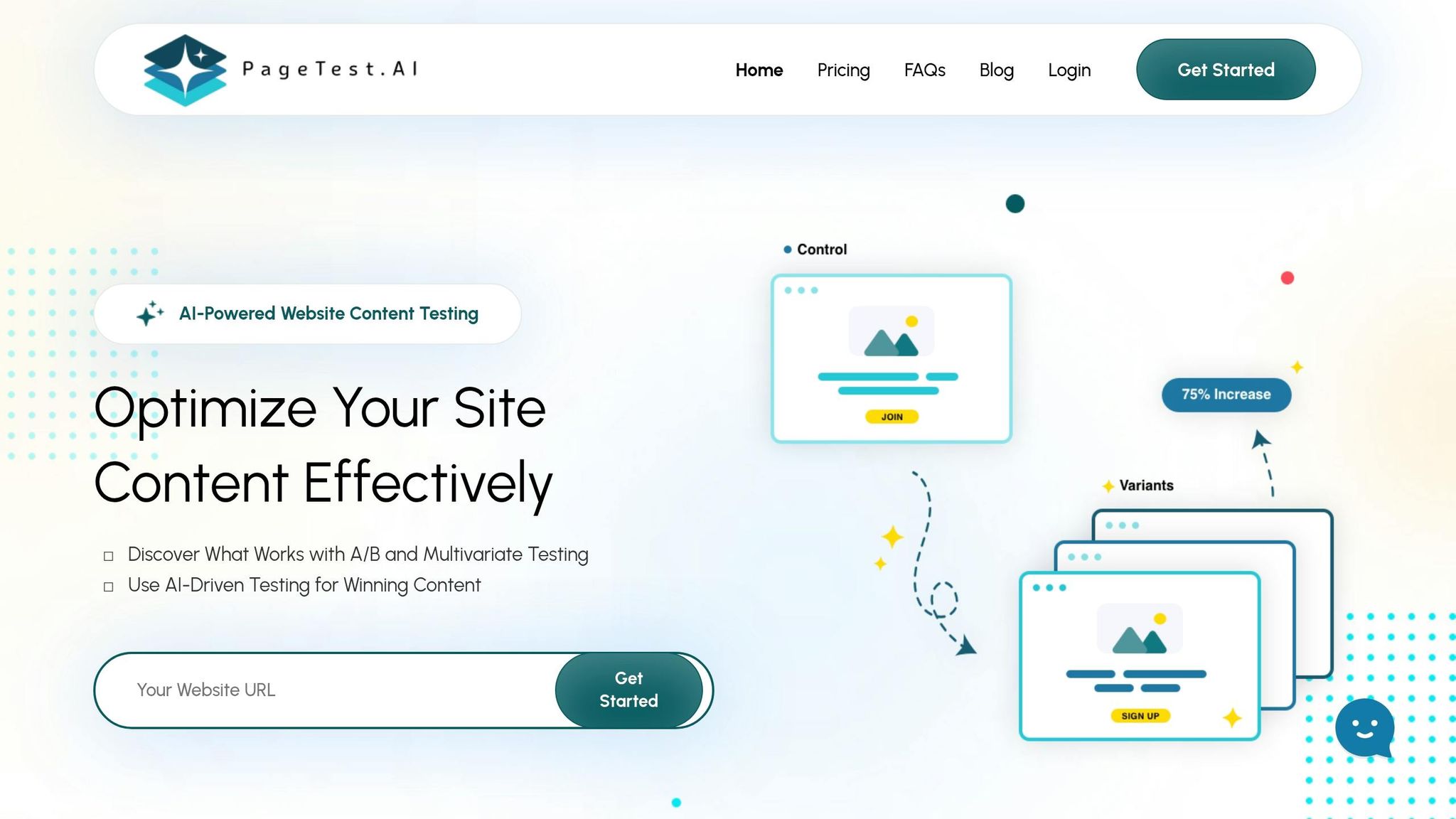
Testing is a key step in ensuring your content aligns with user intent and drives conversions. Building on earlier strategies, PageTest.AI simplifies this process by offering tools to refine and validate your content variations.
AI-Powered Content Testing Made Easy
With PageTest.AI, you can bypass technical hurdles and start testing instantly. Using a Chrome extension, you can select any page element for testing. The platform then generates up to 10 AI-driven content variations based on real conversion data. This makes it easier to uncover phrasing that resonates with your audience, particularly in the context of semantic search optimization, where matching the natural language of users is critical.
“I love that you have a chrome extension, it makes it so much easier!” – Werner Geyser, Founder, Influencer Marketing Hub
Getting started is simple. Add a JavaScript snippet to your site, or use WordPress and Shopify plugins if applicable. Then, highlight the elements you want to test via the Chrome extension. The AI will create variations tailored to different semantic intents – whether they are informational, transactional, or navigational. This streamlined process allows you to efficiently test and pinpoint the messaging that best connects with your visitors.
Tracking Key Metrics for Conversion Success
PageTest.AI tracks essential behavioral signals like time on page, scroll depth, and click events to measure how well your content drives conversions.
You can define success based on your goals – whether it’s tracking button clicks, analyzing scroll depth, monitoring time spent on a page, or observing how users move through your conversion funnel. These insights help determine whether your semantic optimizations are keeping users engaged, a factor search engines consider when evaluating content relevance.
The platform’s real-time dashboard provides an easy-to-read visual summary: Green indicates outperforming variations, Red/Pink shows underperforming ones, and a Gold Trophy highlights statistically significant winners. This clear feedback helps you quickly identify the most effective semantic variations, paving the way for tangible conversion improvements.
Case Example: Optimizing Product Descriptions
A 2025/2026 case study demonstrated how PageTest.AI can transform engagement. A CTA button originally labeled “Generate my app free” received only 2 clicks during testing. An AI-suggested alternative, “Make my app free and easy”, resulted in 11 clicks – a 297% increase. Across 11,000 impressions and 7 tests, another CTA variation achieved a 220% improvement in clicks.
“Knowing we can test every call to action and optimize our SEO efforts is very satisfying.” – David Hall, CEO, AppInstitute
Even on the entry-level Starter plan ($299/month, 10,000 test impressions), PageTest.AI makes it possible for businesses of all sizes to refine their content. By consistently testing different semantic approaches, you can develop a data-driven understanding of the language that converts best for your audience.
Measuring Success and Continuous Improvement
When it comes to gauging success, focus on how well your content addresses user needs and drives conversions – not just where it ranks. With semantic search optimization, the real question is whether your content meets searchers’ expectations and contributes to your business goals.
Analyzing Conversion Data with AI Tools
To get a complete picture of performance, you need a multi-layered approach to metrics. Start with basics like crawlability and schema markup, then move to more advanced indicators like Topic Visibility Scores. These scores aggregate impressions and clicks across an entire topic cluster, rather than isolating individual keywords. Another key metric is the Entity Presence Score, which tracks how many of your pages reference core entities using proper schema markup.
“One keyword does not represent a topic. Clusters span dozens of intents and query phrasings.” – Grégory STOOS
Pages enriched with semantic depth tend to perform better, with increases of 15–25% in dwell time and 10–30% in conversions compared to more generic pages. AI tools also allow you to measure your AI Inclusion Rate, which reflects how often your brand appears in AI-generated summaries, such as those in Perplexity or ChatGPT responses. This metric highlights whether AI systems recognize your content as authoritative. Even a small boost in your semantic score – just 0.1 – can lead to a 3–7% increase in conversions within a month.
To stay ahead, review your metrics weekly. Export data from Google Search Console for your top 50 queries and categorize them by intent type: informational, navigational, transactional, or commercial investigation. This helps you spot content that doesn’t align with searcher intent. Use AI tools to test variations of headlines and CTAs; adding primary keywords and numeric values to titles can increase click-through rates by 18–32% for pages already performing well in the top 10 search results.
While metrics offer valuable insights, achieving long-term success requires consistent efforts to build and maintain semantic authority.
Building Long-Term Authority with Semantic SEO
Sustained growth in semantic SEO relies on treating optimization as an ongoing process. Regularly update your content every 3–6 months with fresh statistics, updated examples, and relevant visuals to ensure it stays useful for both users and AI models. Aim for a Cluster Completeness Index above 90% by covering all planned subtopics and FAQs within your content clusters.
Boost your E-E-A-T (Experience, Expertise, Authoritativeness, Trustworthiness) signals by including detailed author bios, complete with credentials and first-hand case studies. For YMYL (Your Money or Your Life) topics, it’s especially important to include expert reviewers. Track the percentage of your cluster pages that incorporate these elements. Additionally, link your revenue data to entire topic clusters instead of individual landing pages. This approach ties your semantic efforts directly to measurable business outcomes.
“Semantic SEO wins when you measure meaning, not just rankings.” – Grégory STOOS
Conclusion: Using Semantic Search and AI to Drive Conversions
The way businesses approach conversion optimization in 2026 has been reshaped by semantic search. It’s no longer just about matching keywords – it’s about understanding user intent. This shift means you can attract visitors who are more likely to take action, whether that’s making a purchase, signing up, or submitting an inquiry. The strategies outlined here – from topic clusters and schema markup to long-tail keywords and AI-powered testing – help align your content with both search engine algorithms and what users genuinely need.
AI tools play a key role in speeding up this process. Instead of waiting weeks or months for traditional A/B testing results, platforms like PageTest.AI allow you to experiment with multiple variations of headlines, CTAs, and product descriptions all at once. This faster feedback loop, driven by AI insights, enhances your semantic search strategy. For example, testing has shown engagement metrics improving by 220% to 297% when using AI-based tools. These kinds of results can make a real difference to your bottom line.
Keeping your content aligned with evolving search behaviors requires constant updates. Metrics like click-through rates from rich snippets and engagement times are crucial for monitoring progress. AI tools can refine your approach further by identifying trends and offering actionable recommendations. In one notable example, QliqQliq used AI to test landing page variations and saw a 15% boost in conversions within just three weeks. This kind of rapid iteration highlights the power of combining semantic SEO with intelligent testing.
Failing to adapt to semantic search risks leaving your business behind. Search engines now favor content that’s intent-driven, comprehensive, and trustworthy. By following the strategies in this guide and leveraging tools like PageTest.AI – which offers 10,000 free test impressions each month – you can stay ahead of the competition and continuously improve your conversion rates. The future of search is here, and with the right tools, you can thrive in it.
FAQs
How is semantic search different from keyword SEO?
Semantic search prioritizes grasping the meaning, intent, and context behind a query, rather than just matching exact words or phrases. Unlike old-school keyword strategies like stuffing pages with terms, semantic search leverages AI and natural language processing to provide results that are more in tune with what users actually want. This approach underscores the importance of creating clear, well-organized content that genuinely addresses user needs, instead of focusing purely on keyword frequency.
How can I optimize content for user intent fast?
Using AI tools like PageTest.AI can help you fine-tune your content to match user intent more effectively. These tools allow you to test and adjust key website elements, such as headlines, CTAs, and different content variations. By analyzing user behavior and leveraging semantic search insights, they generate tailored content that aligns with what users are looking for. This means you can quickly make updates that boost relevance, enhance engagement, and drive conversions – all while saving time.
What metrics prove semantic SEO is boosting conversions?
Metrics that show how semantic SEO affects conversions include user engagement, citation frequency, content relevance, use of structured data, and content freshness. Together, these elements boost visibility, encourage more interactions, and lead to stronger outcomes.
Related Blog Posts
say hello to easy Content Testing
try PageTest.AI tool for free
Start making the most of your websites traffic and optimize your content and CTAs.
Related Posts

31-08-2026
 Becky Halls
Spiralyze alternatives: CRO agency or software in 2026?
Spiralyze makes an offer that’s hard to argue with. “30% lift in 90 days. No fee until we deliver.” More precisely: 10 tests, 3 wins, more than 30% lift in your first 90 days, and you pay nothing until they’ve done it. I’ll say plainly what most competitor pages wouldn’t. On risk alone, that’s a better offer than […]

31-08-2026
Becky Halls
AB Tasty alternatives: an honest comparison for 2026
AB Tasty is a strong platform with a well-liked support team, sitting at 4.4 on G2 across 418 reviews. Reviewers on TrustRadius describe it as better value than pricier AB Tasty alternatives, which in this category is a real compliment. It also has the most unusual buying process here. No published pricing, and no free […]

31-08-2026
Becky Halls
The best Optimizely alternative: a comparison for 2026
Optimizely is the most capable experimentation platform on the market. I don’t think that’s seriously disputed. Server-side testing, feature flags, personalization, statistical depth, and it all runs at genuine enterprise scale. In 2026 they’ve wrapped the whole thing in “agentic experimentation” branding and shipped an AI variation development agent, and the underlying Web Experimentation product […]