


Website Conversion Rate Estimator
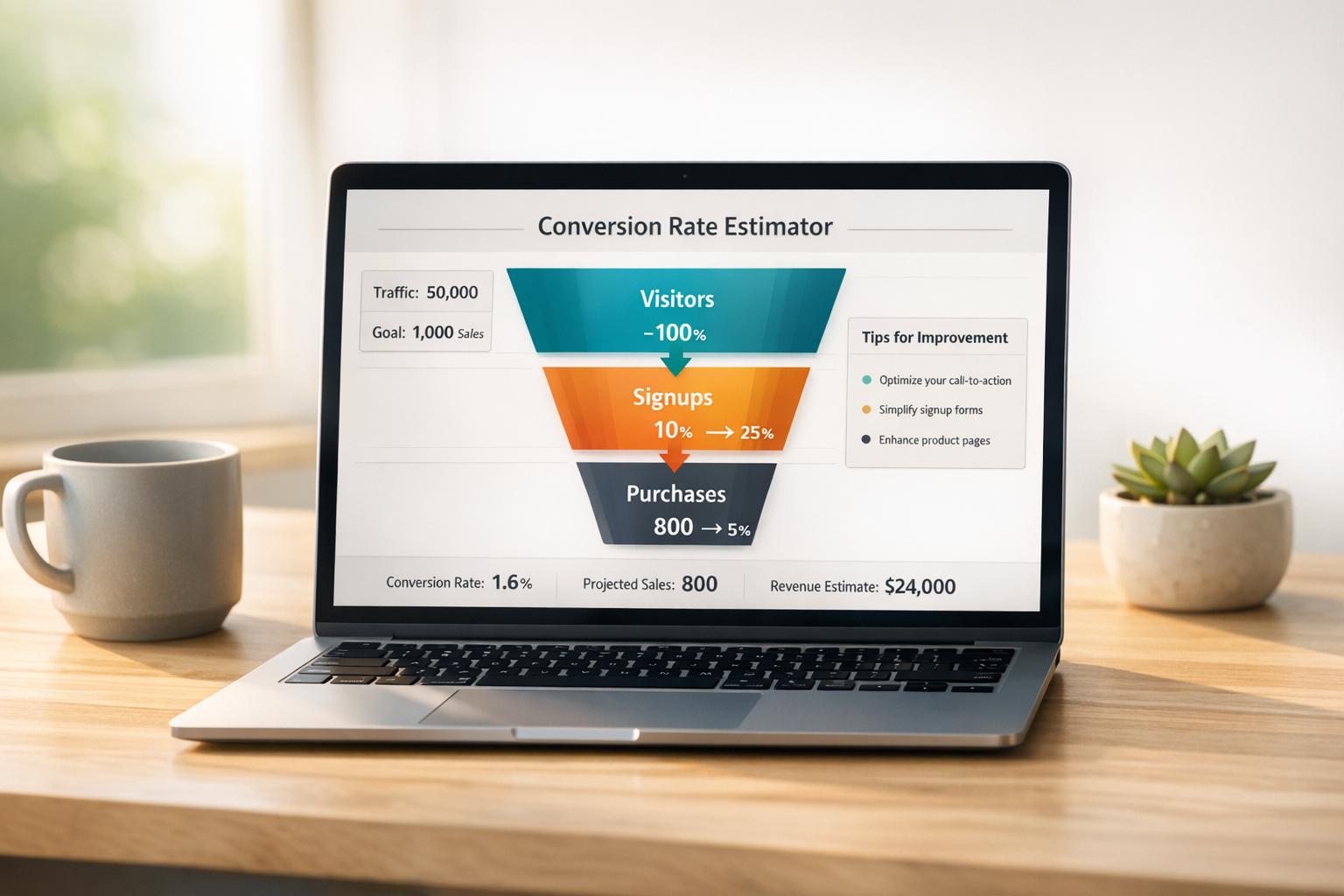
Website Conversion Rate Estimator
 07-02-2026 (Last modified: 16-02-2026)
Unlock Your Website’s Potential with a Conversion Rate Estimator
Most businesses know their traffic numbers.
Fewer know their true conversion potential.
And even fewer know what a small improvement in conversion rate would actually mean for revenue.
A Website Conversion Rate Estimator helps you model the impact of incremental improvements before you invest time or budget into optimisation.
Because guessing what a “better conversion rate” looks like isn’t a strategy. Modelling it is.
Why does conversion rate matter more than traffic?
Traffic is visible. Conversion rate is leverage.
If your website converts at 2% and you increase it to 3%, that’s a 50% improvement in output without increasing traffic.
In our experience, improving conversion rate consistently outperforms increasing traffic when budgets are limited. Ian Naylor, Founder at PageTest.ai
We’ve seen businesses double revenue without increasing visitors, simply by improving on-page clarity, CTA placement, and friction points.
The Website Conversion Rate Estimator makes that leverage visible.
What does a Website Conversion Rate Estimator actually do?
A Website Conversion Rate Estimator calculates the potential revenue impact of improving your current conversion rate.
It typically models:
-
total visitors
-
current conversion rate
-
average order value or lead value
-
projected conversion improvement
Instead of asking:
“How do we improve conversions?”
You start asking:
“What happens if we improve conversion by 0.5%?”
That question changes everything.
Because small improvements often have large financial consequences.
How much difference can small improvements really make?
More than most teams expect.
Let’s say you have:
-
20,000 monthly visitors
-
2% conversion rate
-
£100 average order value
That’s £40,000 in monthly revenue.
If you increase conversion to 2.5%, revenue jumps to £50,000.
No extra traffic. Just improved performance.
We’ve found that many businesses underestimate how powerful incremental optimisation can be.
And once they see the numbers, prioritisation becomes easier.
Why do most websites underperform on conversion?
Because optimisation is reactive, not strategic.
Common issues include:
-
unclear value propositions
-
weak or vague CTAs
-
too many competing actions
In our experience, many underperforming pages don’t need redesigns. They need clarity and testing.
The estimator helps you understand the why behind making those changes.
How should you use a Website Conversion Rate Estimator?
A practical workflow looks like this:
-
Input current traffic and conversion rate
-
Model realistic improvement targets (0.5%, 1%, 2%)
-
Calculate revenue impact
-
Identify which tests justify the effort
-
Run controlled experiments
This prevents optimisation from feeling abstract.
Instead of “let’s improve UX,” you’re saying:
“A 1% lift equals £X per month. That’s worth testing.”
We’ve seen this mindset shift improve decision-making across marketing teams.
Where does testing fit into conversion modelling?
The estimator shows potential. Testing proves reality.
Once you know the financial impact of improvement, you can test:
-
headline clarity
-
CTA wording
-
page structure
-
section order
-
pricing display
-
trust elements
In our experience, the biggest conversion lifts often come from:
-
simplifying messaging
-
removing distractions
-
improving above-the-fold clarity
Not from adding more features.
Modelling + testing creates a loop of measurable improvement.
Can small businesses benefit from this too?
Absolutely! Smaller businesses often benefit even more because:
-
traffic is limited
-
budgets are tighter
-
incremental gains matter more
A 1% lift on 5,000 visitors may not sound huge, but when margins are tight, that improvement compounds fast.
We’ve seen small brands grow sustainably by focusing on conversion rate before increasing ad spend.
Final takeaway
If you don’t know what a better conversion rate is worth, you won’t prioritise optimisation properly.
A Website Conversion Rate Estimator turns abstract percentages into real numbers.
And once you see the revenue impact of even small improvements, testing stops being optional.
It becomes strategic.
say hello to easy Content Testing
try PageTest.AI tool for free
Start making the most of your websites traffic and optimize your content and CTAs.
Related Posts

31-08-2026
 Becky Halls
Spiralyze alternatives: CRO agency or software in 2026?
Spiralyze makes an offer that’s hard to argue with. “30% lift in 90 days. No fee until we deliver.” More precisely: 10 tests, 3 wins, more than 30% lift in your first 90 days, and you pay nothing until they’ve done it. I’ll say plainly what most competitor pages wouldn’t. On risk alone, that’s a better offer than […]

31-08-2026
Becky Halls
AB Tasty alternatives: an honest comparison for 2026
AB Tasty is a strong platform with a well-liked support team, sitting at 4.4 on G2 across 418 reviews. Reviewers on TrustRadius describe it as better value than pricier AB Tasty alternatives, which in this category is a real compliment. It also has the most unusual buying process here. No published pricing, and no free […]

31-08-2026
Becky Halls
The best Optimizely alternative: a comparison for 2026
Optimizely is the most capable experimentation platform on the market. I don’t think that’s seriously disputed. Server-side testing, feature flags, personalization, statistical depth, and it all runs at genuine enterprise scale. In 2026 they’ve wrapped the whole thing in “agentic experimentation” branding and shipped an AI variation development agent, and the underlying Web Experimentation product […]