


Best Practices for AI Competitor Analysis in 2025

Best Practices for AI Competitor Analysis in 2025
 02-02-2026 (Last modified: 03-02-2026)
AI competitor analysis has transformed how businesses track, predict, and respond to rivals. By 2026, companies using AI tools for competitive intelligence achieved faster growth, reduced manual work by over 90%, and gained real-time insights into market shifts. Yet, 44% of businesses still lack visibility into their competitors.
Here’s what you need to know:
- AI delivers real-time updates on pricing, feature launches, and messaging changes, replacing outdated quarterly reports.
- Predictive analytics help forecast competitors’ next moves, like hiring trends or product launches.
- Keyword and content gap analysis is now faster and more precise, identifying opportunities traditional methods miss.
- AI-powered SWOT analysis uses data to pinpoint strengths, weaknesses, opportunities, and threats with high accuracy.
- Insights are shared across teams – from sales to marketing – via automated alerts and updated battlecards.
The takeaway: AI tools don’t just analyze competitors – they help you act faster and smarter in a rapidly changing market.
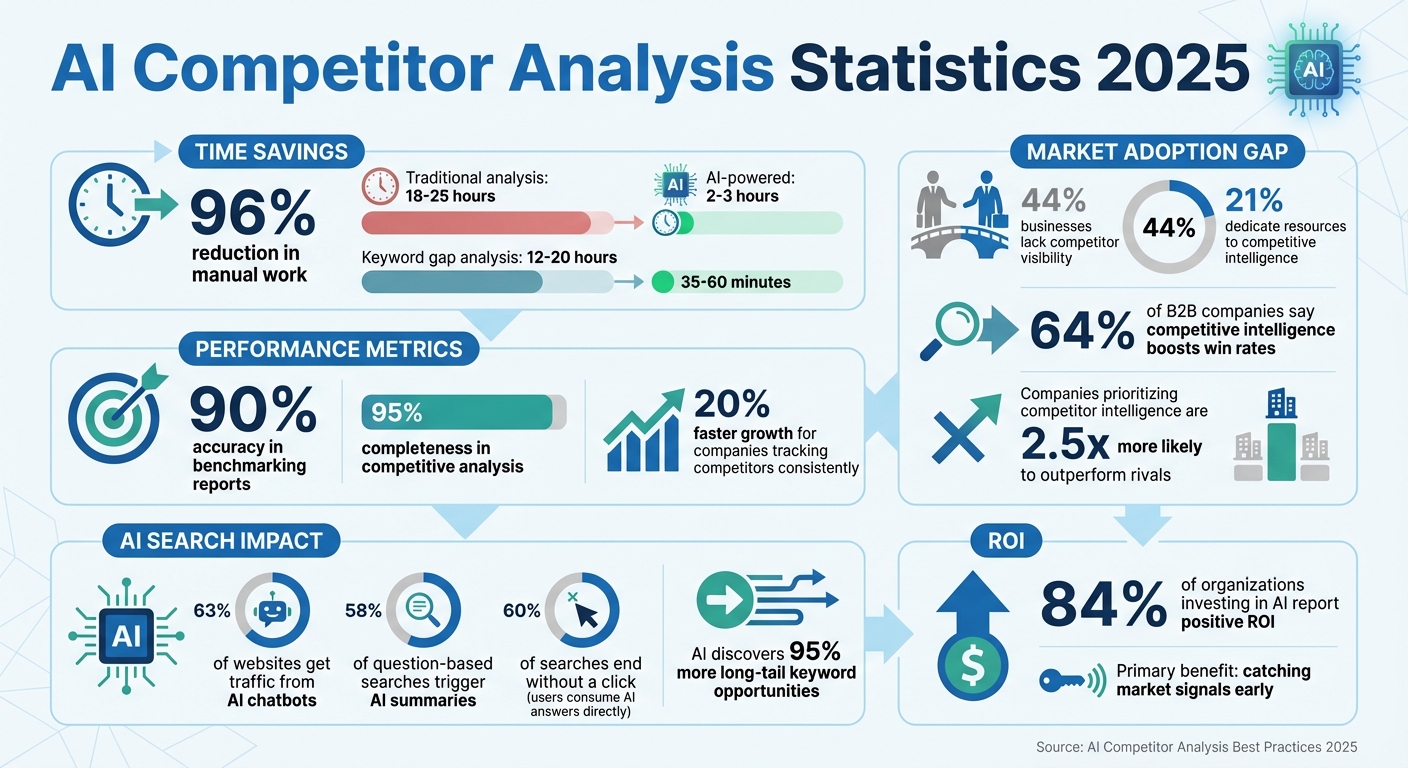
AI Competitor Analysis Impact: Key Statistics and Benefits for 2025
AI Competitor Analysis Automation: Dominate Your Market with Make + Perplexity in 2025
sbb-itb-6e49fcd
Step 1: Set Clear Goals for AI Competitor Analysis
AI tools are powerful, capable of analyzing massive datasets in minutes. But without clear goals, all that data can quickly become overwhelming instead of useful. Many companies fall into this trap, collecting data without first defining what they actually want to learn.
Setting clear goals ensures that every step of your analysis leads to insights that can shape your market strategy.
Identify Your Business Priorities
Start by defining 3–5 key questions that tie directly to decisions you plan to make in the next quarter. For example:
- Are you trying to identify pricing gaps or AB test landing pages for an upcoming product launch?
- Do you want to understand why competitors rank higher for specific keywords?
- Are you entering a new market and need a detailed competitive landscape?
"It all starts with our positioning and really understanding which consumers or groups and segments of consumers are most capable of loving what your brand does."
– Shingly Lee, VP of Marketing, GURU Energy
Your analysis should align with your business objectives. If you’re focused on refining your market positioning, use AI to study how your brand is perceived compared to competitors. If content performance is your priority, dig into keyword gaps and backlink trends. For pricing strategies, track competitor promotions and analyze what you can A/B test regarding the relationship between features and pricing.
It’s also useful to categorize competitors into groups like direct, indirect, legacy, and disruptors. Each group poses unique challenges to your business and requires tailored monitoring strategies.
Once priorities are clear, you can move on to defining precise success metrics.
Choose KPIs to Measure Success
With your priorities in place, identify specific KPIs to measure the success of your analysis. In today’s landscape, this means tracking both traditional metrics and AI-specific ones. For instance, AI Share of Voice is becoming a key indicator – it measures how frequently your brand appears in AI-generated responses compared to competitors. This is crucial since 63% of websites now get traffic from AI chatbots.
Other important KPIs include:
- Citation frequency
- Keyword gap coverage
- Market share changes
- Sentiment scores
Operational metrics also matter. For example, monitor how quickly your AI tools deliver insights and whether they maintain 90% accuracy and 95% completeness in benchmarking reports.
Adjust how often you update these metrics based on their importance. For high-stakes areas like paid search campaigns, daily updates might be necessary. Core market KPIs can refresh weekly, while deeper content audits might only need monthly updates. This approach balances staying informed without drowning in data.
Step 2: Find Competitors Beyond Traditional Search
Competition is no longer limited to the familiar "top 10 blue links" on Google. AI platforms pull information from a wide range of sources – Reddit discussions, YouTube transcripts, niche forums, and industry reports. In fact, a single AI-generated response might reference anywhere from 3 to 30 different sources. This means your competitors now include not just direct business rivals but also content creators like bloggers, community forums, and academic researchers that AI deems credible enough to cite.
As Terrence Ngu, an AI SEO Specialist, puts it:
"Your competitive set expands dramatically in AI search. A single AI response may cite 3 to 30 sources – from industry reports and Reddit threads to YouTube transcripts and competitor pages."
To stay ahead, you’ll need to identify which of these competitors are gaining visibility in AI-generated answers.
Track Competitors on AI Platforms
Start by performing 20–50 searches on major AI platforms and carefully note all the sources they cite. This will help you identify patterns in citations and reveal which brands, websites, or content types consistently earn AI’s trust. You might even discover competitors that don’t show up in traditional search rankings but are dominating AI responses. From there, focus on tracking around 10–15 competitor domains, paying attention to the specific content assets they use to gain visibility. Analyze how they structure their content, present data, and organize information.
AI platforms tend to favor content that’s packed with factual details – think statistics, figures, and other hard data. They also prioritize content with clear organization, such as well-labeled tables, concise lists, and structured headings. Understanding these preferences will give you insights into why certain competitors are cited more often.
Update Your Competitor List Regularly
AI search is constantly evolving. Results can change not just monthly or weekly, but sometimes even hourly as models update and new content gets indexed. A static or quarterly approach to competitor tracking isn’t enough. For example, about 58% of question-based searches now trigger AI-generated summaries, and roughly 60% of searches don’t lead to a click, as users consume AI’s answers directly.
To stay on top of these shifts, update your competitor list on a monthly or quarterly basis. This will help you spot emerging players and new threats early on. AI-powered tools can also help monitor sudden spikes in competitor mentions, which often signal viral campaigns, product launches, or strategic changes. For high-priority areas like paid search or major product rollouts, consider daily or weekly updates.
Unlike traditional competitor analysis, AI offers real-time insights, allowing you to respond quickly to market changes and stay ahead of the curve.
Step 3: Run Keyword and Content Gap Analysis
Now that you’ve nailed down your list of competitors, it’s time to dig into where they’re excelling – and where you’re falling behind. This step, which used to be a grueling 12–20 hours of manual work, can now be completed in just 35–60 minutes with AI tools, cutting the effort by an impressive 96%. The goal here is to uncover the keywords and content gaps that could make or break your strategy.
Find Keyword Opportunities
AI-driven gap analysis compares your site to competitors and highlights two critical areas: "missing" keywords (terms where competitors rank, but you don’t show up) and "underperforming" keywords (where you rank, but competitors are ahead). AI doesn’t just speed up the process – it also uncovers 95% more long-tail keywords vs short-tail opportunities than traditional methods.
A smart starting point? Focus on "striking distance" keywords – those where you’re already ranking between positions 4–20. AI can help prioritize these by evaluating factors like search intent, domain authority, and how much momentum competitors have. These keywords are low-hanging fruit, giving you a chance to climb higher with less effort.
But keyword research has evolved. In 2025, it’s no longer just about search rankings. You also need to monitor "AI gaps" – instances where competitors are mentioned in AI-generated summaries (like ChatGPT, Google AI Overviews, or Perplexity), but your brand is missing. This matters because AI Overviews now show up in 58% of question-based queries, and about 60% of searches end without a click. In this landscape, being cited by AI platforms is as important as ranking on Google’s first page. As Wellows aptly puts it:
"Winning in AI search isn’t about ranking higher – it’s about becoming the source AI trusts".
Review Competitor Content Performance
Once you’ve identified your keyword opportunities, you need to figure out why competitor content is outperforming yours. AI tools can break down the structure of top-ranking pages, analyzing their H2/H3 headings, word counts, FAQ sections, and even how they connect different topics. This analysis gives you a roadmap to create stronger, more competitive content.
Don’t overlook format gaps either. AI platforms often favor specific content types, like detailed guides, structured tables, or even video transcripts – formats your competitors might already be using. For example, if competitors are consistently earning AI citations by including data tables or step-by-step frameworks, it’s a clear signal to incorporate those elements into your strategy. Additionally, analyzing question-based keywords can reveal which questions your competitors are answering that you’re not – key for snagging featured snippets and AI citations.
Step 4: Use AI for SWOT Analysis
SWOT analysis has traditionally been a subjective exercise, relying heavily on individual opinions. But with AI, this process is elevated by analyzing thousands of data points, including customer reviews, market trends, competitor activity, and real-time performance metrics. The result? A more precise, evidence-backed SWOT analysis.
By automating much of the process, AI reduces the time spent on manual tasks from 18–25 hours to just 2–3 hours. Plus, it achieves an impressive 90% accuracy and 95% report completeness.
Run Data-Driven SWOT Analysis with AI
AI transforms SWOT analysis into a tool for actionable insights, powered by real-time data. For example, natural language processing (NLP) identifies recurring positive themes in internal data, while sentiment analysis pinpoints customer feedback that reveals weaknesses.
On the external front, clustering algorithms uncover opportunities by mapping competitor activity and highlighting underserved market segments, often referred to as "white spaces." Meanwhile, scenario planning algorithms shed light on potential threats by simulating market disruptions or economic shifts. And with predictive models, AI identifies emerging opportunities and risks before they fully materialize.
Instead of delivering a static report, AI creates a dynamic, continuously updating SWOT dashboard. This allows you to align strengths with opportunities and address risks proactively. Additionally, anomaly detection can spot inefficiencies buried within your data, offering a clearer picture of operational challenges.
Detect Opportunities and Threats Early
The standout feature of AI-driven SWOT analysis is its predictive power. Just as AI can identify content gaps with precision, it can also detect subtle market changes that guide proactive strategies. For example, machine learning can forecast competitor actions, such as product launches or pricing adjustments, giving you the chance to respond ahead of time. It’s no surprise that 84% of organizations investing in AI report a return on investment largely due to catching market signals early.
Some key real-time indicators include competitor pricing shifts, job postings that hint at expansion, patent filings that reveal R&D priorities, and leadership hires that signal strategic moves. By integrating automated monitoring tools with your CRM or communication platforms, your sales and product teams can stay informed about critical developments as they happen.
To stay ahead, set regular updates: weekly for core KPIs, monthly for full SWOT reviews, and more frequently in fast-changing areas. It’s also important to establish a decision framework to determine which AI-generated recommendations require human oversight. This ensures that while AI provides data-driven insights, the final decisions remain grounded in human expertise. With these insights seamlessly integrated into broader strategic plans, your SWOT analysis becomes a cornerstone of your competitive strategy.
Step 5: Monitor Competitor Actions and Market Changes
The business landscape moves fast. Competitors can tweak pricing, roll out new features, or announce partnerships overnight, completely altering the market. Relying on quarterly reports to keep up just doesn’t cut it anymore – they’re outdated by the time you read them. AI steps in here, offering around-the-clock monitoring across numerous data sources, identifying shifts within hours. This real-time insight allows businesses to adjust strategies on the fly, keeping every department aligned.
Here’s a telling statistic: 64% of B2B companies say competitive intelligence significantly boosts their win rates, but only 21% dedicate resources to it. Companies that consistently track competitors tend to grow 20% faster than those that don’t. The gap between those who leverage real-time monitoring and those who don’t is growing wider.
Track Competitor Activity in Real-Time
AI-driven tools can spot subtle but critical changes, such as updates to website content , which can be further optimized through smarter website content testing, new product announcements, pricing shifts, partnership press releases, or even job postings on LinkedIn. For example, if a competitor begins hiring a large number of healthcare sales reps, it might signal a move into a new market – well before they make any formal announcement.
Using Natural Language Processing (NLP), AI tools can evaluate whether a change is minor (like a typo) or something major, like a strategic pivot. Platforms like Visualping and Hexowatch monitor competitor websites, instantly notifying you of changes to pricing pages or homepage messaging. These alerts are routed to the relevant teams – sales gets pricing updates, product teams get feature announcements, and marketing handles messaging changes. This ensures the right people act on the right information without overwhelming everyone.
But AI doesn’t stop at just sending alerts – it also interprets these signals to guide strategic decisions.
Read Market Signals with AI
Beyond real-time updates, AI helps uncover deeper market trends. Think of it as moving from "reactive archaeology" to proactive strategy. Instead of outdated spreadsheets, you get live data streams paired with predictive analytics.
"AI competitive intelligence agents monitor competitors continuously across dozens of sources, detect meaningful changes within hours, and alert your team with analysis of what changed and why it matters." – AI Agents Copilot
Advanced systems prioritize changes based on their importance. For example, a homepage redesign is flagged as high-priority, while a minor footer tweak is rated lower. This helps your team focus on what truly matters. AI can even track subtle shifts in language over months, identifying a competitor’s evolving strategy before it’s officially announced.
An emerging trend is monitoring your "AI Share of Voice" – essentially, how often your brand appears in AI-generated search results compared to competitors. As tools like ChatGPT and Perplexity gain traction, understanding your presence in these AI-driven platforms is becoming crucial for staying ahead.
Step 6: Share AI Analysis Across Teams
To make AI insights truly valuable, they need to become part of the everyday workflow. Surprisingly, 44% of companies admit they have no visibility into their competitors, highlighting a major gap in actionable integration. The key? Embed AI-driven analysis into the tools and processes teams already use.
Companies that prioritize competitor intelligence are 2.5 times more likely to outperform their rivals. The secret isn’t just collecting data – it’s about ensuring the right people have access to it exactly when they need it. For example, in 2025, Gainsight adopted Klue’s AI "Compete Agent" and connected it seamlessly to Slack and Salesforce. This integration allowed sales reps to ask natural-language questions about competitors and get instant answers during live deals. Jason Hersh, Principal of Market Intelligence at Gainsight, summed it up perfectly:
"I can’t be in every deal. But now I don’t have to be because I know that Klue is. It’s like having my own CI assistant."
By sharing real-time competitor insights across teams, businesses can act faster and more cohesively.
Build Cross-Team Collaboration
Different teams need different types of insights. Executives look for strategic summaries to understand market positioning and threats. Sales teams need tactical data, like win-loss analysis and quick answers to competitor objections. Marketing teams focus on messaging gaps and new content opportunities, while product teams want feature comparisons and ideas for roadmap improvements.
Automating the delivery of insights to the right teams is crucial. For instance:
- If AI detects a competitor’s pricing change, send an alert to your CRM so sales can act immediately.
- When a competitor launches a new feature, notify the product team right away.
- If search rankings shift, inform SEO professionals and agencies through Slack.
This process, often called "intelligence routing", ensures insights are delivered in a way that aligns with each team’s daily tasks.
To keep everyone aligned, hold weekly cross-department reviews of AI findings. Use these meetings to prioritize actions by evaluating revenue potential, required effort, and time-to-value. This structured approach ensures that resources are focused on the competitive moves that matter most.
Create Competitive Battlecards
While collaboration ensures insights reach the right teams, battlecards serve as quick-reference tools for immediate competitive responses.
Battlecards are concise, one-page summaries that outline a competitor’s positioning, pricing, key features, and recommended responses. They’re a lifeline for sales reps dealing with objections like, “Why shouldn’t we just go with [Competitor X]?” The problem with traditional battlecards is that they can quickly become outdated – by the time they’re manually updated, competitors may have already shifted their strategies.
AI-powered battlecards solve this issue by automatically refreshing whenever competitors change pricing, introduce new features, or update their messaging. This ensures teams always have the most up-to-date information. Adding visual tools like Price vs. Quality grids can help teams instantly understand where their product stands in the market and spot untapped opportunities.
To make battlecards even more effective, categorize competitors into groups like Direct, Indirect, Legacy, and Disruptors. This segmentation helps tailor responses to each type of competitor. Additionally, include actionable talking points alongside the data. This ensures that when a sales rep picks up a battlecard, they know exactly what to say to address objections and win the deal.
Conclusion: Stay Ahead with AI Competitor Analysis
Key Takeaways
AI-powered competitor analysis is changing the game. Tasks that once took 18–25 hours can now be completed in just 2–3 hours. By following six key practices – like setting clear goals and sharing insights across teams – you can create a more focused and adaptable strategy for competitive intelligence.
The numbers speak for themselves. Companies using AI for competitor analysis report 90% benchmark accuracy and 95% report completeness. Yet, 44% of businesses still lack visibility into their competitors, giving early adopters a major edge. As Despina Gavoyannis, Senior SEO Specialist at Ahrefs, explains:
"AI search changes fast, and regular benchmarking turns your one-off study into an ongoing strategic advantage."
These stats highlight the shift toward a more dynamic and proactive approach to staying competitive.
Looking Ahead
To stay ahead, you need to evolve your strategies to match the fast-paced market. Competitive landscapes are no longer static – pricing, product launches, and messaging can shift overnight. Real-time monitoring has replaced static reports, and predictive intelligence now helps anticipate competitor moves before they happen. With 63% of websites already seeing traffic from AI chatbots – half of that from ChatGPT alone – tracking your "AI Share of Voice" is becoming just as vital as balancing A/B testing and SEO metrics.
Adaptability is key. Update your core KPIs weekly and run in-depth reports monthly. High-volatility areas, like paid search, might even require daily monitoring. While AI excels at processing data and identifying trends, human expertise is still critical for making strategic decisions and ensuring ethical practices. The companies leading by 2025 won’t just be using AI – they’ll have systems that blend automated insights with human creativity and judgment. This combination will ensure seamless collaboration, real-time tracking, and smarter decision-making.
FAQs
How can AI-driven competitor analysis help improve my business strategy in 2025?
AI is reshaping the way businesses approach competitor analysis, offering faster and more precise insights into markets and rival strategies. By automating the collection and analysis of data, AI can reveal patterns and trends that might otherwise slip through the cracks. This means you can pinpoint market opportunities, fine-tune your strategies, and make smarter, data-backed decisions to maintain a competitive edge.
One of the standout benefits of AI tools is their ability to monitor competitors in real time. Whether it’s tracking their search engine rankings, social media activity, or content strategies, these tools provide a clear picture of where your competitors are gaining momentum. Armed with this knowledge, you can focus your efforts on areas that need improvement, like boosting customer engagement or refining marketing campaigns.
In a marketplace that’s constantly evolving, AI-powered competitor analysis keeps you agile, helping you prioritize opportunities that deliver the biggest impact.
What key metrics should I focus on for effective AI-driven competitor analysis?
To get the most out of AI in competitor analysis, hone in on key performance indicators (KPIs) that lead to practical insights. Here are a few important ones to consider:
- Market visibility: Keep tabs on how competitors rank, their search visibility, and their share of voice in the market.
- Performance gaps: Pinpoint areas where competitors are ahead, whether it’s in website traffic, backlinks, or the overall quality of their content.
- Keyword and content dominance: Analyze the keywords and topics where competitors excel and see how their content connects with their audience.
- Trend analysis: Spot emerging trends in their strategies, like upcoming product launches or shifts in their marketing campaigns.
Focusing on these metrics can help you identify new opportunities, fine-tune your approach, and stay ahead in your industry.
How can my team effectively use AI insights for competitor analysis?
To effectively use AI-generated insights for competitor analysis, it’s crucial that your team knows how to interpret and apply the data. Start by providing clear training and guidelines to help them understand the context and recognize the limitations of AI outputs. For instance, while AI might highlight market trends or pinpoint competitor gaps, the real challenge is correctly interpreting this data to create actionable strategies.
Collaboration is another key element. Bringing together analysts, marketers, and decision-makers ensures that insights are aligned with your business goals. Regular team discussions can help prioritize actions and fine-tune strategies based on the data. On top of that, establishing feedback loops is essential. By tracking the outcomes of AI-driven decisions, your team can learn what works and continuously refine your approach.
With a focus on training, collaboration, and constant improvement, AI insights can become a powerful tool to give your business an edge.
Related Blog Posts
say hello to easy Content Testing
try PageTest.AI tool for free
Start making the most of your websites traffic and optimize your content and CTAs.
Related Posts

30-03-2026
 Ian Naylor
How Internal Links Boost Conversions
Strategic internal links guide users, improve SEO, and turn site navigation into measurable conversion growth.

28-03-2026
Ian Naylor
Core Web Vitals Benchmarks by Industry
Industry Core Web Vitals benchmarks and practical fixes for LCP, INP, and CLS, plus mobile vs desktop gaps and optimization tips.
26-03-2026
Ian Naylor
How to Benchmark Mobile Retention Rates
Benchmark Day 1/7/30 retention, run cohort analysis, and optimize onboarding, habit triggers, and personalization to improve app retention.